

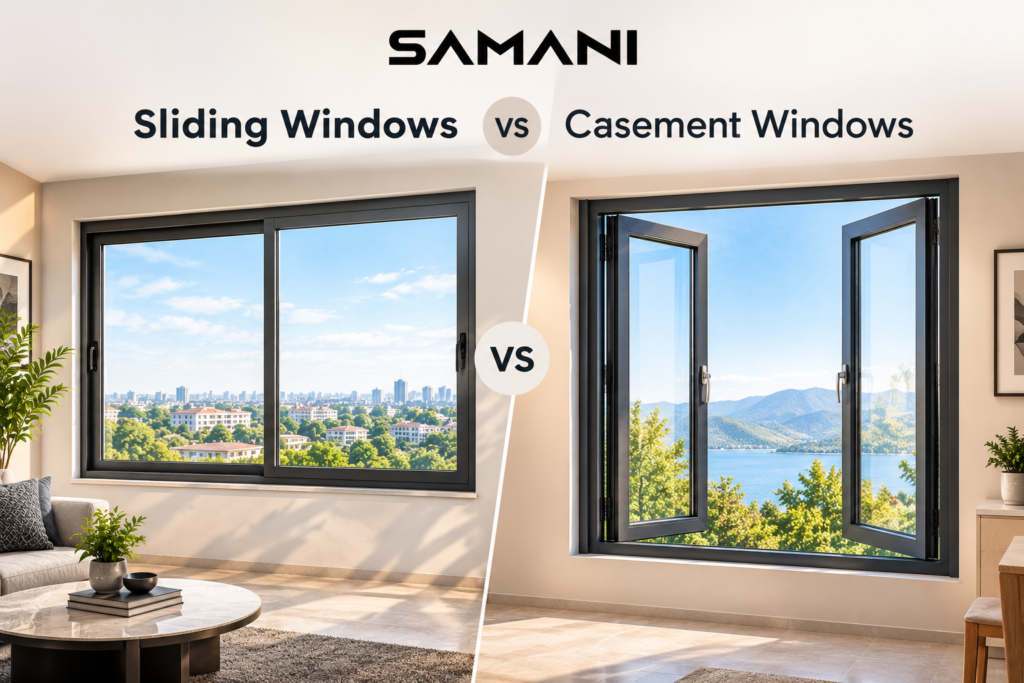

Casement and sliding windows are two popular choices for modern homes, offices and commercial spaces, but they work in very different ways. Casement windows open using hinges, while sliding windows move horizontally along a track. This difference affects ventilation, space requirements, operation, sealing, appearance and the type of room where each window works best.
Choosing between the two is therefore not simply a matter of appearance. The right option depends on the room, opening size, ventilation needs, available space, design preference, glass specification and overall project requirements.
For homeowners, architects and builders, understanding the difference between casement windows and sliding windows can make the buying decision much easier.
What Is a Casement Window?
A Casement Windows is a window with a hinged sash that opens outward or inward, depending on the system and installation.
When opened, the sash moves away from the frame rather than sliding along a track. This allows a significant portion of the window opening to be used for ventilation.
Casement windows are commonly selected when ventilation, clear views and a more openable window design are important.
They can be manufactured using different frame materials, including aluminium and uPVC, and are available in different sizes and configurations.
Common applications include:
- Bedrooms
- Living rooms
- Kitchens
- Study rooms
- Offices
- Larger residential openings
- Combination window systems
What Is a Sliding Window?
A sliding window consists of panels that move horizontally along tracks.
Instead of projecting into the room or outside the building, the sash moves sideways. This makes sliding windows particularly useful where space around the window needs to remain clear.
They are commonly used in:
- Bedrooms
- Living rooms
- Kitchens
- Balconies
- Offices
- Apartments
- Compact rooms
Sliding windows are available in different configurations, including two-panel and multi-panel arrangements, depending on the system.
What Is the Main Difference Between Casement and Sliding Windows?
The primary difference is their opening mechanism.
A casement window uses hinges, while a sliding window uses horizontal tracks and rollers.
| Feature | Casement Windows | Sliding Windows |
| Opening method | Hinged | Horizontal sliding |
| Ventilation | Generally offers a large openable area | Depends on the number and size of sliding panels |
| Space requirement | Requires clearance for sash movement | Does not require swing clearance |
| Operation | Hinged opening | Panels slide along tracks |
| Design | Clean, contemporary options available | Simple and practical |
| Hardware | Hinges, handles and locking mechanisms | Rollers, tracks, handles and locks |
| Maintenance | Hardware and seals require periodic checking | Tracks and rollers require cleaning |
| Suitable for | Ventilation-focused spaces | Space-conscious rooms |
| Large openings | Depends on system and configuration | Available in larger configurations |
| Material options | Aluminium, uPVC and others | Aluminium, uPVC and others |
The actual performance of either type depends on the complete window system, including profile, glass, hardware, seals and installation.
Which Provides Better Ventilation: Casement or Sliding Windows?
Casement windows can provide a larger effective opening for ventilation because the hinged sash can open away from the frame.
However, ventilation depends on more than window type.
Room size, opening dimensions, wind direction, building orientation and the position of other openings can all influence airflow.
Sliding windows can also provide useful ventilation, but only part of the overall frame area may be open when the panels overlap.
For rooms where natural airflow is a major priority, casement windows can therefore be worth considering.
Casement vs Sliding Windows for Mumbai Homes
Mumbai homes have some additional considerations because of heavy monsoon rainfall, humidity, urban pollution and, in some areas, coastal exposure.
For a Mumbai home, consider the location and purpose of each opening.
For Bedrooms
Casement windows can be useful where ventilation is a priority.
Sliding windows can be more convenient where furniture is close to the opening.
For Living Rooms
Either option can work. The choice may depend on the opening size, view, ventilation and overall architectural design.
For Kitchens
Sliding windows can be convenient when the window is positioned above or near a counter because the panels do not swing inward.
Casement windows can provide a larger opening where ventilation is particularly important.
For Balconies
Sliding windows can work well where space is limited and a simple horizontal opening is preferred.
The final choice should consider the balcony layout and exposure to rain and wind.
Which Has Better Security?
Security depends primarily on the complete window system rather than whether the window is casement or sliding.
Important considerations include:
- Locking mechanism
- Number of locking points
- Frame construction
- Glass type
- Hardware
- Installation
- Overall system design
A properly specified window with suitable locking hardware can provide good security regardless of the opening style.
For ground-floor or easily accessible windows, homeowners should pay particular attention to the locking and glazing specification.
Which Looks More Modern?
Both can have a modern appearance.
The final visual result depends on the:
- Frame profile
- Frame colour
- Glass area
- Hardware
- Sightlines
- Window proportions
- Building architecture
Slim aluminium casement windows can create a contemporary appearance, while large sliding windows can provide broad glazed areas and clean horizontal lines.
The best-looking option is ultimately the one that works with the building’s architecture.
What Should You Consider Before Buying?
Before selecting casement or sliding windows, consider these seven factors.
1. Room Layout
Check whether furniture, counters or curtains could interfere with an opening sash.
2. Ventilation
If natural airflow is a major priority, compare the effective opening area of the available systems.
3. Window Size
Larger openings may require a different profile and glazing specification.
4. Glass
Choose the glass according to safety, solar control, acoustic and design requirements.
5. Hardware
Check hinges, rollers, locks, handles and other moving components.
6. Weather Exposure
For monsoon or coastal areas, pay attention to seals, drainage and installation.
7. Maintenance
Consider whether you are comfortable regularly cleaning sliding tracks or checking hinged hardware.
Casement vs Sliding Windows: Which One Should You Choose?
The answer depends on what you want from the window.
Choose casement windows when ventilation and a larger openable area are important. Choose sliding windows when space-saving operation and easy horizontal movement are priorities.
For many homes, there is no need to use only one type.
A combination of casement and sliding windows can provide different benefits in different rooms.
For example, casement windows can be used in bedrooms and study areas where airflow is important, while sliding windows can be installed in kitchens or compact spaces where swing clearance is limited.
Why Choose Samani ECC for Casement and Sliding Windows?
Samani ECC offers contemporary casement windows and sliding windows for residential and commercial applications, with options designed around different architectural requirements.
The range includes aluminium and uPVC window solutions that can be configured according to opening size, room requirements, glass selection, hardware and design preferences.
Whether you are planning a new home, renovating an apartment or specifying windows for a commercial project, selecting the right window style starts with understanding how the space will be used.
Samani ECC focuses on combining modern aesthetics with practical functionality to create window solutions suited to contemporary Indian architecture.
Frequently Asked Questions
1. What is the main difference between casement and sliding windows?
Casement windows open on hinges, while sliding windows move horizontally along tracks. This difference affects ventilation, space requirements, hardware and operation.
2. Are casement windows better than sliding windows?
Neither is universally better. Casement windows can be useful when ventilation is a priority, while sliding windows can be convenient where space-saving operation is important.
3. Which window is better for ventilation?
Casement windows can provide a larger openable area in many configurations, which can make them suitable for ventilation-focused applications.
4. Are sliding windows good for small rooms?
Yes. Since sliding panels do not swing into the room, they can work well where furniture or other objects are close to the window.
5. Which is better for Mumbai: casement or sliding windows?
Both can work in Mumbai. The choice should consider the room, ventilation, available space, monsoon exposure, opening size and complete window specification.
Conclusion
The difference between casement and sliding windows goes beyond how they look. Their opening mechanisms influence ventilation, space requirements, hardware, maintenance and how they fit into different rooms.
Casement windows can be a strong option when ventilation and a larger openable area are important, while sliding windows can be particularly practical where space-saving operation is preferred.
For the best result, select the window based on the room, opening, glass, profile, hardware, weather exposure and installation requirements rather than choosing purely on appearance or price.
With the right specification, both casement and sliding windows can become practical and attractive parts of a modern home. Samani ECC provides aluminium and uPVC window solutions designed to help homeowners, architects and builders create functional and contemporary spaces.