

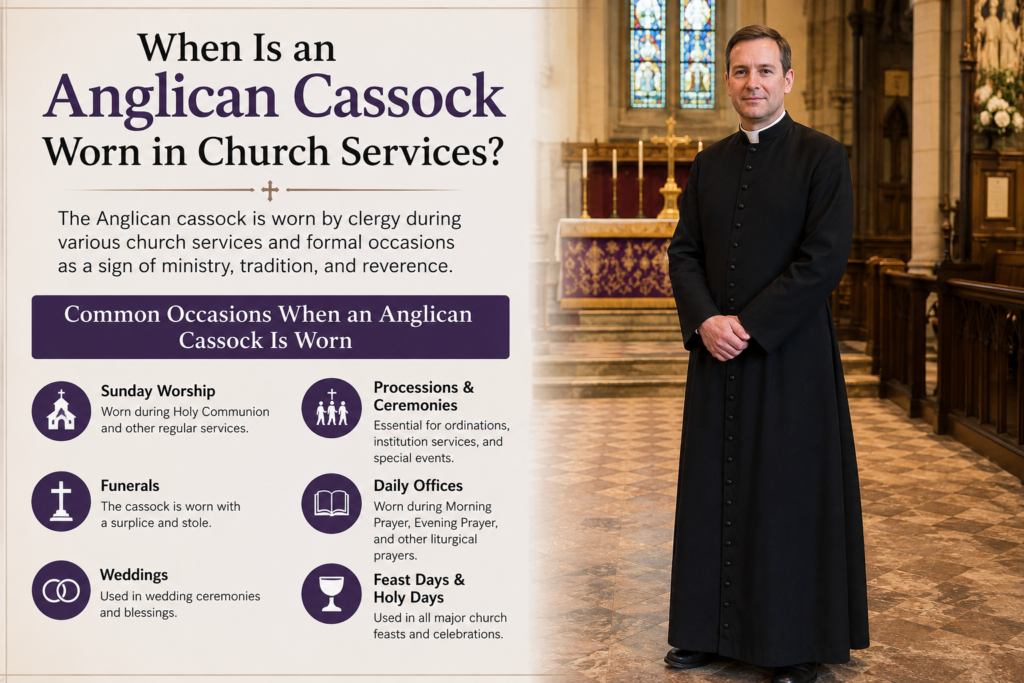

The Anglican cassock is worn across a wide range of church services , from the quiet discipline of daily Morning Prayer to the solemnity of a bishop’s ordination. In short, clergy wear the cassock whenever they are exercising their ministerial role in a liturgical or formal church setting. It is, above all else, a working garment. But the occasions vary considerably, and so does the way the anglican cassock is worn. Understanding those distinctions tells you a great deal about Anglican identity, history, and the enduring logic of sacred dress.
What Is an Anglican Cassock?
The cassock is a long, close-fitting garment that reaches to the ankles. It buttons down the front or, in some traditions, along the shoulder and side and is typically worn as the foundational layer of clerical dress. In the Church of England and across the Anglican Communion, it comes most often in black, though purple is the recognised colour for bishops and archdeacons, and red or scarlet appears in certain cathedral and royal chapel contexts.
It is not a vestment in the strict liturgical sense. The cassock does not change with the liturgical season, and it carries no eucharistic function of its own. Think of it less as a ritual garment and more as a clerical uniform, the constant beneath everything else.
The cassock worn in Anglican circles is most commonly the Roman or Sarum style: a single-breasted garment with a row of buttons running from collar to hem. The double-breasted Jesuit style, familiar from Catholic religious orders, is rarely seen in Anglican use. Some High Church clergy opt for the buttoned-cuff and slightly more fitted cut associated with Anglo-Catholic practice, while Evangelical ministers may wear the cassock more sparingly or not at all outside formal liturgical occasions.
When Is an Anglican Cassock Worn in Church Services?
The cassock appears across the full spectrum of Anglican worship, but its presence is not uniform. The rule of thumb, broadly observed across the Communion, is this: wherever a minister officiates, the cassock is appropriate. Where vestments are worn over it, the cassock is essential. Where no vestments are required, a graveside committal, a hospital blessing, a quiet daily office, the cassock alone may suffice.
The Church of England’s liturgical guidance has never rigidly legislated cassock use in the way that Roman rubrics govern vestments. Custom, tradition, and the ethos of individual parishes have always shaped practice. A Tractarian parish in North Oxford will dress its clergy quite differently from a low-church congregation in rural Norfolk, yet both, in their own way, observe the cassock as the baseline of ministerial identity.
Why Do Anglican Clergy Wear Cassocks?
There is a practical answer and a theological one.
Practically, the cassock emerged as standard clerical dress during the medieval period as a way of distinguishing clergy from laity in everyday life. By the time of the English Reformation, it was so deeply embedded in clerical culture that it survived wholesale, even as much else was stripped away. Thomas Cranmer and his contemporaries retained the cassock not as a popish remnant but as a simple mark of office.
Theologically, the cassock signifies that the person wearing it has set themselves apart for sacred service. It is a visible reminder, to the congregation, to the minister, and to the watching world, that the one who stands before the altar or behind the pulpit does so in a representative capacity. The cassock says: this person belongs to something larger than themselves.
There is also something to be said for its effect on the wearer. Clergy who have worn cassocks for decades often speak of how putting one on clarifies the mind and steadies the spirit. It is, in a certain sense, a habit in the older meaning of the word, a discipline of dress that shapes interior disposition.
Anglican Cassock Use in Different Church Services
Sunday Worship
On a typical Sunday, the cassock serves as the foundation for whatever else is worn. At a choral Eucharist in a cathedral, it sits beneath alb and chasuble. At a low-church parish communion, it may be worn with surplice and stole. In liturgical churches, you will not find a priest vesting for the Eucharist without first putting on the cassock. It is the garment that begins the preparation.
For lay ministers, readers, vergers, choristers, the cassock also plays a significant role. Cathedral choristers have worn black cassocks with white surplices for centuries; it is one of the most recognisable sights in English ecclesiastical life.
Funerals
Funerals call for unambiguous, dignified dress. The cassock, worn with surplice and black stole, communicates gravity without theatre. In some High Church parishes, a cope may replace the surplice at a Requiem Mass, but the cassock remains constant beneath.
At graveside burials, particularly in rural ministry, where a priest might move between church, country lane, and churchyard, the cassock offers practicality alongside solemnity. It is one context where wearing the cassock alone, without surplice, is broadly accepted.
Weddings
A wedding calls for the cassock paired with surplice and white or coloured stole, depending on churchmanship. The symbolism here is celebratory rather than penitential, and the white surplice over black cassock achieves a clean, formal appearance that suits the occasion’s dignity.
Some clergy in Anglo-Catholic parishes vest fully for a nuptial Eucharist. Others, particularly in evangelical settings, may wear only the cassock and stole or forgo the cassock in favour of clerical suit and gown. Practice varies, but the cassock remains the most traditional choice.
Processions and Special Ceremonies
Processions at ordinations, institution services, diocesan synods, royal occasions are where Anglican ceremonial dress is most fully on display. Here the cassock is non-negotiable. Canons process in cassock, surplice, and hood. Bishops wear their purple cassocks beneath the chimere and rochet. The cassock anchors the entire visual grammar of the procession.
At ordinations, candidates are typically vested in cassock and surplice before receiving their stoles, the moment when the cassock’s role as preparatory garment is most clearly seen. It is the garment you wear before you are what you are about to become.
Choir Offices and Daily Prayer
The Daily Office, Morning Prayer, Evening Prayer, Compline, represents the cassock at its most functional. Here, in choir or in a parish church with a small gathered congregation, the cassock and surplice is the standard dress. There is no Eucharist, no elaborate vestiture; just the priest, the office, and the garments suited to ordered daily prayer.
For cathedral clergy with choir obligations, the cassock may be worn for several hours each day. It becomes, quite literally, a working dress, worn in vestry, worn in procession, worn at the lectern, worn in conversation with visitors afterwards.
Anglican Cassock vs Other Priest Outfits
The cassock occupies a specific place within the wider landscape of priest outfits. It is distinct from the alb — the white garment worn for the Eucharist and distinct from the surplice, which is worn over it. It is not a cope, which is a processional cloak, nor a stole, which is the narrow band of fabric that denotes holy orders.
In Roman Catholic practice, the cassock is also worn by priests, but with notable differences. The Catholic cassock typically features a fascia, a sash worn around the waist ,and colour varies more systematically by rank: black for priests, purple for bishops, red for cardinals, white for the Pope. Anglican usage is broadly similar in its colour hierarchy but less rigidly enforced, and the fascia is rarely seen outside Anglo-Catholic or cathedral contexts.
The Geneva gown, favoured in Reformed and some low Anglican traditions, is a separate garment entirely, worn instead of the cassock and surplice combination, and associated with preaching ministry rather than sacramental priesthood. Its use signals a particular theological emphasis on Word over Sacrament.
The Role of the Cassock in Traditional Clergy Attire for Elders
Within the context of clergy attire for elders, whether one means senior priests, cathedral dignitaries, or those recognised as elders within an Anglican congregation, the cassock takes on additional significance. Longevity in ministry tends to deepen attachment to traditional dress, and many clergy who have served for decades speak of the cassock not as an obligation but as a companion.
For elders in the broad sense, men and women who carry the weight of long experience and accumulated pastoral authority, wearing the cassock is a form of continuity with those who came before. It is one of the few garments that connects a twenty-first century curate in Coventry with a seventeenth-century rector in the same county. That continuity matters.
Is the Anglican Cassock Still Common Today?
Yes — though with some variation. In cathedrals, collegiate chapels, and high-church parishes, the cassock remains in everyday liturgical use. Cathedral clergy still put it on for every service. Choral foundations still robe their singers in it.
In evangelical and charismatic Anglican churches, use has declined. Some clergy in these traditions dress in clerical collar and shirt alone, or adopt entirely contemporary clothing. This reflects a conscious theological decision about accessibility and the relationship between form and faith.
Yet there has been, in recent years, a quiet revival of interest in traditional Anglican dress among younger clergy, particularly those drawn to the Anglo-Catholic and Prayer Book traditions. For many of them, the cassock is not a relic but a reclamation: a deliberate choice to dress with gravity in an age that rarely does so.
Conclusion
The Anglican cassock has outlasted empires, reformations, and revolutions in church fashion. It is worn at the altar and at the graveside, in the choir stall and in the ordination rite, by bishops in purple and choristers in black. Its persistence speaks to something deeper than habit: the conviction that what a minister wears when they stand before God and the congregation is not a trivial matter.
Whether worn beneath full eucharistic vestments at a solemn High Mass or alone at a quiet evening office in an empty church, the Anglican cassock carries the same message it always has. Sacred work deserves sacred dress.
Frequently Asked Questions
What is the difference between an Anglican cassock and a Catholic cassock?
Both traditions use a long, ankle-length garment, but the Anglican cassock less frequently features the fascia sash common in Catholic use. Colour hierarchies are similar, black for priests, purple for bishops but Anglican practice tends to be less rigidly codified and varies more by parish tradition.
Do all Anglican clergy wear cassocks?
No. Cassock use varies significantly across the Communion. High-church, Anglo-Catholic, and cathedral clergy wear them regularly. Some evangelical and charismatic clergy rarely or never wear a cassock, preferring clerical shirts or contemporary dress.
Can laypersons wear a cassock in the Anglican Church? Yes. Lay ministers, vergers, servers, and choristers often wear cassocks as part of their liturgical role. A chorister’s black cassock and white surplice is one of the most enduring images of Anglican worship.
What colour cassock does an Anglican vicar wear?
Most Anglican priests wear black. Purple is reserved for bishops and archdeacons. Red or scarlet cassocks are worn in certain royal chapels and cathedral foundations. Canons of some cathedrals wear black with specific trimmings according to their statutes.
Is a cassock worn under an alb?
It depends on the tradition. In many Anglican churches, the cassock is worn beneath the alb for the Eucharist. In others, particularly those with a more Catholic ceremonial, the alb is worn directly and the cassock is set aside. Practice varies by parish and by the preferences of individual clergy.
When did Anglican clergy start wearing cassocks?
The cassock has been worn by Christian clergy since at least the early medieval period. Its use was confirmed within the Church of England following the Reformation and was given official sanction in early versions of clerical dress codes. By the seventeenth century, it was the expected dress of an ordained minister in public ministry.