

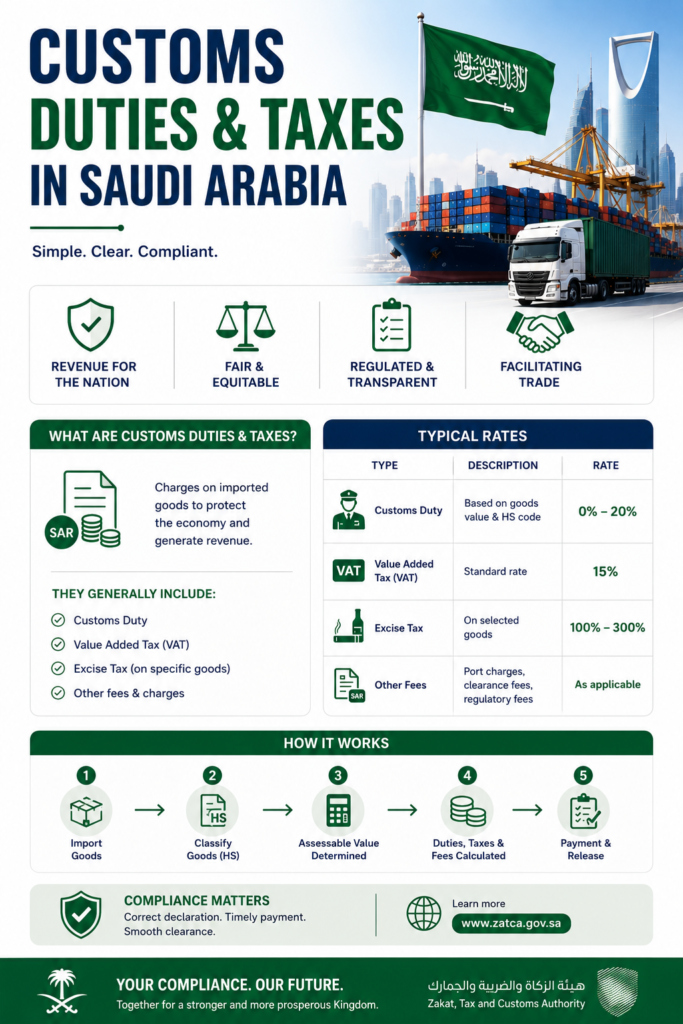

Understanding how to do customs clearance is essential for businesses importing goods into the Kingdom, especially when dealing with customs duties, import taxes, VAT regulations, shipment valuation, tariff classifications, customs documentation, and trade compliance requirements. One of the most important aspects of importing into Saudi Arabia is knowing how customs duties and taxes are calculated. Failure to understand these costs can lead to unexpected expenses, shipment delays, and compliance issues. Whether you are a first-time importer or an established business, having a clear understanding of Saudi Arabia’s customs duty structure can help you plan imports more effectively and avoid costly surprises.
What Are Customs Duties and Taxes?
Customs duties and taxes are charges imposed by government authorities on imported goods entering Saudi Arabia. These charges serve multiple purposes, including:
- Protecting local industries
- Generating government revenue
- Regulating international trade
- Encouraging compliance with import regulations
- Supporting economic policies
Importers must pay applicable duties and taxes before their goods can be released through customs clearance procedures.
Why Customs Duties Matter for Importers
Customs duties directly impact:
- Import costs
- Product pricing
- Profit margins
- Supply chain planning
- Business competitiveness
Accurate duty calculations help businesses estimate total landed costs before goods arrive in Saudi Arabia.
Failure to calculate duties correctly can affect profitability and disrupt operations.
Types of Import Charges in Saudi Arabia
Importers should understand that customs costs often consist of multiple components.
Customs Duties
Customs duty is the primary charge applied to imported goods.
Duty rates vary depending on:
- Product category
- HS code classification
- Country of origin
- Applicable trade agreements
Some products may be subject to low duty rates, while others face higher tariffs.
Value Added Tax (VAT)
Saudi Arabia applies Value Added Tax (VAT) on most imported goods.
VAT is generally calculated based on:
- Customs value of goods
- Customs duties
- Additional import charges
VAT must typically be paid during the customs clearance process.
Excise Tax (For Specific Products)
Certain products may also be subject to excise taxes.
Examples include:
- Tobacco products
- Energy drinks
- Soft drinks
- Certain luxury goods
Excise taxes are separate from customs duties and VAT.
How Customs Value Is Determined
Customs duties are not calculated solely on the product purchase price.
Saudi customs authorities generally consider:
Product Value
The actual cost of the goods.
Freight Charges
Transportation expenses from the country of origin.
Insurance Costs
Coverage provided during shipment transit.
Additional Charges
Certain related costs may also be included in customs valuation.
The combined amount is often referred to as the customs value.
Understanding HS Codes
One of the most important aspects of customs clearance is proper product classification.
HS (Harmonized System) Codes are internationally recognized codes used to identify products.
Correct HS code classification determines:
- Duty rates
- Tax obligations
- Import restrictions
- Compliance requirements
- Certification needs
Incorrect HS codes can lead to:
- Overpayment of duties
- Underpayment penalties
- Customs delays
- Additional inspections
Step-by-Step Process for Customs Duty Assessment
Understanding how duties are calculated helps importers prepare for customs clearance.
Step 1: Product Classification
Customs authorities identify the appropriate HS code for the imported product.
The classification determines the applicable tariff rate.
Step 2: Customs Valuation
The customs value of the shipment is calculated.
Authorities review:
- Commercial invoice
- Freight charges
- Insurance costs
- Supporting documentation
Step 3: Duty Calculation
The applicable duty rate is applied to the customs value.
The resulting amount becomes the customs duty payable.
Step 4: VAT Calculation
VAT is calculated based on:
- Customs value
- Customs duties
- Additional charges
Step 5: Payment and Clearance
Importers must pay all required duties and taxes before cargo release.
Once payment is completed, customs authorities can authorize shipment clearance.
Documents Required for Duty Assessment
Accurate documentation is essential for calculating customs charges.
Commercial Invoice
The commercial invoice includes:
- Product descriptions
- Unit prices
- Total value
- Buyer and seller details
Packing List
The packing list helps verify:
- Shipment contents
- Package quantities
- Weight details
Bill of Lading or Airway Bill
This document confirms transportation arrangements and shipment ownership.
Certificate of Origin
The certificate of origin identifies where products were manufactured.
It may influence tariff treatment under trade agreements.
Compliance Certificates
Some products require:
- SABER Certificates
- Product Certificates of Conformity
- Industry-specific approvals
These documents help verify compliance with Saudi regulations.
Common Factors Affecting Duty Rates
Several factors influence the amount of customs duty payable.
Product Category
Different products attract different tariff rates.
Examples include:
- Electronics
- Machinery
- Consumer goods
- Industrial equipment
Country of Origin
Trade agreements may affect duty treatment for certain imports.
Product Classification
Accurate HS coding is essential for correct duty assessment.
Customs Valuation
Higher shipment values generally result in higher duty obligations.
Common Customs Duty Challenges
Importers often encounter issues that increase costs or delay clearance.
Incorrect Product Classification
Using inaccurate HS codes may result in:
- Higher duties
- Customs reviews
- Shipment delays
Under-Valuation of Goods
Declaring incorrect shipment values can trigger audits and penalties.
Missing Documentation
Incomplete paperwork often delays customs processing.
Failure to Meet Compliance Requirements
Products requiring certification may face clearance holds if approvals are missing.
How to Reduce Customs Clearance Delays
Businesses can improve efficiency by following best practices.
Prepare Documents Early
Ensure all paperwork is complete before shipment arrival.
Verify Product Classification
Use accurate HS codes to avoid disputes and delays.
Maintain Accurate Valuation Records
Declare product values honestly and consistently.
Obtain Required Certifications
Products requiring SABER registration or conformity certificates should be approved before shipment dispatch.
Work With Customs Clearance Experts
Professional customs brokers can assist with:
- Duty calculations
- Product classification
- Customs declarations
- Compliance management
- Shipment tracking
Their expertise often helps reduce costs and improve efficiency.
Benefits of Understanding Customs Duties and Taxes
Businesses that understand import costs gain several advantages.
Better Financial Planning
Accurate duty estimates improve budgeting and forecasting.
Improved Pricing Strategies
Businesses can calculate product costs more accurately.
Reduced Compliance Risks
Proper procedures help avoid penalties and delays.
Faster Customs Clearance
Well-prepared documentation supports efficient cargo release.
Stronger Supply Chain Management
Predictable import costs improve operational planning.
The Role of Customs Brokers
Many businesses choose to work with customs clearance specialists.
These professionals help with:
- Import documentation
- Duty assessments
- Regulatory compliance
- Product classification
- Shipment processing
For new importers, professional guidance can significantly simplify the customs clearance process.
The Future of Customs Processing in Saudi Arabia
Saudi Arabia continues to modernize customs operations under Vision 2030.
Recent developments include:
- Electronic customs declarations
- Automated duty calculations
- Digital compliance verification
- Faster cargo processing
- Enhanced shipment tracking systems
These initiatives are making imports more transparent and efficient for businesses operating in the Kingdom.
Conclusion
Learning how to do customs clearance involves more than simply submitting documents and releasing cargo. Importers must also understand how customs duties, VAT, shipment valuation, and product classification affect the total cost of bringing goods into Saudi Arabia.
By understanding duty calculations, maintaining accurate documentation, using correct HS codes, and complying with Saudi regulations, businesses can avoid costly delays and improve import efficiency. Whether importing consumer goods, industrial equipment, or commercial products, a strong understanding of customs duties and taxes is essential for successful international trade in Saudi Arabia.