

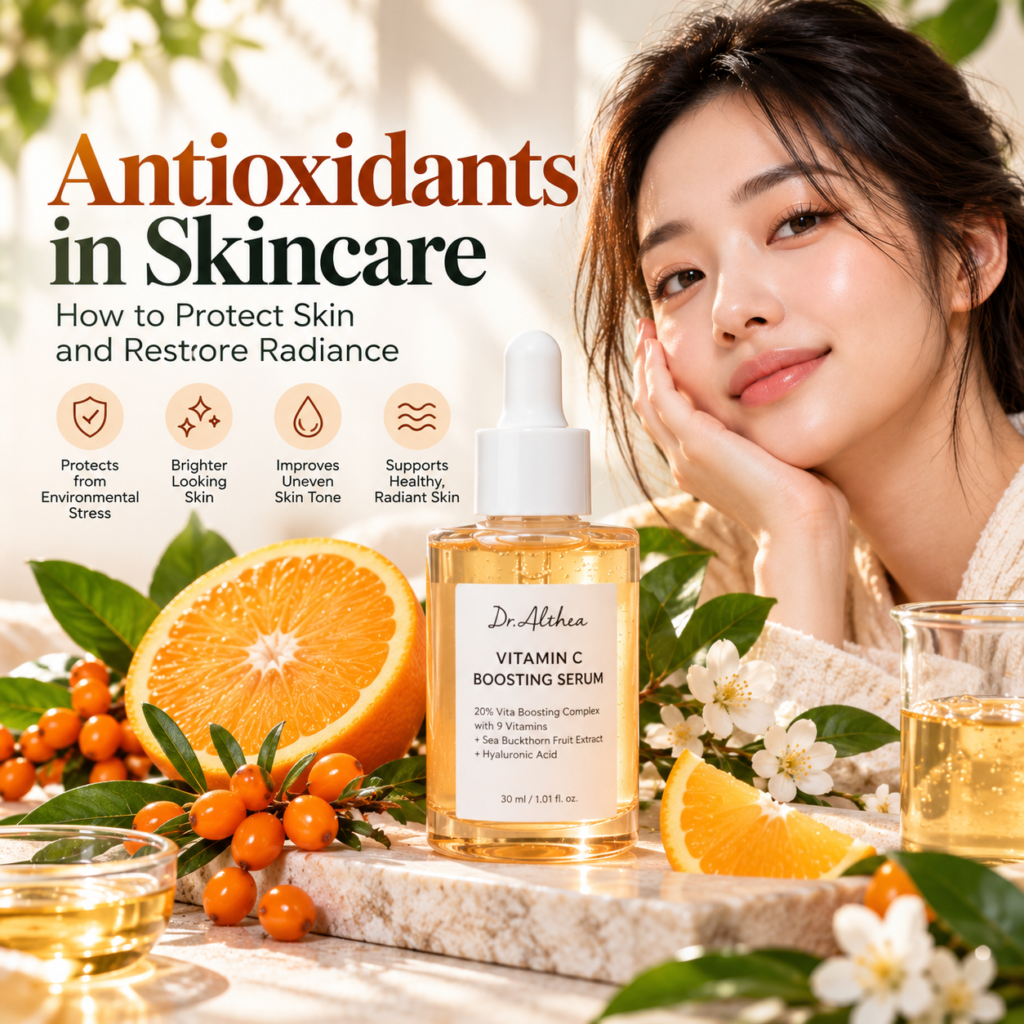

Daily exposure to sunlight, air pollution, and other environmental stressors can influence how the skin looks and feels. Over time, these factors may contribute to dullness, uneven skin tone, and visible signs of premature ageing. Although skincare cannot eliminate every environmental effect, using products with antioxidant ingredients can help support a healthier-looking complexion.
Antioxidants have become an important part of modern skincare because they help neutralise free radicals, unstable molecules that can damage cellular components when present in excess. Ingredients such as vitamin C, vitamin E, and certain botanical extracts are frequently included in skincare formulations for this reason.
However, choosing an antioxidant product involves more than selecting a serum with an impressive ingredient list. Understanding how antioxidants work, which formulations suit your skin, and how to combine them with daily sun protection can help you build a more effective routine.
What Are Antioxidants and Why Does Skin Need Them?
The skin is continuously exposed to environmental factors that can generate reactive oxygen species, commonly associated with oxidative stress. Sunlight, particularly ultraviolet radiation, is an important contributor, while pollution and other external stressors may also play a role.
The body has natural antioxidant defence systems to manage these reactive molecules. However, when oxidative stress exceeds the skin’s ability to control it, damage to lipids, proteins, and other cellular components may occur.
This process can contribute to changes associated with premature skin ageing, including uneven pigmentation and reduced skin elasticity.
Topical antioxidants provide additional support at the skin’s surface. Their effectiveness depends on the ingredient, concentration, stability, packaging, and overall formulation. Not every antioxidant performs identically, and a product containing several antioxidants is not automatically better than a simpler, well-formulated alternative.
For everyday skincare, antioxidants are best considered part of a broader strategy that includes gentle cleansing, moisturisation, and consistent sun protection.
How Vitamin C Supports Brighter-Looking Skin
Vitamin C is one of the most widely studied antioxidants used in topical skincare. It plays a role in collagen synthesis and can help protect against oxidative stress associated with environmental exposure.
Vitamin C is also relevant to people concerned about dullness and uneven skin tone. Certain topical formulations can help improve the appearance of pigmentation by influencing processes involved in melanin production.
There are different forms of vitamin C in skincare. L-ascorbic acid is the best-known form, while derivatives such as 3-O-ethyl ascorbic acid and ascorbyl glucoside are used in formulations designed around stability and product performance.
These forms differ in their chemical properties, formulation requirements, and available evidence. Their effectiveness depends on how they are incorporated into the finished product.
Vitamin C can be particularly useful when the goal is to support radiance while addressing some visible effects of environmental exposure. However, it does not replace sunscreen, and it cannot guarantee the removal of dark spots or reverse every sign of skin ageing.
Other Antioxidant Ingredients Worth Understanding
Vitamin C is not the only ingredient that contributes antioxidant properties to skincare. Several other ingredients can complement it or serve different purposes in a balanced routine.
Vitamin E
Vitamin E is a fat-soluble antioxidant used in many skincare products. It helps protect lipids from oxidative damage and can complement vitamin C in certain formulations.
Because the two ingredients have different chemical properties, formulators sometimes combine them to support antioxidant performance. The results depend on the complete formula rather than the presence of either ingredient alone.
Vitamin E is also found in moisturising products, making it relevant to routines focused on both skin comfort and environmental protection.
Niacinamide
Niacinamide, a form of vitamin B3, supports the skin barrier and can help improve the appearance of uneven skin tone. Although it is not simply interchangeable with vitamin C, it can complement antioxidant-focused routines.
Its barrier-supporting properties make it useful for people who experience dehydration or want to improve the overall appearance of their complexion.
Niacinamide is available in a wide range of concentrations. Higher percentages are not necessarily more effective for everyone, so skin tolerance should guide product selection.
Green Tea Extract
Green tea extract contains polyphenols, including catechins, that have antioxidant properties. It is used in skincare formulations designed to condition the skin and support protection against environmental stressors.
The quality and concentration of the extract matter, and results vary between formulations. Botanical ingredients can also cause reactions in some individuals, so they should not automatically be considered suitable for every skin type.
Sea Buckthorn Extract
Sea buckthorn fruit extract is another ingredient used in antioxidant-focused skincare. It contains naturally occurring compounds, including carotenoids and vitamin-related nutrients, depending on the extract and processing method.
In cosmetic products, sea buckthorn-derived ingredients may contribute to antioxidant support and skin conditioning. Their benefits depend on the specific formulation, rather than on comparisons with whole fruits alone.
Choosing an Antioxidant Serum for Your Skin
A suitable antioxidant serum should address your priorities without unnecessarily complicating your routine.
If your main concern is dullness, a vitamin C-focused formulation may be worth considering. If uneven pigmentation is more prominent, you may also want to understand whether the product contains ingredients that target the appearance of dark spots.
People with dry or dehydrated skin should pay attention to supporting ingredients such as glycerin, hyaluronic acid, and other moisturising components. These ingredients help maintain hydration, which can improve the appearance of roughness and dullness.
Sensitive skin requires a more cautious approach. Some vitamin C formulations, especially those containing acidic forms at higher concentrations, may cause stinging or irritation. Introducing a product gradually can help you assess its suitability.
Packaging also deserves attention. Certain antioxidant ingredients are sensitive to light, air, or heat. Opaque or appropriately designed packaging can help protect vulnerable formulations, while correct storage helps maintain product quality.
Finally, consider the complete ingredient list and the manufacturer’s directions. An antioxidant serum should fit comfortably into your routine rather than force you to discontinue products that already work well for your skin.
Exploring Dr Althea Vitamin C Boosting Serum
For people interested in a vitamin C-focused product, Dr Althea Vitamin C Boosting Serum is one formulation to consider.
According to the product listing, the serum features a 20% Vita Boosting Complex containing nine vitamins and sea buckthorn fruit extract. The formula also includes hyaluronic acid to support hydration. These ingredients make the product relevant to routines focused on dullness, uneven-looking skin tone, and a more radiant complexion.
Vitamin C-related ingredients provide the antioxidant-focused element, while hydrating components can help the skin feel more comfortable. This combination may appeal to people who want to address several appearance-related concerns with a single serum.
However, the term “20% Vita Boosting Complex” should not be interpreted as 20% pure vitamin C. The concentration of the overall complex and the concentration of individual active ingredients are different measurements.
As with any active skincare product, individual results will depend on skin type, formulation tolerance, consistency, and sun exposure. The serum should not be expected to remove all pigmentation or replace other essential skincare steps.
Before purchasing, review the current ingredient list and usage instructions. If your skin is sensitive, perform a patch test and introduce the product gradually. Stop using it if persistent irritation develops.
How to Build an Antioxidant-Focused Skincare Routine
A straightforward routine is often easier to maintain than one containing numerous overlapping treatments.
Morning: Cleanse, Treat, Moisturise, and Protect
Begin with a gentle cleanser that removes excess oil and overnight residue without leaving the skin tight.
Apply your antioxidant serum according to its instructions. Allow it to settle before applying a moisturiser suited to your skin type.
Finish with broad-spectrum sunscreen with SPF 30 or higher. Apply an adequate amount and reapply as directed, particularly during extended outdoor exposure.
This final step is essential because ultraviolet radiation contributes to oxidative stress and can worsen existing pigmentation. Antioxidants can complement sun protection, but they do not provide an equivalent substitute for sunscreen.
Evening: Maintain Hydration and Skin Comfort
In the evening, remove sunscreen, makeup, and daily residue with a suitable cleanser. Follow with your chosen treatment products and moisturiser.
You do not necessarily need to use every active ingredient twice a day. Follow the directions for your particular serum and adjust the routine according to your skin’s response.
If you use retinoids or exfoliating acids, introduce products carefully rather than combining multiple new treatments at once. This can reduce the risk of irritation and make it easier to identify which product is causing a reaction.
Common Mistakes When Using Antioxidant Skincare
One mistake is expecting immediate results. Improvements in dullness and uneven pigmentation generally take time, and the timeline varies according to the concern and the formulation.
Another mistake is assuming that more active ingredients always produce better results. A formula containing many ingredients may not suit every skin type, particularly when several components have the potential to irritate.
Ignoring sunscreen is another major problem. Even a carefully selected antioxidant serum cannot prevent all sun-related damage when sun protection is inconsistent.
Finally, avoid treating every form of pigmentation in the same way. Flat post-acne marks, melasma, sunspots, and structural acne scars have different causes and may respond differently to topical products. Persistent or unusual pigmentation should be assessed by a dermatologist.
Finding Korean Antioxidant Skincare in Pakistan
When comparing skincare products, focus on ingredient transparency, formulation, intended benefits, and instructions rather than marketing claims alone.
Climate is another practical consideration. Warm weather, humidity, and frequent sun exposure can influence which textures feel comfortable throughout the day. Some people prefer lightweight serums, while others need richer moisturisers to maintain hydration.
Consumers researching Korean skincare Pakistan can explore different formulations and compare products according to their skin concerns. Reading product descriptions and ingredient lists can help distinguish antioxidant-focused treatments from products primarily designed for hydration or exfoliation.
You can also explore ColorShow for skincare and beauty products across different categories. Choosing products that fit your needs and following their instructions is more useful than building a routine around trends alone.
A Balanced Approach to Long-Term Skin Health
Antioxidants can play a valuable role in skincare by helping protect against oxidative stress and supporting a brighter, healthier-looking complexion. Vitamin C is particularly relevant to routines targeting dullness and uneven skin tone, while ingredients such as vitamin E, niacinamide, and sea buckthorn extract can provide complementary benefits.
Nevertheless, no single serum can address every skin concern. Gentle cleansing, adequate moisturisation, consistent sun protection, and careful product selection remain essential foundations.
Choose a formulation that suits your skin, introduce it gradually, and give it time to demonstrate whether it is helping. A consistent, evidence-informed routine is a more sustainable way to support skin health than relying on quick fixes or excessive product layering.