
Most people notice the first bulging vein years before they do anything about it. The legs feel heavy by evening, socks leave deeper marks than they used to, and a quiet assumption settles in that the only real fix is an operation. That assumption is largely outdated. This article explains how varicose veins treatment without surgery Chennai patients can now consider works, who it suits, what can go wrong, and how long recovery takes.
What Is Happening Inside the Vein
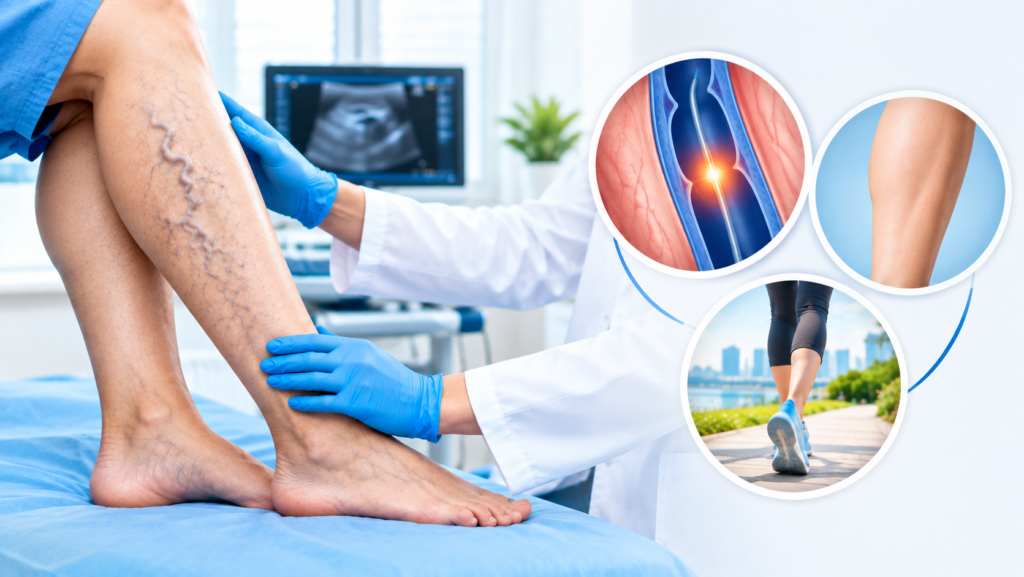
Leg veins have small valves that open to let blood travel up toward the heart and close to stop it falling back. In varicose veins, those valves no longer seal. Blood drifts backward, pressure builds, and the vein wall stretches until it bulges and twists under the skin. Doctors call this venous reflux. It most often involves the great saphenous vein, which runs along the inner thigh and calf.
Symptoms
Appearance is a poor guide. Some people with thick, ropy veins feel nothing, while others with barely visible ones have aching legs. The usual complaints are heaviness, throbbing, ankle swelling that settles overnight, itching, and cramps in bed.
Brown staining or tightening of the skin near the ankle points to long-standing pressure and deserves a proper check. A sore that will not heal needs review. A suddenly swollen, painful calf needs same-day attention, because it can signal a clot.
Causes and Risk Factors
Family history is the strongest factor. Pregnancy adds to it, since hormones relax the vein walls and the growing uterus raises pressure in the legs. Jobs that involve long hours of standing, higher body weight and advancing age also contribute. A previous deep vein clot can damage valves too.
Exercise and weight control ease symptoms, but they cannot repair a valve that has already failed.
How Doctors Diagnose It
The assessment begins with an examination, ideally while you stand. The key test is a venous Doppler (duplex) ultrasound. It shows which veins are leaking, how severe the reflux is, and whether the deep veins are open.
This scan decides the treatment. If a procedure is proposed without one, it is reasonable to ask why.
Non-Surgical Treatment Options
Compression Stockings
Usually the first step. They relieve heaviness and swelling but do not close a leaking vein. They are also used after procedures and for patients who are not candidates for intervention, including during pregnancy.
Sclerotherapy
A medicine, often mixed into a foam, is injected under ultrasound guidance. It irritates the lining of small veins so they collapse and are gradually absorbed. It is used for smaller veins and for any residual veins after a larger vein has been treated.
Radiofrequency or Laser Ablation
This is the standard approach for saphenous vein reflux. After the skin is numbed, a thin catheter is passed into the vein through a puncture. Numbing fluid is placed around the vein, and heat from inside the catheter seals it. The procedure typically takes under an hour.
Adhesive Closure
A medical-grade adhesive closes the vein without heat, so the numbing injections along the leg are often not needed. It is avoided in people with known allergies to the material.
These are image-guided, catheter-based procedures, the routine work of interventional radiologists such as Dr. Arjunlokesh Netaji, who trained at JIPMER and AIIMS.
How the Options Compare
| Method | Suited For | Anaesthesia | Usual Return to Routine | Main Limitation |
| Compression stockings | Mild symptoms, pregnancy | None | Immediate | Does not close the vein |
| Sclerotherapy | Small and spider veins | None or topical | 1–2 days | Repeat sessions often needed |
| Radiofrequency or laser ablation | Large trunk veins | Local | 1–3 days | Tightness and bruising along the vein |
| Adhesive closure | Selected trunk veins | Local | 1–2 days | Rare allergic reaction |
| Open surgery (stripping) | Selected complex cases | General or spinal | 1–2 weeks | Larger wounds, longer recovery |
Benefits
The appeal of varicose veins treatment without surgery Chennai clinics offer lies mostly in what is avoided: a groin incision, general anaesthesia and a long wait before normal activity. Most procedures are done as day care, and walking is encouraged straight away, which also helps lower clot risk.
Published studies report high vein closure rates. Individual results still vary, and no doctor can promise that new varicose veins will never appear.
Risks
Bruising and a pulled-muscle tightness along the thigh for a few days are common. Skin staining over the treated vein may follow and usually fades over months.
Less commonly, a superficial vein becomes inflamed, or a small nerve is irritated, causing patches of numbness or tingling. This is mainly seen with heat-based methods below the knee. A clot in the deep veins is uncommon but serious, and it is the reason you are asked to report new calf pain or breathlessness without delay.
Recovery Time
Most patients walk out the same day and return to desk work within a day or two. Stockings are usually worn for one to two weeks, though your doctor will confirm the duration.
For about a week, avoid heavy lifting, hard exercise and long periods of standing. Bruising settles over two to three weeks, and the closed vein shrinks over the following months. A follow-up ultrasound confirms that the vein has closed.
Tips From Clinical Practice
- Ask for a Doppler scan report before agreeing to any plan.
- Prefer a clinic that offers more than one technique, so the method fits your veins rather than the reverse.
- Check the operator’s wider catheter experience. Many interventional radiologists also perform embolisation for other conditions, such as Uterine Fibroids Treatment In Chennai, and that background carries over directly to vein work.
- Wear the stockings for the full period advised, even when the leg feels fine.
Recent Medical Updates
Guidance has moved steadily toward endovenous treatment. The UK’s NICE guideline on varicose veins advises offering endothermal ablation first for suitable patients, with foam sclerotherapy and then surgery as later options. The 2022 European Society for Vascular Surgery guidelines on chronic venous disease similarly favour endovenous ablation over open surgery for eligible patients.
Non-thermal techniques such as adhesive closure and mechanochemical ablation are now more widely available. Their long-term data are still maturing.
Frequently Asked Questions
Does the procedure hurt?
Most patients describe pressure or a pulling sensation rather than pain. The numbing injections along the vein cause the most discomfort.
Can varicose veins come back?
Yes. New veins can develop over the years, especially with a strong family history. Treating the source vein properly reduces the chance but cannot remove it.
When can I drive or return to work?
Many people do both within one or two days. Your doctor may advise a longer break if your job is physically demanding.
Is it covered by insurance?
Coverage depends on the insurer and on whether the procedure is judged medically necessary rather than cosmetic. Check with your insurer and the hospital’s billing team beforehand.
Who may not be suitable?
People with an active deep vein clot, significant leg artery disease, or very tortuous veins may need another plan. Pregnancy is usually a reason to wait.
Is this only done by surgeons?
No. Vascular surgeons and interventional radiologists both perform these procedures. The shared skill is catheter work under imaging, which is also used for conditions like Uterine Fibroids Treatment In Chennai.
Conclusion
Varicose veins treatment without surgery Chennai residents can choose today is gentler than it was a decade ago, with a short recovery and risks that can be explained plainly. The right option still depends on your vein anatomy, symptoms and general health, and that is why a scan-based assessment comes first.
If leg heaviness, swelling or skin changes are affecting your daily routine, consider booking a consultation with Dr. Arjunlokesh Netaji (MD, DNB, MNAMS, DM, EBIR) to find out which approach suits you. This article is for general education and does not replace personal medical advice.