

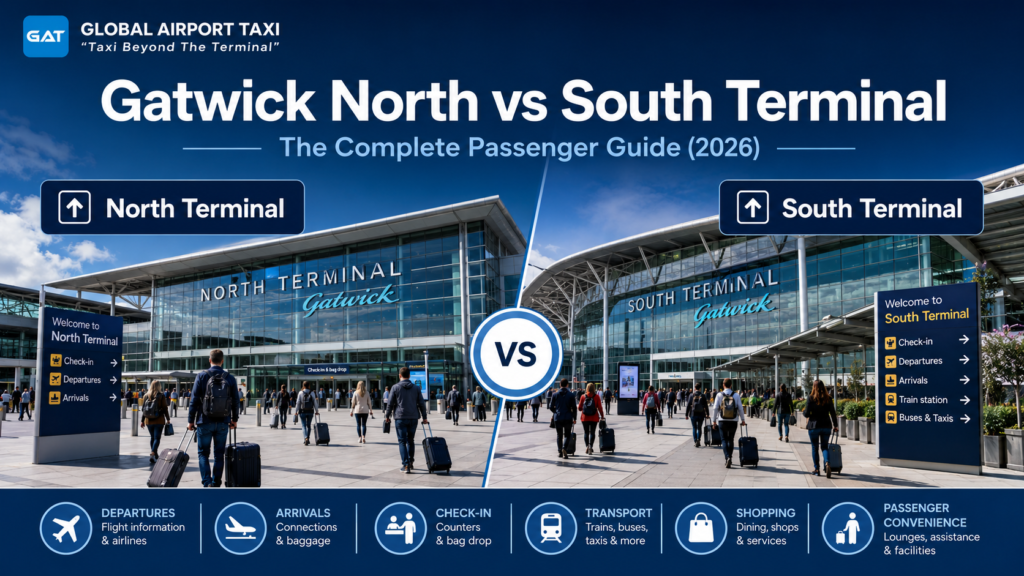

Gatwick is the only major UK airport where turning up at the wrong building can cost you your flight. It has two entirely separate terminals — North and South — sitting on opposite sides of the runway, each with its own check-in desks, security, gates, arrivals hall and transport connections.
They are not interchangeable. There is no airside link between them, which means that once you’re through security in one terminal, you cannot walk to the other. You’d have to exit, take the shuttle, and clear security all over again.
This guide covers what separates the two terminals, how to work out which one you need, and exactly what to do if you find yourself in the wrong place.
The Short Version
| North Terminal | South Terminal | |
|---|---|---|
| Opened | 1988 | 1958 (original terminal) |
| Rail station | No — shuttle to South | Yes, directly connected |
| Inter-terminal shuttle | Free, every few minutes | Free, every few minutes |
| Transit time | ~2 min on the shuttle, 10–15 min door to door | Same |
| Airside connection | None | None |
The single most important line in this entire guide: check your boarding pass 24 hours before you fly, not the day you booked. Airlines move between terminals, and Gatwick has seen several reshuffles during 2026 alone.
Which Airlines Use Which Terminal?
Terminal allocation at Gatwick depends entirely on your airline, not your destination — both terminals handle short-haul and long-haul international flights.
North Terminal is easyJet’s main operating base and also handles a growing roster of long-haul carriers including Emirates, WestJet, Turkish Airlines, Singapore Airlines, Air China and China Southern.
South Terminal is the original terminal and is directly connected to the railway station. British Airways operates from here, along with Ryanair and, since a March 2026 move, Jet2.
A caution worth taking seriously: this allocation changed more than once during 2026. easyJet consolidated its Gatwick operation into a single terminal after years of splitting across both, British Airways brought its flights together in the South Terminal, and Jet2 switched buildings entirely. Any list published today may be out of date within months.
Treat the above as a general orientation, then verify on the official Gatwick Airport terminals page or your boarding pass. It takes thirty seconds and removes the single biggest risk of the day.
North Terminal in Detail
The North Terminal opened in 1988 and covers around 98,000 square metres. It has three piers, and gate numbering in Pier 6 was revised at the start of 2026 — so if you’re a frequent flyer working from memory, check the screens rather than assuming.
Worth knowing: if you’re flying long-haul from the North Terminal, allow extra time after security. Some gates involve a genuinely long walk, and the terminal is currently working around a major pier extension project.
Arrivals: the arrivals hall is on the ground floor. Meeting points, car hire desks and the shuttle platform are all signposted from the baggage reclaim exit.
Getting to the train: there is no railway station at the North Terminal. You’ll need the free inter-terminal shuttle to South Terminal first — budget 10–15 minutes with luggage.
South Terminal in Detail
The South Terminal is the older of the two, dating back to 1958, and handles a substantial share of the airport’s traffic. Its defining practical advantage is the railway station, which sits directly alongside the terminal.
That connection matters more than most passengers realise. Gatwick Express services to London Victoria, Thameslink trains to St Pancras and London Bridge, and Southern services all depart from here. If you’re arriving into North Terminal and heading straight for a train, factor the shuttle into your timings.
Arrivals: as with North, the arrivals hall is on the ground floor with meeting points clearly marked after baggage reclaim.
The Inter-Terminal Shuttle
A free automated shuttle connects the two terminals. The transit itself takes around two minutes and services run every few minutes, 24 hours a day.
The two-minute figure is the part people quote and the part that misleads them. Realistically:
- Terminal to terminal with hand luggage: 10–15 minutes including walking and waiting
- If you’ve gone to the wrong terminal for a departure: allow at least 45 minutes, because you’ll need to exit, transit, and re-clear security — and Gatwick security queues can be long
If you’re already inside security at the wrong terminal and your flight is in an hour, that maths does not work. This is why the boarding-pass check matters.
Getting To and From Each Terminal
By train: South Terminal only. Gatwick Express reaches London Victoria in roughly 31 minutes; Thameslink serves London Bridge, Blackfriars, Farringdon and St Pancras International. North Terminal passengers need the shuttle first.
By coach: National Express serves both terminals directly, with services running to London Victoria Coach Station. It’s the cheapest option and the slowest.
By car: both terminals have short-stay and long-stay parking, though costs mount quickly on trips longer than a few days. Drop-off zones at both terminals carry a charge.
By pre-booked transfer: this is where the two-terminal layout is most easily managed. When you book a private transfer, you specify your terminal at the point of booking, and the driver goes directly to the correct arrivals hall.
A pre-booked Gatwick airport taxi also removes the second problem the terminal split creates: the guessing game about where to actually meet someone. Drivers meet passengers inside the designated arrivals area of the specified terminal with a name board, and flight tracking means a delayed landing doesn’t leave you paying for waiting time. For families arriving into North Terminal with luggage, being collected at the door rather than hauling cases onto a shuttle to reach a train station is a meaningful difference.
By ride-hailing app: both terminals have designated pickup zones, though these are not always immediately adjacent to arrivals, and surge pricing is common when several flights land together.
What To Do If You’re at the Wrong Terminal
If you’re departing and haven’t cleared security: head straight for the shuttle. You have not lost as much time as you think, provided you notice early. Follow signs for the inter-terminal shuttle from landside.
If you’re departing and have already cleared security: speak to airport staff immediately. You will need to exit and re-clear security at the other terminal, and depending on your remaining time this may not be possible.
If you’re arriving and your lift is at the other terminal: call them before you get on the shuttle. It’s usually easier for a car to reposition than for you to move with luggage — though if you’ve pre-booked with a reputable operator, they’ll simply redirect the driver.
Six Things To Do Before You Fly From Gatwick
- Check your boarding pass 24 hours before departure. Not your original booking email — the boarding pass.
- Tell whoever is collecting you which terminal you’re arriving into. North and South arrivals halls are a mile apart.
- Allow 45 minutes if you might need to switch terminals on a departure day.
- North Terminal passengers taking the train: add 15 minutes for the shuttle to South Terminal.
- Don’t rely on old gate knowledge. Numbering changed in parts of the airport during 2026.
- Arrive two hours before short-haul, three before long-haul. Gatwick’s check-in halls are large and busy.
The Bottom Line
Gatwick’s two-terminal layout is manageable once you know it exists — and genuinely disruptive if you don’t. Nearly every terminal-related problem at Gatwick traces back to one of two things: a passenger who checked their terminal when they booked rather than before they travelled, or a driver waiting in the wrong arrivals hall.
Both are avoidable in under a minute. Check the boarding pass, confirm the terminal when you arrange your transport, and the rest of the journey takes care of itself.
Terminal and airline information is accurate as of mid-2026 and subject to change. Always confirm your terminal on your boarding pass or at gatwickairport.com before travelling.