

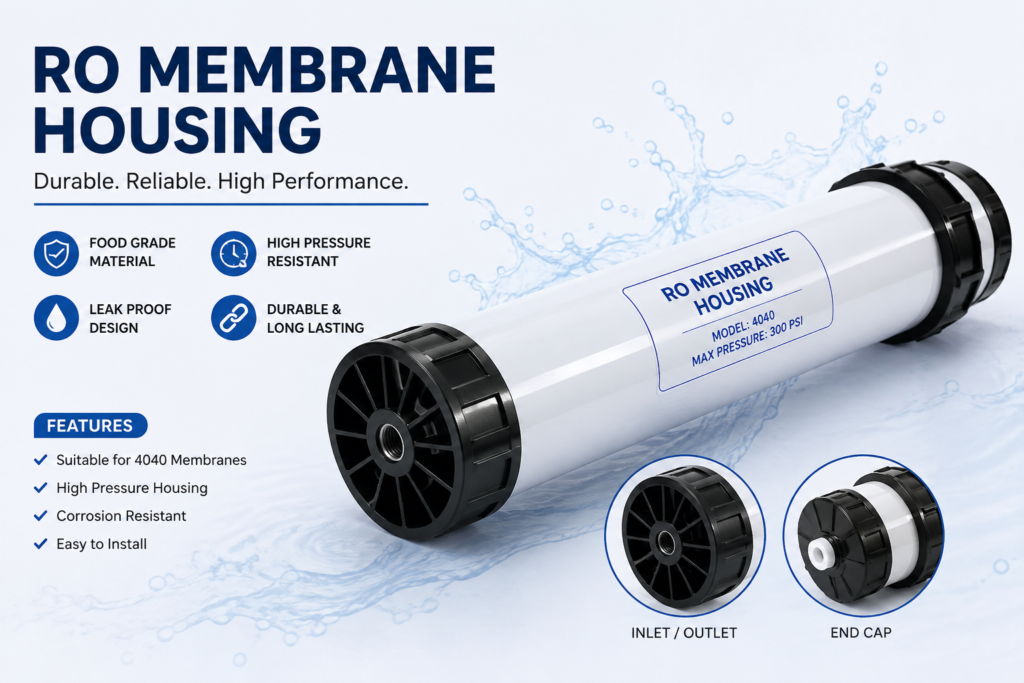

When people look at an RO system, the membrane is usually the component that receives the most attention. However, the membrane cannot operate effectively without a properly engineered pressure vessel around it.
The RO Membrane Housing Design determines how the membrane is positioned, how water enters and moves through the vessel, how pressure is contained, and how permeate and concentrate streams are separated.
A good RO membrane housing design provides the correct membrane fit, pressure containment, sealing, internal flow path, and connection arrangement required for reliable reverse osmosis operation. The design must be matched to the membrane, operating pressure, water conditions, and overall system configuration.
This is why membrane housing should be viewed as an engineered component rather than simply a container.
1. What Makes a Good RO Membrane Housing?
A properly designed RO Membrane Housing needs to satisfy several requirements at the same time.
First, it must physically accommodate the membrane element.
Second, it must withstand the pressure required by the RO system.
Third, it must maintain reliable sealing between different water streams.
Finally, it must support the intended flow path through the membrane.
A housing that meets only one of these requirements may still be unsuitable.
For example, a pressure vessel may have sufficient physical strength but the wrong internal dimensions for the membrane. Another housing may accommodate the membrane correctly but have an unsuitable port configuration.
Good design is therefore about compatibility between multiple components.
2. How Housing Dimensions Affect Membrane Operation
Membrane elements are manufactured to specific dimensions.
The housing must be designed to accommodate these dimensions correctly.
Important measurements may include:
- Membrane diameter
- Membrane length
- Internal vessel diameter
- Vessel length
- End configuration
- Connection locations
- Sealing areas
If the dimensions are incorrect, the membrane may not sit properly inside the vessel.
This can make installation difficult and may interfere with the intended water-flow arrangement.
The housing should therefore be selected according to the membrane manufacturer’s specifications.
It is not advisable to assume that two products are compatible simply because they appear to have similar dimensions.
3. The Importance of Internal Water Flow
Water flow is central to reverse osmosis.
Feed water enters the pressure vessel and travels across the membrane element.
A portion of the water passes through the membrane and becomes permeate.
The remaining stream continues as concentrate.
The housing must support this flow arrangement.
Its internal configuration and membrane positioning help maintain the intended direction of movement.
If water does not travel through the membrane element as intended, the system may not perform efficiently.
This is one reason why pressure vessel design and membrane selection need to be considered together.
The vessel should not restrict the intended flow path or create installation conditions that interfere with membrane operation.
4. Pressure Vessel Design and Operating Conditions
An RO Membrane Pressure Vessel must be designed for the pressure conditions of the system.
Reverse osmosis requires pressure because water must be driven through the semipermeable membrane.
The vessel therefore becomes a pressure-containing component.
Several operating conditions need to be considered during selection.
Operating Pressure
The vessel should have an appropriate pressure rating for the intended application.
Temperature
Operating temperature can influence material performance and should remain within specified limits.
Water Chemistry
The feed water can affect the suitability of the housing material and internal components.
Operating Frequency
A vessel used continuously in an industrial plant may experience very different service conditions from one used intermittently.
These factors should be considered together.
The highest possible pressure rating is not automatically the correct choice. The objective is to select a vessel that is properly rated for the actual system.
5. End Caps, Ports and Sealing Arrangements
The body of the pressure vessel is only one part of its design.
End caps, ports, seals, and internal components also play important roles.
End Caps
End closures provide access to the membrane and help create a sealed pressure environment.
They need to be properly designed and installed.
Feed Connection
The feed port provides the entry point for pressurized water.
Its size and configuration should correspond with the system piping.
Permeate Connection
Permeate needs to be collected separately from the concentrate stream.
The vessel’s internal and external connection arrangement supports this separation.
Concentrate Connection
The concentrate outlet allows rejected water to leave the pressure vessel.
Sealing
O-rings and other sealing components help prevent unwanted leakage.
A housing can have strong structural construction but still experience problems if the sealing arrangement is unsuitable.
6. FRP Membrane Housing Design Considerations
FRP Membrane Housing is widely used in water treatment because fiberglass-reinforced plastic can provide a combination of corrosion resistance, strength, and relatively low weight.
FRP construction is suitable for many commercial and industrial applications when the vessel is operated within its specified conditions.
When evaluating FRP housing, buyers should consider:
- Pressure rating
- Operating temperature
- Membrane compatibility
- Feed water chemistry
- Connection configuration
- Vessel dimensions
- Installation environment
The fact that a housing is made from FRP does not by itself determine whether it is suitable.
Different products can have different specifications and construction characteristics.
The application should always determine the required design.
7. Single-Element vs Multi-Element Housing
RO systems can use pressure vessels designed for different numbers of membrane elements.
Single-Element Housing
A single-element vessel is generally used where system capacity requirements are relatively modest.
Its smaller configuration can make installation and membrane replacement more straightforward.
Multi-Element Housing
Larger systems may use vessels designed to accommodate multiple membrane elements.
This configuration can support higher water production without requiring a separate pressure vessel for every individual membrane.
Industrial systems frequently use multiple vessels and multiple membrane elements as part of a larger RO array.
The correct choice depends on system capacity and membrane configuration.
The vessel should always be compatible with the specific membrane elements being installed.
8. How Housing Design Supports System Efficiency
Efficiency in an RO system depends on many factors.
Pretreatment, membrane condition, feed water quality, pressure, recovery, temperature, and cleaning all influence performance.
The housing is one part of this overall system.
A properly designed vessel can support efficient operation by maintaining:
- Correct membrane positioning
- Controlled pressure
- Appropriate water flow
- Reliable sealing
- Proper permeate collection
- Controlled concentrate discharge
This does not mean that a particular housing automatically increases membrane rejection or recovery.
Instead, good housing design helps ensure that the pressure vessel does not become a limitation within the system.
A correctly matched housing provides the foundation required for the membrane to operate under its intended conditions.
9. Design Mistakes That Can Create RO Problems
Poor housing selection can create issues even when the membrane itself is high quality.
Incorrect Dimensions
If the membrane and vessel dimensions do not match, installation and sealing can become difficult.
Inadequate Pressure Rating
A vessel that is not rated for the intended operating pressure is unsuitable.
Incorrect Port Configuration
Mismatched connections can complicate installation and require unnecessary modifications.
Poor Sealing
Incorrect or damaged seals can result in leakage and pressure loss.
Wrong Material
A material that is unsuitable for the feed water or operating environment may experience premature deterioration.
Incorrect Membrane Configuration
A vessel designed for one configuration should not automatically be used with a different arrangement without confirming compatibility.
These mistakes can often be avoided by collecting the technical specifications before purchasing.
10. How to Specify the Right Housing
A good specification starts with the RO membrane.
Identify the exact membrane type and dimensions first.
Then establish the system requirements.
Important information includes:
Membrane details:
Diameter, length, model, and number of elements.
Pressure:
Normal operating pressure and relevant system limits.
Flow:
Required feed flow, permeate production, and concentrate flow.
Water:
Feed water characteristics, temperature, and chemistry.
Material:
Required housing construction based on the application.
Connections:
Feed, permeate, concentrate, and piping requirements.
Installation:
Available space, orientation, and maintenance access.
Once these details are known, the appropriate pressure vessel can be selected with greater confidence.
11. Why Manufacturer Specifications Matter
A membrane housing should be supported by clear technical documentation.
A manufacturer should be able to provide information about dimensions, pressure ratings, materials, connection configuration, and compatible membrane elements.
Technical documentation helps buyers verify that the product matches their system.
It is especially important for industrial applications, where a small mismatch can create significant installation or operating problems.
Buyers should avoid selecting a pressure vessel based solely on photographs, general descriptions, or price.
The actual technical specifications matter more.
12. Designing for Maintenance
Good design should consider not only initial installation but also future maintenance.
RO membranes eventually need cleaning, inspection, or replacement.
The housing should therefore allow the membrane to be accessed according to the manufacturer’s service procedure.
Seals and other replaceable components should also be accessible when required.
For commercial and industrial systems, maintenance access can influence downtime.
A technically suitable vessel that is difficult to service may create unnecessary operational inconvenience.
This is why maintenance should be considered during the design and selection stage.
13. Frequently Asked Questions
What is RO Membrane Housing Design?
RO membrane housing design refers to the engineering of the pressure vessel that contains the RO membrane and manages pressure, water flow, sealing, membrane positioning, and connection requirements.
Why are housing dimensions important?
The dimensions must match the membrane element so that it can be installed, sealed, and operated correctly.
What is an RO membrane pressure vessel?
It is a pressure-resistant vessel specifically designed to contain one or more RO membrane elements during reverse osmosis operation.
Is FRP suitable for RO membrane housing?
FRP can be suitable for many RO applications because of its corrosion resistance and relatively low weight. Its suitability depends on pressure, temperature, water chemistry, and other system requirements.
Can one housing hold multiple membranes?
Yes. Multi-element pressure vessels are designed to accommodate multiple membrane elements when the system configuration requires them.
Does housing design affect RO performance?
Housing design can affect the operating environment of the membrane by influencing pressure containment, membrane positioning, sealing, and flow configuration.
What should I check before buying an RO membrane housing?
Check membrane compatibility, dimensions, pressure rating, material, port configuration, number of elements, operating conditions, and manufacturer documentation.
Conclusion
The RO Membrane Housing Design is an important part of reverse osmosis engineering.
A membrane may perform its separation function, but it relies on the pressure vessel to provide the correct physical and hydraulic environment.
Dimensions, internal flow, pressure rating, end closures, ports, seals, material, and membrane configuration all contribute to housing performance.
For smaller systems, a compact single-element vessel may provide the required configuration. Larger industrial installations may require multi-element pressure vessels designed for continuous operation.
FRP is a widely used material for many applications, while other materials may be selected when specific operating conditions require them.
The most important principle is compatibility.
The housing should match the membrane, pressure, water conditions, flow requirements, connections, and maintenance needs of the complete RO system.
By treating the pressure vessel as an engineered part of the RO process rather than simply a container, system designers and buyers can make more reliable equipment decisions.
A properly designed RO Membrane Housing provides the foundation for controlled pressure, correct flow, secure membrane installation, and dependable operation throughout the life of the RO system.