

The real performance of an SS Vessel is often revealed when a system starts facing frequent cleaning, leakage, corrosion, pressure issues or unnecessary maintenance. A vessel may look perfectly functional from the outside, yet its design, material or configuration may not be suitable for the process.
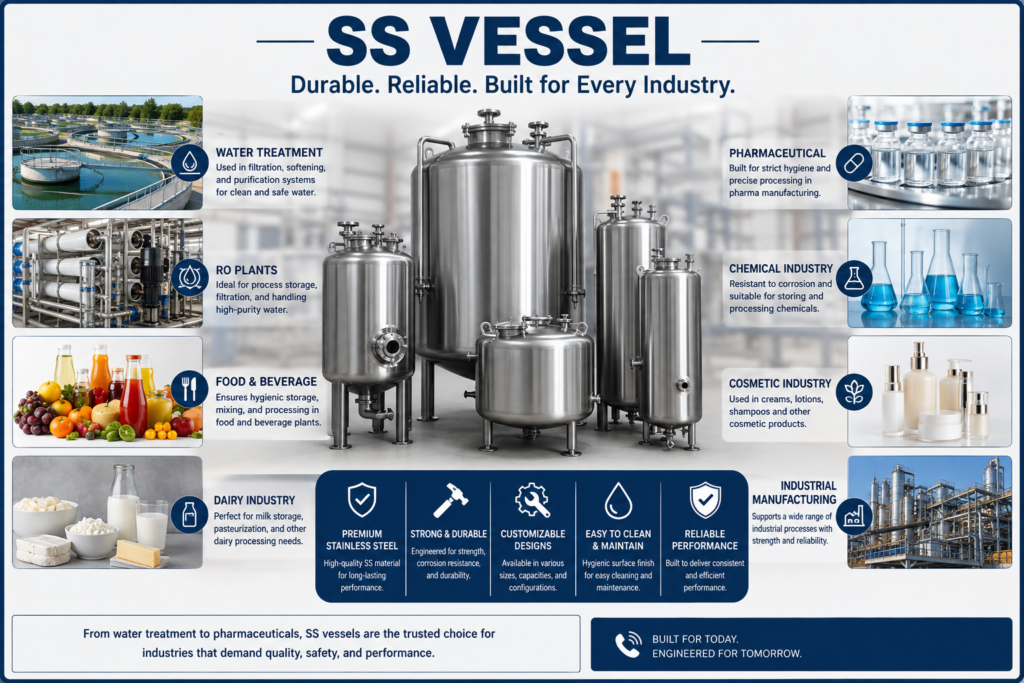
For industries using water treatment systems, RO plants, filtration equipment, food processing machinery, pharmaceutical systems or chemical processes, the vessel is an important part of the overall setup.
A properly designed SS Vessel can support durability, hygienic operation, easier maintenance and reliable process handling. But choosing stainless steel alone is not enough. The vessel must also match the application’s capacity, pressure, temperature, fluid characteristics and operating conditions.
This article highlights seven signs that indicate an industrial vessel may need a better design and explains how the right stainless steel solution can improve overall system performance.
Featured Snippet: What Is an SS Vessel?
An SS Vessel is a stainless steel container designed for applications such as storage, filtration, mixing, processing and water treatment. Its performance depends on factors including stainless steel grade, vessel capacity, pressure rating, fabrication quality, surface finish and process-specific design.
1. Frequent Corrosion Is a Warning Sign
Stainless steel is known for its corrosion resistance, but that does not mean every stainless steel vessel is immune to corrosion.
If corrosion is appearing repeatedly, the problem may involve material selection, environmental conditions, chemical exposure, surface condition or maintenance.
For example, water containing certain dissolved substances can create a more demanding environment than ordinary treated water.
Chemical processing can be even more challenging because the fluid may interact differently with different stainless steel grades.
This is why simply replacing a corroded vessel with another stainless steel vessel may not solve the underlying problem.
The first step should be understanding why the corrosion occurred.
What Should Be Checked?
Consider:
- Stainless steel grade
- Fluid composition
- Chloride exposure
- Operating temperature
- Cleaning chemicals
- Surface condition
- External environment
- Maintenance practices
A better-designed vessel starts with proper material compatibility.
2. Cleaning Takes Too Much Time
Cleaning is an important part of many industrial processes.
If workers are spending excessive time cleaning a vessel, the issue may not always be the cleaning procedure.
The vessel’s design itself can make cleaning easier or harder.
Poor internal geometry, difficult-to-access areas, unsuitable fittings or inadequate drainage can create unnecessary cleaning challenges.
This is particularly important in food, beverage, dairy and pharmaceutical applications.
An appropriately designed stainless steel vessel can incorporate features that support easier cleaning and drainage.
Why Surface Finish Matters
A suitable internal surface finish can help reduce areas where deposits accumulate.
However, surface finish should be selected according to the process.
A vessel intended for basic industrial water storage may not require the same finish as equipment used in a hygiene-sensitive manufacturing environment.
The design should therefore reflect the actual cleaning requirements.
3. The Vessel Is Always Operating Near Its Capacity
Another sign of poor vessel selection is consistently operating close to the vessel’s maximum capacity.
This can happen when the original system was designed for a smaller production requirement and the business later expanded.
For example, a water treatment plant may initially process a certain volume per day.
As demand increases, the same vessel may be expected to handle a significantly higher workload.
This can create operational limitations.
Instead of forcing the existing vessel to handle requirements beyond its intended purpose, businesses should review the entire system.
A new or customized Stainless Steel Vessel Tank may provide a more appropriate solution.
Think About Future Requirements
When replacing a vessel, consider expected growth.
The goal is not to purchase the biggest possible vessel.
Instead, consider whether the new vessel can comfortably support the expected operating requirement without unnecessary oversizing.
4. Leakage Keeps Appearing Around Connections
Sometimes the vessel itself is not the problem.
Connections, fittings, valves, gaskets and seals can become weak points in an otherwise good system.
Repeated leakage around the same connection may indicate that the configuration needs to be reviewed.
Possible causes include:
- Incorrect connection size
- Poor alignment
- Damaged gasket
- Improper installation
- Excessive vibration
- Incorrect pressure conditions
- Poor-quality fittings
A properly specified SS Vessel should be designed with the complete piping system in mind.
The inlet, outlet, drain, vent and other ports should correspond with the requirements of the installation.
Why Custom Connections Can Help
Industrial plants do not always have standardized layouts.
A customized vessel can be manufactured with connection locations and sizes suited to the actual installation.
This can reduce unnecessary modifications during installation.
5. Pressure Requirements Have Changed
One of the most serious reasons to reconsider vessel design is a change in operating pressure.
A vessel originally designed for one pressure range may not be suitable if the process has been upgraded.
This is particularly important when the system has:
- A higher-capacity pump
- Modified filtration equipment
- New process conditions
- Increased operating pressure
- Different temperature conditions
A Stainless Steel Pressure Vessel requires careful engineering because pressure creates mechanical stress within the vessel.
The vessel’s design pressure and operating pressure should be clearly established before selection.
It is unsafe to assume that a stainless steel vessel can automatically handle higher pressure simply because the material itself is strong.
6. Maintenance Costs Keep Increasing
A vessel can remain operational while becoming increasingly expensive to maintain.
This is often overlooked because the equipment has not technically failed.
However, frequent repairs, replacement seals, cleaning requirements and unexpected downtime can gradually increase operating costs.
For businesses, this creates an important question:
Is repairing the existing vessel still more economical than replacing it with a better-designed system?
The answer depends on the condition and application.
If maintenance issues are caused by incorrect sizing, unsuitable material or poor design, repeatedly repairing the same vessel may only postpone the underlying problem.
Look at Total Cost
Instead of comparing only purchase prices, consider:
- Repair frequency
- Labor costs
- Replacement parts
- Cleaning time
- Downtime
- Energy requirements
- Expected service life
This provides a more realistic view of the vessel’s value.
7. Your Process Has Changed but the Vessel Has Not
Industrial processes evolve.
A business may increase production, change its raw materials, introduce new chemicals or modify its cleaning process.
The vessel, however, may remain unchanged for years.
This can create a mismatch.
For example, a vessel designed for general water handling may later be used for a more demanding process.
A vessel designed for one production volume may later be expected to handle a much higher flow rate.
A vessel designed for a specific temperature may be exposed to different operating conditions after a process upgrade.
Whenever the process changes significantly, vessel suitability should be reviewed.
Why SS Vessel Design Should Start With the Application
A common purchasing mistake is starting with the product instead of the process.
Businesses may search for a particular capacity or vessel size and then try to fit it into the plant.
A better approach is the opposite.
Start by identifying:
What fluid will the vessel handle?
What volume is required?
What pressure will it experience?
What temperature will it operate at?
How frequently will it be cleaned?
What connections are required?
What space is available?
Once these requirements are clear, the appropriate vessel design can be developed.
Choosing the Right Stainless Steel Grade
Stainless steel comes in different grades, and material selection should reflect the application.
Two commonly considered grades are 304 and 316L, but neither should be selected automatically for every application.
Factors such as chemical exposure, chloride concentration, temperature and hygiene requirements can influence the decision.
For a simple water application, one grade may be adequate.
For a demanding process, another grade may be more appropriate.
The key is to select the material based on technical requirements rather than popularity or price alone.
SS Vessel in Water Treatment Applications
Water treatment plants often require equipment capable of continuous operation.
An SS Vessel may be used for:
- Water storage
- Filtration
- Process handling
- Pretreatment
- Specialized treatment applications
The vessel should be sized according to flow rate and process requirements.
For filtration applications, internal components may also need to be considered.
For storage, the vessel should provide the required volume.
For pressure applications, the pressure rating must match the system.
A single “standard” vessel cannot necessarily serve every water treatment application.
SS Vessel for RO Plants
RO systems require careful control of pressure and flow.
Depending on the system design, stainless steel vessels may be considered for supporting storage, filtration or other process functions.
The requirements can vary significantly between a small commercial RO system and a large industrial plant.
An industrial RO plant may require:
- Higher flow capacity
- Larger vessel dimensions
- Specialized connections
- Continuous operation
- More demanding cleaning
- Greater attention to pressure
The vessel should therefore be selected according to the actual RO plant configuration.
SS Vessel for Food and Beverage Industry
Food and beverage applications place special importance on hygiene.
An SS Vessel can be useful because stainless steel can be fabricated with smooth and cleanable surfaces.
But hygiene depends on the design as a whole.
Important factors can include:
- Internal surface finish
- Weld quality
- Drainage
- Sanitary fittings
- Gasket selection
- Cleaning method
- Internal geometry
A vessel designed for hygienic processing should be specified accordingly.
SS Vessel for Pharmaceutical Applications
Pharmaceutical manufacturing often requires controlled equipment and repeatable cleaning processes.
Vessels may be used for mixing, storage, formulation or processing.
Here, material grade and surface finish can become particularly important.
The vessel may also require detailed documentation and quality verification depending on the application.
Before ordering, businesses should communicate their process and documentation requirements clearly to the manufacturer.
SS Vessel for Chemical Processing
Chemical applications require careful material compatibility analysis.
The same stainless steel grade may perform differently depending on:
- Chemical concentration
- Temperature
- Exposure duration
- Fluid composition
- Cleaning chemicals
For this reason, chemical applications should be evaluated individually.
The objective is not simply to select a “strong” vessel.
The objective is to select a vessel whose material and construction are compatible with the actual process.
How a Good SS Vessel Manufacturer Can Help
Selecting an experienced SS Vessel Manufacturer can make the entire process more efficient.
A capable manufacturer should be able to discuss:
- Material grade
- Vessel dimensions
- Capacity
- Pressure rating
- Connections
- Surface finish
- Fabrication
- Testing
- Customization
Instead of simply asking for a price, provide the manufacturer with complete process information.
This allows the manufacturer to recommend a more appropriate configuration.
Questions to Ask Before Ordering
Ask:
- Which stainless steel grade is recommended and why?
- What operating and design pressure is supported?
- What capacity is suitable for the process?
- Can the connection arrangement be customized?
- What surface finish will be provided?
- What testing is performed?
- What maintenance is recommended?
- What technical documents are supplied?
Clear answers to these questions can help reduce purchasing mistakes.
Standard SS Vessel or Customized Vessel?
A standard vessel can be suitable when the application has straightforward requirements.
Customization becomes more valuable when the plant has specific constraints.
For example:
- Limited installation space
- Unusual pipe arrangement
- Special drainage requirements
- Specific pressure requirements
- Large capacity
- Hygiene-sensitive process
- Special internal components
A customized SS Vessel can be designed around these requirements.
However, customization should solve a real problem rather than simply add features.
How to Make an SS Vessel Last Longer
Even the best-designed vessel requires proper operation.
Businesses should:
- Follow recommended operating limits
- Perform regular inspections
- Check fittings and connections
- Replace worn seals
- Use suitable cleaning procedures
- Monitor corrosion
- Avoid unnecessary mechanical damage
- Follow manufacturer maintenance recommendations
For pressure applications, operating conditions should be monitored carefully.
Early detection of small problems can prevent larger equipment issues.
Why Buying Only on Price Can Backfire
Industrial equipment should be evaluated differently from ordinary consumer products.
A cheaper vessel may appear attractive during the purchasing stage.
But if it requires frequent repairs or does not integrate properly with the system, the initial saving can disappear quickly.
A better purchasing strategy is to compare:
Initial cost + installation + maintenance + downtime + expected service life.
This provides a more realistic assessment.
A slightly higher-quality vessel may offer better value if it reduces long-term operational problems.
The Real Meaning of a “Good” SS Vessel
A good SS Vessel is not necessarily the one with the thickest walls, largest capacity or highest price.
It is the one that is correctly engineered for its purpose.
That means:
- Appropriate stainless steel grade
- Correct dimensions
- Suitable capacity
- Required pressure rating
- Proper connections
- Appropriate surface finish
- Good fabrication quality
- Correct installation
- Proper maintenance
When these elements work together, the vessel can support reliable system performance.
Frequently Asked Questions
What are the main signs that an SS Vessel needs replacement?
Frequent corrosion, repeated leakage, excessive maintenance, inadequate capacity, pressure limitations or major process changes can indicate that the vessel needs evaluation or replacement.
Can an existing SS Vessel be upgraded?
In some situations, components or connections may be modified. However, pressure-related or structural modifications should be evaluated by qualified professionals before being implemented.
Is stainless steel completely resistant to corrosion?
No. Stainless steel provides corrosion resistance, but performance depends on grade and operating conditions.
What is the best SS Vessel for water treatment?
There is no single best vessel for every plant. The correct choice depends on water chemistry, flow rate, capacity, pressure, temperature and the specific treatment process.
What is a Stainless Steel Pressure Vessel?
It is a stainless steel vessel specifically designed for pressure operation. Its construction and rating must correspond to the required operating conditions.
Can an SS Vessel be customized?
Yes. Depending on the manufacturer, capacity, dimensions, connections, supports, ports and other specifications can be customized.
Conclusion
An SS Vessel can provide dependable performance across water treatment, RO, filtration, food processing, pharmaceutical, chemical and industrial applications—but only when its design matches the process.
Frequent corrosion, difficult cleaning, repeated leakage, capacity limitations, pressure changes, rising maintenance costs and process upgrades are all reasons to reassess whether the existing vessel is still suitable.
The solution is not always to buy a larger or more expensive vessel.
Instead, businesses should identify the actual problem and select a design that addresses it.
A reliable SS Vessel Manufacturer can help evaluate material grade, capacity, pressure, connections, surface finish and customization requirements.
When these factors are considered together, a Stainless Steel Vessel Tank can become a long-term asset rather than a recurring maintenance concern.
The best vessel is the one that fits the process today, supports the system tomorrow and avoids unnecessary problems along the way.