
Introduction
When someone searches for a local business, they usually want an answer quickly. They may be looking for a restaurant for dinner, a dentist for an appointment, a plumber for an urgent repair, or a nearby store that has what they need. In those moments, accurate information can make the difference between a customer choosing your business and moving on to a competitor.
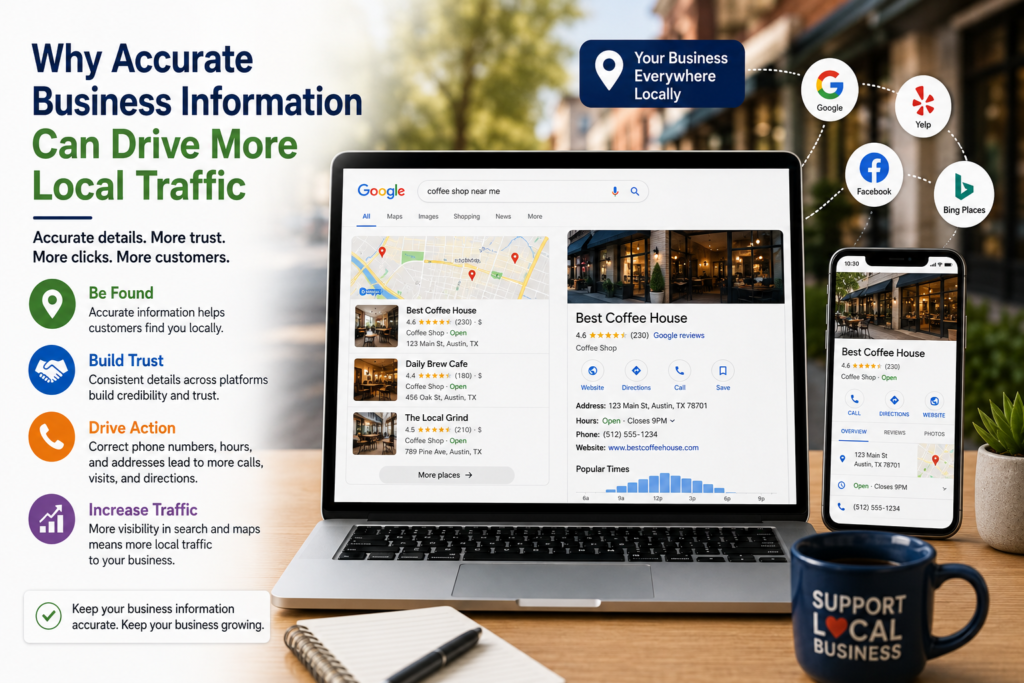
This is where business listing sites and local business citations become important. Your business name, address, phone number, website, hours, services, and other details appear across many online platforms. When those details are accurate and consistent, customers can find your business more easily, understand what you offer, and feel more comfortable contacting or visiting you.
The opportunity is substantial. BrightLocal’s 2026 consumer research found that 84% of U.S. consumers had searched for a local business online during the previous three months. It also found that 73% of consumers began their most recent local business search on a mobile device.
That means local businesses need to think beyond simply having a website. Your business information needs to be correct wherever potential customers might discover you.
A missing phone number, outdated address, incorrect opening hours, or inconsistent business name may look like a minor issue. To a customer who is ready to visit or call, however, it can create enough uncertainty to choose another business.
Accurate information helps remove that uncertainty.
What Does “Accurate Business Information” Actually Mean?
Accurate business information means that the essential details customers see online are correct, complete, current, and consistent.
This can include:
- Official business name
- Physical address
- Service area
- Phone number
- Website URL
- Opening and closing hours
- Holiday hours
- Business categories
- Products and services
- Appointment or booking information
- Business description
- Photos
- Directions
- Social media profiles
For a local business, these details are more than basic contact information. They help customers decide whether your business is relevant and accessible.
Google itself recommends that businesses keep their Business Profile information complete and accurate. Google states that businesses with complete and accurate information are more likely to appear in relevant local search results.
This does not mean accurate information guarantees a top ranking. Local search visibility depends on multiple factors, including relevance, distance, prominence, and other signals. But accurate information gives customers and search platforms a reliable foundation to work with.
Why Local Traffic Starts With Trust
Local traffic is not just about people physically walking past your storefront.
Today, a customer might discover a business online, compare it with competitors, check the address, read reviews, look at photos, and then decide whether to visit.
That entire journey can happen in minutes.
BrightLocal’s 2026 research found that 72% of consumers look at three or fewer businesses before making a local purchasing decision. Only 6% said they simply click the top result without considering other factors.
This is important for small businesses.
You do not necessarily need to convince every person searching online. You need to make your business look like a trustworthy choice when customers are comparing a small number of options.
Accurate information contributes to that impression.
If one business has complete hours, a clear address, recent photos, helpful reviews, and an easy-to-find phone number, while another has missing information and an outdated listing, customers may naturally feel more confident about the first business.
Local visibility gets a customer to your listing. Accurate information helps give them a reason to continue.
Accurate Listings Help Customers Find You
The first and most obvious benefit of accurate business information is discoverability.
Imagine someone searches for “Italian restaurant near me.”
Search engines and mapping platforms need to understand which businesses are actually relevant to that search. They consider factors such as location, category, relevance, and prominence.
If your business profile clearly identifies you as an Italian restaurant, provides the correct address, includes accurate hours, and has complete information, customers have a much easier time understanding what you offer and where you are located.
Google explains that local results appear when people search for businesses or places near their location and that relevance, distance, and prominence are key factors in local results.
Accuracy therefore supports both the customer experience and the broader local search foundation.
Your Google Business Profile Is a Critical Starting Point
For many U.S. small businesses, Google Business Profile should be one of the first places to verify and maintain.
Google allows businesses to manage how they appear on Search and Maps, including information such as their phone number, website, location, hours, photos, services, and reviews.
A complete profile can make it easier for potential customers to answer basic questions before they contact you.
For example:
Are you open?
Where are you located?
Can I call you?
Do you offer the service I need?
Can I get directions?
What do other customers think?
A customer who can answer those questions quickly has fewer reasons to leave your listing and look elsewhere.
Review your profile regularly rather than treating it as a one-time setup task.
Business Citations Extend Your Local Presence
Your Google Business Profile is important, but it is not the only place customers may find you.
Local business citations can appear on:
- Business directories
- Review platforms
- Industry websites
- Local chamber websites
- Mapping services
- Social media platforms
- Community websites
- Local publications
- Professional associations
These mentions can expand your digital footprint and give customers additional ways to discover your company.
Businesses can research relevant business listing sites and local business citations when developing a local visibility strategy.
However, the goal should not be to create hundreds of random listings.
Quality and relevance are more useful than quantity.
A local healthcare practice, for example, may benefit from healthcare directories, professional organizations, local community resources, and major search platforms. A restaurant may need a different collection of platforms. A contractor may benefit from industry-specific directories and local organizations.
Choose platforms that make sense for your customers.
Inconsistent Information Can Send Customers Elsewhere
Now consider the opposite situation.
A customer finds your business online, but the information does not match.
Google says you close at 8 p.m.
Another website says you close at 9 p.m.
Your website has one phone number.
A directory has an older number.
Your Google listing shows one address.
A social media profile shows an old location.
What happens?
The customer has to decide which information is correct.
That creates friction.
And when customers are already comparing several businesses, friction can be enough to lose the opportunity.
They may simply choose the competitor whose information is clearer.
This is especially important for businesses that depend on immediate local traffic. Restaurants, retail stores, medical practices, salons, automotive services, home-service companies, and many other businesses often need customers to take action soon after searching.
Accurate Hours Can Increase Real-World Visits
Opening hours may seem like a basic detail, but they have a direct relationship with local traffic.
A customer searching for “coffee shop open now” is not interested in a business that appears to be closed.
Likewise, someone searching for an urgent service may immediately contact another provider if your listing suggests that you are unavailable.
Accurate hours help customers make decisions with confidence.
Remember to update:
- Regular hours
- Weekend hours
- Holiday hours
- Seasonal schedules
- Temporary closures
- Special event hours
This is particularly important around major U.S. holidays.
A customer who arrives at a closed business because of outdated online information is unlikely to think, “The listing must be wrong.”
They may simply think the business is unreliable.
Your Address Can Influence Local Traffic
For businesses with physical locations, the address is one of the most important pieces of information you publish.
BrightLocal’s 2026 research found that 44% of consumers consider the address or how close a business is when researching a local business. Complete listing information was also important to 34% of consumers.
That makes sense.
If someone needs a nearby dentist, restaurant, grocery store, or auto repair shop, location matters.
A complete address helps customers understand where you are.
Google also recommends using a complete, accurate address for businesses that serve customers at their location. Service-area businesses that do not receive customers at their address can instead configure their service area appropriately.
Do not use an address simply because you think it will help you rank in a particular city.
Use your legitimate business location and follow platform guidelines.
Accuracy is more sustainable than shortcuts.
Mobile Search Makes Accuracy Even More Important
Local search is increasingly happening on smartphones.
BrightLocal’s 2026 research found that 73% of respondents started their most recent local business search on a mobile phone.
Mobile users often have a specific action in mind.
They may want to:
- Call
- Get directions
- Check hours
- Visit a website
- Book an appointment
- Read reviews
- Compare prices
- Visit a store
This means your business information needs to be easy to access on a small screen.
Your phone number should be clickable.
Your website should load properly.
Your address should be easy to find.
Your hours should be clear.
Your location should make sense on a map.
The fewer steps a customer has to take, the better.
Accurate Information Supports Customer Confidence
Customers may not consciously think about business information accuracy, but they notice when something feels inconsistent.
Consider two businesses.
Business A has:
- Accurate hours
- Current photos
- Complete address
- Recent reviews
- Clear services
- Working website
- Correct phone number
Business B has:
- Missing hours
- Old photos
- Incomplete address
- Few recent updates
- Broken website link
- Different phone numbers across platforms
Even if both businesses provide excellent services, Business A may appear more trustworthy during the initial research stage.
BrightLocal found that clear and complete information—including hours, address, and phone—was the single most important factor influencing consumers’ decisions in its 2026 local search research, with 32% ranking it among their top three reasons for choosing a business.
That is a powerful reminder that basic information can influence serious purchasing decisions.
Reviews Work Better When Business Details Are Clear
Reviews are one of the strongest forms of local social proof, but they work alongside other information.
BrightLocal’s 2026 research found that 38% of consumers consider star ratings and 37% consider the number of reviews when researching local businesses.
Now imagine a potential customer sees dozens of positive reviews but cannot find a reliable phone number or current opening hours.
The reviews may create interest, but inaccurate information can still prevent action.
That is why local marketing should be viewed as a complete customer journey.
Visibility → Information → Trust → Action
Each stage matters.
Keep Your Website and Listings Aligned
Your website should act as the primary source of truth for customers, but it should not contradict your external profiles.
Compare the following details regularly:
- Business name
- Address
- Phone number
- Hours
- Services
- Service areas
- Booking links
- Contact forms
- Location pages
- Business descriptions
If you change your phone number, update the website and important listings.
If you move locations, update your address everywhere.
If you change operating hours, update your profiles.
If you stop offering a service, remove or update outdated descriptions.
Small updates can prevent large customer frustrations.
Local Content Can Turn Search Visibility Into Traffic
Accurate business information helps people find you, but useful content can give them another reason to visit your website.
For example, a roofing company in Dallas might publish:
“How to Prepare Your Roof for Severe Texas Weather.”
A dental office in Chicago could create:
“What to Know Before Your First Family Dental Visit.”
A landscaping company in Phoenix might publish:
“A Seasonal Guide to Maintaining a Desert-Friendly Yard.”
This type of content combines expertise with local relevance.
It also supports Google’s broader expectation that helpful content should demonstrate experience and expertise rather than simply repeat keywords.
Use real examples where appropriate.
Explain genuine customer questions.
Share practical advice.
Reference local conditions when they genuinely affect the topic.
The result should be useful even if the reader never becomes a customer.
That is how you build credibility.
Use Location Pages Carefully
Businesses serving multiple U.S. cities can create location-specific pages, but these pages should provide genuine value.
Avoid producing dozens of nearly identical pages where only the city name changes.
Instead, make each page useful.
Include information such as:
- Areas served
- Local services
- Directions
- Location-specific testimonials
- Relevant project examples
- Local FAQs
- Contact details
- Service availability
For example, a home-services company serving Austin, Round Rock, and Cedar Park can explain what services it provides in each area rather than creating repetitive pages designed only to rank.
Local SEO works best when the content actually helps local customers.
Create a Business Information Master Sheet
One simple way to prevent mistakes is to maintain a master business information document.
Record your official:
- Business name
- Address
- Phone number
- Website
- Hours
- Holiday hours
- Categories
- Services
- Service areas
- Booking URL
- Social media profiles
- Business description
Whenever something changes, update this document first.
Then use it when updating your profiles.
This makes it much easier for employees, agencies, freelancers, and marketing teams to use the same information.
For businesses with multiple locations, maintain a separate record for each location.
Audit Your Most Important Listings
You do not have to check every website on the internet every week.
Start with the platforms that matter most.
A practical audit might include:
- Google Business Profile
- Major mapping platforms
- Major review websites
- Industry-specific directories
- Local business directories
- Social media profiles
- Chamber or professional organization pages
- Your own website
Check the basic information.
Is the phone number correct?
Is the address complete?
Are the hours current?
Does the website link work?
Are services accurate?
Are there duplicate listings?
Does the business name match the real-world name?
Fix the most important problems first.
Do Not Try to Manipulate Local Search
Local SEO works best when it reflects the real business.
Avoid practices such as:
- Adding unnecessary keywords to your business name
- Creating fake locations
- Using addresses where you do not legitimately operate
- Creating duplicate profiles
- Publishing misleading information
- Buying fake reviews
- Creating large numbers of irrelevant directory listings
These tactics may seem attractive because they promise quick visibility, but they can create long-term problems.
Google’s guidance emphasizes accurate business representation and complete, up-to-date information.
A trustworthy local presence should be based on reality.
Monitor What Customers Actually Experience
There is another important part of accuracy: checking what customers see.
Search your business name from time to time.
Look at your Google profile.
Check Maps.
Review your website on mobile.
Look at major directories.
Search for your business phone number.
Search for your address.
Try making a booking or contact request.
This simple exercise can reveal problems that may otherwise remain hidden.
For example, you might discover:
- A wrong holiday schedule
- A broken booking link
- An old address
- A duplicate profile
- An incorrect category
- An outdated description
- A phone number that no longer works
You cannot fix what you do not know about.
Track Local Traffic and Conversions
Accurate information is valuable, but businesses should measure whether their local marketing efforts are actually contributing to results.
Track metrics such as:
- Website visits from local search
- Phone calls
- Appointment requests
- Contact forms
- Direction requests
- Online bookings
- Store visits where measurable
- Local keyword visibility
- Review growth
- Conversion rates
Do not become obsessed with traffic alone.
A thousand visitors who never contact you may be less valuable than 100 highly relevant local visitors who become customers.
Focus on actions that support your business goals.
Accurate Information Matters as Search Evolves
Local search is changing.
Customers are using traditional search engines, maps, review platforms, social media, and increasingly AI tools.
BrightLocal’s 2026 research found that 75% of consumers used more than one channel during their most recent local business search. It also found that 23% used AI during that search, while many consumers still returned to Google or another channel to verify information before making a decision.
This makes accurate business information increasingly important.
The more places customers search, the more opportunities there are for outdated information to create confusion.
A consistent digital presence helps your business communicate the same basic facts across different discovery channels.
As local search becomes more fragmented, accuracy becomes a competitive advantage because customers need reliable information wherever they discover your business.
A Simple Accuracy Checklist for Small Businesses
Use this checklist as part of a monthly or quarterly local marketing routine:
- Check your Google Business Profile.
- Confirm your business name.
- Verify your address.
- Check your phone number.
- Confirm opening hours.
- Update holiday hours.
- Test website links.
- Review service information.
- Check major directories.
- Check map listings.
- Review social media information.
- Look for duplicate listings.
- Check important industry citations.
- Review customer feedback.
- Test your website on mobile.
- Search your business name manually.
For businesses with frequent changes, perform these checks more often.
Final Thoughts
Local traffic does not begin when someone walks through your door.
It often begins much earlier—with a search.
A customer types a question into Google, opens Maps, checks a business profile, reads reviews, visits a website, and decides whether your business is worth contacting or visiting.
At every stage, accurate information matters.
The address needs to be right.
The phone number needs to work.
The hours need to be current.
The services need to be clear.
The website needs to match.
Your listings need to tell the same basic story.
For small businesses across the United States, this is one of the most practical parts of local marketing because it is largely within your control. You cannot control exactly where Google ranks you or which competitor appears next to you. But you can control whether customers receive clear, accurate, useful information when they find you.
And that can make a meaningful difference.
BrightLocal’s latest research shows that consumers care about proximity, reviews, complete information, pricing, and other practical details when choosing local businesses.
So do not think of accurate business information as administrative maintenance.
Think of it as customer service.
Every accurate listing makes it easier for someone to find you. Every corrected phone number removes friction. Every updated opening hour prevents disappointment. Every complete profile gives customers more confidence.
In local marketing, those small improvements can add up to more visibility, more visits, more calls, and ultimately more opportunities to grow.
Frequently Asked Questions
1. Why is accurate business information important for local SEO?
Accurate information helps search engines and customers understand who your business is, what you offer, and where you operate. Google specifically recommends keeping Business Profile information complete and accurate, and says this can improve a business’s ability to appear in relevant local search results.
2. What information should a local business keep consistent?
At minimum, maintain the same legitimate business name, address, phone number, website, opening hours, categories, and core service information across important online platforms.
3. How do local citations help drive local traffic?
Local citations give customers additional places to discover your business and can reinforce your online presence. When information is accurate across relevant and reputable platforms, customers can more easily verify that they have found the correct business.
4. How often should I check my business listings?
A quarterly audit is a reasonable starting point for many small businesses. However, update your listings immediately whenever important information changes, such as your address, phone number, website, services, or operating hours.
5. Can inaccurate business information cause customers to choose competitors?
Yes. Inaccurate or conflicting information can create uncertainty about whether a business is open, where it is located, or how to contact it. When customers are comparing only a few businesses, that uncertainty can make another business appear to be the easier and more reliable choice.