

A reverse osmosis plant can have a high-quality membrane and still struggle with performance if the water entering the membrane is not properly managed. In many cases, the issue does not appear as a sudden breakdown. Instead, the plant slowly starts behaving differently.
The pressure increases.
The permeate flow drops.
Cleaning becomes more frequent.
Chemical consumption changes.
Eventually, the operator starts wondering whether the membrane has reached the end of its life.
Before replacing expensive components, it is worth looking at the chemistry of the system.
This is where RO Chemicals become an important part of the bigger picture. They are used to manage specific conditions that can affect membrane performance, but their success depends on correct selection, accurate dosing, suitable pretreatment, and regular monitoring.
Featured Snippet: What Are RO Chemicals Used For?
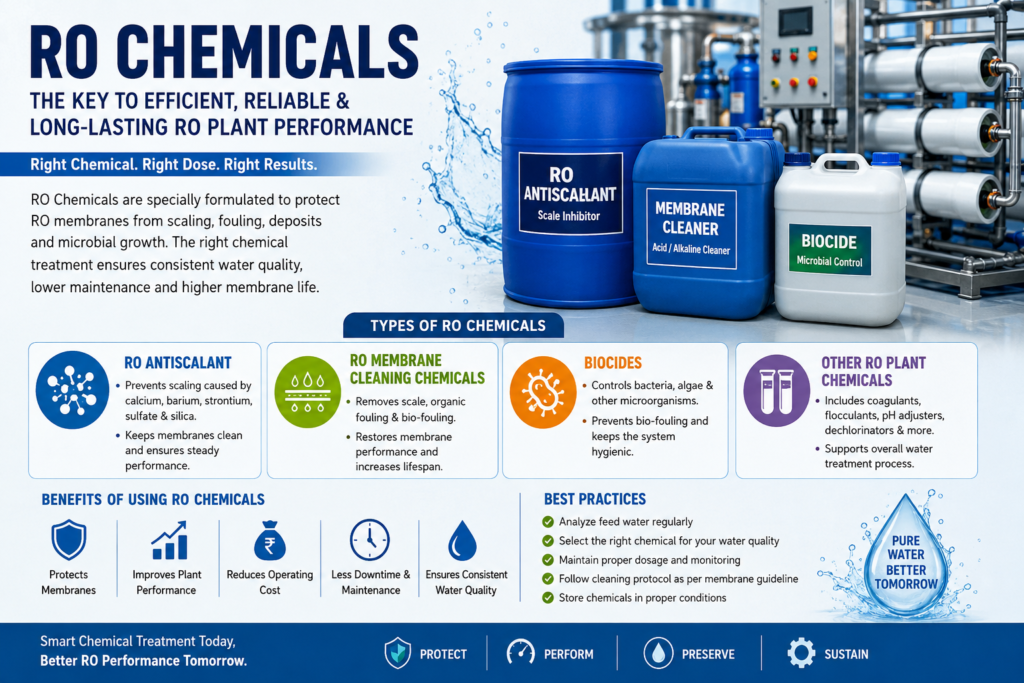
RO Chemicals are specialized water-treatment chemicals used in reverse osmosis plants to control scaling, fouling, deposits, and biological-related problems. Common products include antiscalants, membrane cleaning chemicals, biocides, and other treatment chemicals selected according to feed-water quality and RO system requirements.
An RO Plant Is More Than Just a Membrane
When people discuss RO systems, the membrane often receives most of the attention.
But an operating RO plant is actually a combination of several connected stages.
Water first goes through pretreatment. It is then pressurized and sent toward the RO membrane. The membrane separates permeate from concentrated reject water.
Every stage affects the next one.
If pretreatment is poor, the membrane receives a higher contaminant load.
If the operating recovery is changed, dissolved substances can become more concentrated.
If feed-water chemistry changes, scaling potential may change.
If chemical dosing is incorrect, the protection strategy may become less effective.
Therefore, membrane performance should always be viewed in the context of the complete system.
Why Feed-Water Analysis Comes First
Selecting an RO chemical without understanding the feed water is similar to trying to solve a mechanical problem without inspecting the machine.
Different water sources create different challenges.
Borewell water may contain high levels of hardness, silica, iron, or dissolved salts. Municipal water may have a different chemical profile. Industrial water can contain substances associated with a specific manufacturing process.
These differences influence chemical requirements.
A proper water analysis can help identify important characteristics and potential risks.
Once the water is understood, the chemical program can be developed around actual conditions rather than assumptions.
RO Antiscalant and the Problem of Concentrated Minerals
Scaling is one of the major concerns in RO operation.
The RO membrane rejects a significant portion of dissolved substances. As water continues through the system, these rejected substances become more concentrated.
Under suitable conditions, some minerals can precipitate and form deposits.
These deposits can accumulate on the membrane surface and affect water flow.
This is where RO Antiscalant is commonly used.
Antiscalants are formulated to help reduce the tendency of certain scale-forming substances to precipitate and deposit under suitable operating conditions.
However, the effectiveness of an antiscalant depends on the particular water chemistry and system conditions.
Factors such as pH, temperature, recovery, mineral concentration, membrane type, and operating configuration can all influence scaling potential.
Why the Same Antiscalant May Not Work Everywhere
Two RO plants can have identical capacities but different chemical requirements.
Consider two plants producing the same quantity of water.
One uses relatively low-hardness municipal water.
The other receives high-hardness groundwater with significant dissolved minerals.
The scaling conditions are different even though the plant capacity is the same.
This is why chemical selection should be based on the water and operating conditions rather than simply on RO capacity.
The right chemical program is application-specific.
What Happens When the Chemical Dose Is Incorrect?
Chemical dosage is another important part of RO operation.
If an antiscalant is under-dosed, the system may not receive the intended scale-control protection.
If it is significantly over-dosed, chemical consumption can rise without delivering proportional benefits.
The dosing system itself can also introduce errors.
Pump calibration, chemical concentration, feed-water flow, tank preparation, and injection conditions can all influence actual dosing.
Regular checks can help ensure that the intended dose and actual dose remain reasonably aligned.
Scaling Is Not the Only Problem
One of the most important points in RO maintenance is that not every membrane deposit is scale.
Membranes can also experience:
- Organic fouling
- Colloidal fouling
- Biological fouling
- Suspended-material deposition
- Other accumulated contaminants
These conditions can produce similar symptoms.
For example, a decline in permeate flow may be associated with scaling, fouling, pressure changes, temperature changes, or membrane aging.
Therefore, operators should avoid assuming that every performance problem can be solved by increasing antiscalant dosage.
First identify what is actually happening.
RO Membrane Cleaning Chemicals Have a Different Role
Preventive chemical treatment and membrane cleaning are two different activities.
Preventive treatment attempts to control conditions before severe deposits develop.
Cleaning is performed when accumulated deposits have already affected membrane performance.
This is where RO Membrane Cleaning Chemicals become relevant.
Different cleaning chemicals are designed for different types of deposits. An appropriate cleaning formulation may help remove mineral scale, organic material, biological deposits, or other fouling depending on the product and application.
However, chemical compatibility with the membrane is essential.
The membrane manufacturer’s cleaning recommendations should be followed regarding chemical type, concentration, temperature, cleaning duration, and other relevant conditions.
Why Frequent Cleaning Should Raise a Question
Cleaning an RO membrane is sometimes necessary.
But if a plant requires cleaning much more frequently than it used to, the cleaning itself should not be considered the complete solution.
For example:
A membrane previously required cleaning every six months.
Now it requires cleaning every two months.
That change is useful information.
It may point toward:
- A change in feed-water quality
- Pretreatment deterioration
- Increased recovery
- Incorrect chemical dosage
- A change in chemical formulation
- Biological growth
- Cartridge-filter problems
- Changes in operating conditions
The objective should be to identify the reason for the increased fouling rather than simply repeating the cleaning cycle.
Pretreatment Can Determine How Hard the RO Membrane Has to Work
A membrane cannot compensate for poor pretreatment indefinitely.
Depending on the feed-water source, pretreatment may include multimedia filters, activated carbon, softeners, cartridge filters, micron filtration, or other treatment processes.
These stages reduce the load placed on the membrane.
If a pretreatment filter becomes ineffective, more unwanted material can reach the RO system.
At that point, increasing chemical dosage may not solve the entire problem.
The pretreatment equipment needs to be examined as well.
This is why successful RO operation depends on the relationship between pretreatment and chemical treatment.
When Feed-Water Conditions Change
Another overlooked factor is water-source variation.
A plant may operate with one feed-water profile for months and then experience a change because of seasonal conditions, groundwater variation, changes in an industrial process, or a different water source.
This can change the scaling and fouling potential.
If the plant’s chemical program was designed around the old water conditions, its performance may change.
Periodic water analysis can therefore be useful, particularly when operating behavior changes unexpectedly.
RO Chemicals and Total Operating Cost
The purchase price of a chemical is only one part of its cost.
Consider two products.
Product A has a lower price per unit but requires a relatively high dose.
Product B has a higher purchase price but performs effectively at a lower optimized dose.
Simply comparing the price of the containers could make Product A appear cheaper.
But the actual monthly consumption could tell a different story.
For RO plants, chemical economics should ideally consider:
Purchase price + dosage + monthly consumption + cleaning frequency + membrane maintenance + potential downtime.
This broader calculation is particularly relevant for industrial water-treatment plants.
Why Industrial RO Plants Need Closer Monitoring
An industrial RO plant may operate continuously and process a large volume of water.
That means a small decline in performance can have a noticeable financial effect.
For example, increasing pressure may affect energy consumption. More frequent cleaning can increase maintenance time. Premature membrane replacement can increase capital and operating expenses.
This makes chemical management more important as system size increases.
Industrial plants can benefit from monitoring:
- Feed-water chemistry
- Permeate flow
- Feed pressure
- Differential pressure
- Conductivity
- Recovery
- Salt rejection
- Chemical consumption
- Cleaning frequency
Together, these measurements provide a better picture of system health.
Don’t Ignore Changes in Chemical Consumption
Chemical consumption can act as an operational indicator.
Suppose the plant’s water production has remained relatively stable but chemical consumption suddenly increases.
Possible causes could include:
- Dosing-pump calibration problems
- Change in chemical concentration
- Incorrect chemical preparation
- Increased feed-water flow
- Leakage
- Changes in feed-water chemistry
- Incorrect dosing settings
A sudden change should therefore be investigated rather than simply accepted as normal.
The Difference Between a Chemical Problem and a System Problem
Not every problem involving RO Chemicals is actually caused by the chemical.
For example, if an operator notices scaling, the cause could involve:
- Incorrect antiscalant selection
- Incorrect dosage
- High recovery
- Increased hardness
- Changed pH
- Poor pretreatment
- Operating conditions
Similarly, if organic fouling appears, the cause may involve feed-water quality or pretreatment rather than the cleaning chemical.
This distinction is important because replacing the chemical without identifying the actual cause may simply repeat the same problem.
Choosing RO Plant Chemicals More Intelligently
A practical chemical-selection process should begin with the application.
Ask:
What is the feed-water source?
What does the water analysis show?
What type of membrane is installed?
What is the recovery rate?
What type of deposit or fouling is occurring?
How often is membrane cleaning required?
What does the operating data show?
These questions provide a much better starting point than selecting a chemical solely because it is commonly used.
What Should Buyers Look for in an RO Chemical?
For dealers, distributors, technicians, and plant owners, several factors can be considered before purchasing.
Application Suitability
The chemical should be intended for the type of RO or water-treatment application.
Dosage Requirements
The recommended dosage should be considered alongside actual plant conditions.
Membrane Compatibility
This is particularly important for cleaning chemicals.
Technical Information
Product specifications, application guidelines, storage information, and safety documentation can help users manage the product properly.
Supply Consistency
Industrial users may require a stable supply because unexpected chemical shortages can disrupt treatment operations.
Technical Support
For complex applications, access to knowledgeable technical support can be valuable.
Common Mistakes in RO Chemical Management
Using a Fixed Dose Forever
Water quality and operating conditions can change. A chemical program should be reviewed when important system conditions change.
Treating Every Deposit as Scale
Fouling can have several causes. Correct identification matters.
Increasing Chemical Dosage Without Investigation
More chemical does not automatically solve a problem.
Ignoring Pretreatment
Poor filtration or softening can increase the contaminant load reaching the membrane.
Choosing Only by Price
The lowest purchase price does not necessarily mean the lowest total treatment cost.
Cleaning Without Finding the Cause
Repeated cleaning may temporarily restore performance while the original problem continues.
A Better Approach to RO Plant Maintenance
A reliable RO maintenance strategy combines several activities.
Start with water analysis.
Maintain pretreatment.
Select suitable RO Chemicals.
Keep dosing equipment calibrated.
Record operating parameters.
Monitor changes in membrane performance.
Clean the membrane when necessary.
Investigate recurring problems rather than repeatedly treating the symptoms.
This approach creates a much clearer understanding of what is happening inside the system.
Frequently Asked Questions About RO Chemicals
What are RO Chemicals?
RO Chemicals are specialized treatment products used in RO systems to manage scaling, fouling, biological growth, and other water-treatment challenges.
What is RO Antiscalant used for?
RO Antiscalant is used to help control the formation and deposition of certain mineral scales on RO membranes under appropriate water and operating conditions.
What are RO Membrane Cleaning Chemicals?
They are chemicals used during membrane-cleaning procedures to help remove specific deposits or fouling from RO membranes.
Can RO Chemicals increase membrane life?
Proper chemical treatment can help control certain scaling and fouling conditions, which may support better membrane performance. However, membrane life also depends on pretreatment, operation, cleaning, water quality, and maintenance.
How often should RO Chemicals be dosed?
There is no single dosage or schedule suitable for every plant. Dosing depends on feed-water chemistry, system design, flow, recovery, chemical formulation, and supplier or technical recommendations.
Can antiscalant solve all RO membrane problems?
No. Antiscalants are designed primarily for specific scaling risks. They do not replace pretreatment or address every type of organic, biological, or colloidal fouling.
Conclusion
The most important lesson about RO Chemicals is that they should never be viewed as a one-product-fits-all solution.
An RO plant responds to its feed water, operating conditions, pretreatment, membrane condition, and chemical program as one connected system.
RO Antiscalant can help manage certain mineral scaling risks. RO Membrane Cleaning Chemicals can support membrane maintenance when deposits have accumulated. Other RO Plant Chemicals may be required for specific treatment challenges.
But successful chemical management goes beyond simply buying and dosing a product.
It requires understanding the water, monitoring the plant, maintaining pretreatment, checking dosing accuracy, and investigating changes in performance.
When these factors are managed together, chemical treatment becomes a practical part of RO plant management rather than just another recurring expense. The result is a more informed maintenance strategy, better control over chemical consumption, and a stronger foundation for consistent RO system performance.