

A reverse osmosis system can contain dozens of components, but not all of them receive the same attention. The membrane usually gets the spotlight because it performs the separation process. The pump gets attention because it creates pressure. Filters are regularly replaced because they protect the membrane.
Then there is the RO Membrane Housing—a component that often remains unnoticed until there is a leak, compatibility issue, or replacement problem.
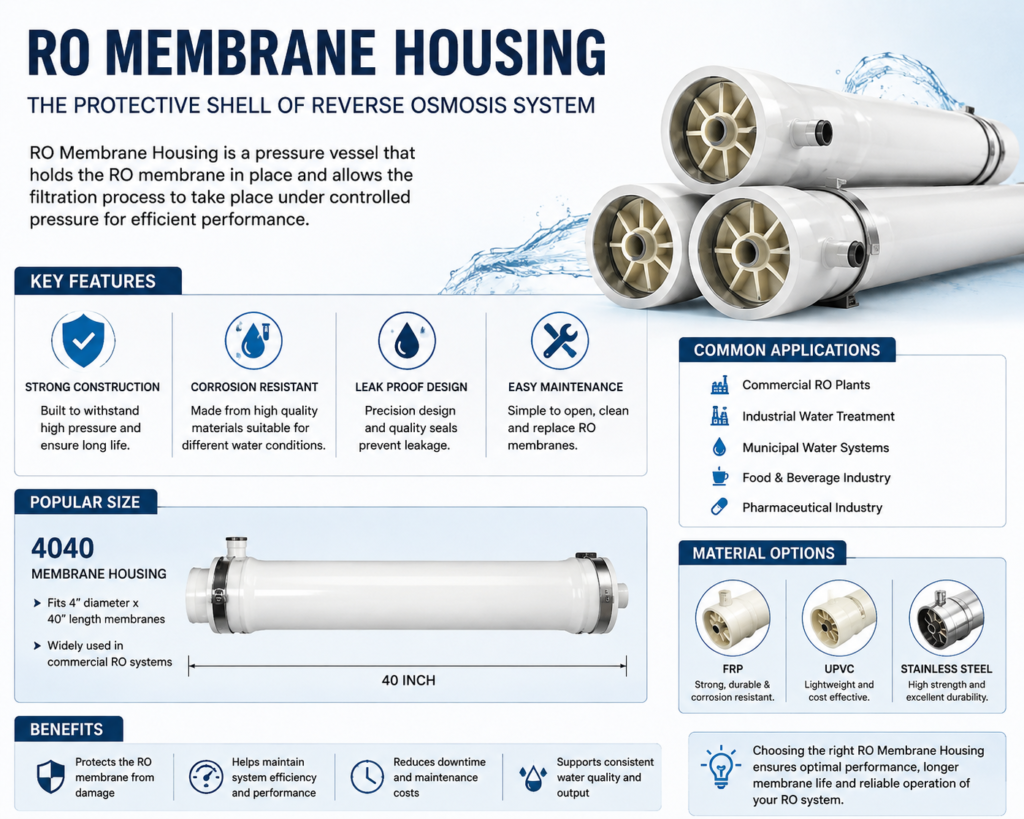
The housing is the pressure-containing chamber that holds the RO membrane and provides the pathway needed for feed water to move through the membrane assembly. Its dimensions, material, connections, seals, and pressure capability all need to match the application.
For RO dealers, technicians, distributors, commercial plant operators, and businesses sourcing RO components, understanding these factors can make membrane replacement and system maintenance considerably more straightforward.
What Is the Actual Job of an RO Membrane Housing?
The simplest explanation is that an RO Membrane Housing holds the membrane.
But that description does not explain its full purpose.
During reverse osmosis, feed water enters the housing under pressure. The water travels through the membrane element, where separation takes place. A portion passes through the membrane as permeate, while the remaining water carries rejected dissolved substances toward the concentrate or reject outlet.
The housing keeps this entire membrane assembly enclosed.
It also helps maintain the physical arrangement required for water to travel through the membrane correctly.
Therefore, the housing has several practical functions:
- Holds the membrane securely
- Creates a sealed pressure environment
- Supports the intended water-flow pathway
- Protects the membrane from external physical damage
- Provides connection points for the RO plumbing
- Allows the membrane to be removed and replaced
This makes the housing an active part of the RO assembly rather than simply an outer cover.
Why Housing Compatibility Is the First Thing to Check
A common mistake when purchasing RO components is assuming that similar-looking products are interchangeable.
They are not necessarily interchangeable.
A membrane housing must correspond to the membrane it is designed to accommodate. Dimensions, internal configuration, seals, end connections, and other specifications can differ between products.
Before purchasing a replacement housing, identify the membrane first.
Important information can include:
- Membrane diameter
- Membrane length
- Membrane model
- Membrane configuration
- Operating pressure
- Connection arrangement
- Application type
Once these specifications are known, the housing can be selected more accurately.
This is particularly important when replacing an existing component because the new housing needs to work with the system that is already installed.
Why the 4040 Format Is Important in Commercial RO
One of the most recognized membrane formats in commercial water treatment is 4040.
An RO Membrane Housing 4040 is generally designed for the widely used 4-inch by 40-inch membrane format.
4040 membranes are common in commercial and light-industrial RO systems because they offer a practical balance between membrane surface area and system size.
However, buyers should not assume that every 4040 housing is identical.
The 4040 designation identifies the general membrane format, but additional specifications still matter.
Before purchasing, verify:
- Exact membrane compatibility
- Pressure rating
- Port configuration
- Connection dimensions
- Housing material
- Number of membrane elements
- Installation requirements
This approach prevents the common mistake of treating “4040” as a complete specification.
A Housing Can Be the Right Size and Still Be the Wrong Product
This is an important point for RO component buyers.
Suppose a commercial RO system uses a 4040 membrane.
A buyer finds a housing labeled 4040 and assumes it will work.
But the housing may have a different port configuration from the existing plumbing.
It may also have different material specifications or pressure capabilities.
The result can be an unexpected installation problem.
The lesson is simple:
Membrane size is necessary information, but it is not always sufficient information.
The complete system needs to be considered.
Pressure Is Part of Housing Selection
Reverse osmosis depends on pressure.
The system pushes feed water toward the membrane, allowing water to pass through while many dissolved substances are rejected.
Because the membrane housing contains this pressurized water, its pressure capability is an important specification.
A housing should be selected according to the operating conditions of the RO system.
This is especially relevant to commercial and industrial equipment, where operating conditions may differ significantly from those of domestic purifiers.
Before installation, the applicable housing and system specifications should be checked.
The objective is not simply to find a housing that physically accommodates the membrane.
It needs to be suitable for the pressure conditions as well.
The Material Should Suit the Operating Environment
RO membrane housings can be manufactured from different materials depending on the application.
Plastic-based housings can be useful in certain compact systems.
FRP housings are commonly used in water-treatment applications and can offer a combination of strength and corrosion resistance.
Stainless steel options can provide robust construction where the application requires suitable metal construction.
There is no universal answer to the question, “Which material is best?”
The correct choice depends on:
- Water conditions
- Pressure
- Installation environment
- Required durability
- System design
- Maintenance requirements
For this reason, material should be selected based on technical requirements rather than appearance.
Seals Are Small Components With a Big Responsibility
A membrane housing can have a strong body and still leak if its sealing components are not in good condition.
O-rings and other seals help create a secure connection between housing components.
During membrane replacement or maintenance, technicians should inspect these parts carefully.
A seal can develop problems because of:
- Wear
- Incorrect positioning
- Physical damage
- Contamination
- Improper installation
- Repeated removal and reinstallation
If leakage occurs after servicing, the seal should be one of the first areas checked.
However, if replacing the seal does not solve the issue, the housing itself should be inspected.
A damaged thread or sealing surface can continue to cause leakage even with a new O-ring.
Why Repeated Tightening Is Not Always the Answer
When an RO housing leaks, tightening the connection may appear to be the easiest solution.
Sometimes this works.
But repeated tightening without finding the actual cause can create additional problems.
If the seal is damaged, tightening may not restore the seal.
If the thread is damaged, excessive force may make the problem worse.
If the sealing surface is scratched or deformed, tightening alone cannot correct it.
A better troubleshooting approach is to identify the source of the leakage before applying more force.
This is particularly important for technicians servicing commercial RO systems.
RO Membrane Housing for Commercial RO Applications
Commercial water treatment places greater demands on equipment.
A commercial RO system may operate for many hours and supply treated water to businesses or facilities that depend on continuous availability.
Examples include:
- Hotels
- Restaurants
- Hospitals
- Offices
- Manufacturing facilities
- Educational institutions
- Water-treatment businesses
For these applications, the RO Membrane Housing for Commercial RO should be considered as part of the plant’s reliability strategy.
A suitable housing should match the membrane, pressure, connections, material requirements, and installation conditions.
Product availability is also important.
If a replacement component is difficult to source, a relatively simple maintenance problem can become a longer operational interruption.
Why RO Membrane Housing Price Needs Context
Price is an important purchasing factor, but RO Membrane Housing Price should not be considered in isolation.
A product that costs less initially may not necessarily provide the best value.
Imagine a low-priced housing that causes repeated sealing problems.
The cost may then include:
- Replacement seals
- Technician labor
- Additional service visits
- Installation time
- Water loss
- Potential downtime
A slightly more expensive product that is properly matched to the application may prove more economical over its service life.
For commercial buyers, the purchasing decision should therefore consider total value.
What Should Buyers Compare?
A simple comparison table can make the purchasing process easier.
| Factor | What to Verify |
|---|---|
| Membrane size | Does the housing match the membrane? |
| Pressure | Is the pressure capability suitable? |
| Material | Is it appropriate for the application? |
| Connections | Do the ports match the system? |
| Seals | Are replacement seals available? |
| Construction | Is the housing suitable for expected use? |
| Supplier | Can future requirements be supported? |
| Price | Does the cost provide good overall value? |
This approach is particularly useful for distributors and businesses purchasing multiple units.
How Technicians Can Reduce Installation Problems
Installation problems are often preventable.
Before beginning work, the RO system should be depressurized.
The old housing should be inspected before removal where practical.
The replacement should be compared with the original component.
The membrane should be checked for correct dimensions and configuration.
Seals should be inspected before installation.
Connections should be assembled correctly.
After installation, the system should be pressurized gradually and inspected for leakage.
These steps can reduce unnecessary service problems and make the replacement process more predictable.
The Housing Should Be Inspected During Membrane Replacement
One of the best opportunities to inspect membrane housing is when the membrane is already being removed.
Instead of installing the new membrane immediately, technicians can inspect the housing assembly.
Check for:
- Cracks
- Damaged threads
- Worn seals
- Scratched sealing surfaces
- Damaged ports
- Corrosion where applicable
- Physical deformation
- Evidence of repeated leakage
If the housing is in good condition and suitable for the replacement membrane, it may continue to be used.
If there is structural damage or compatibility uncertainty, further evaluation may be necessary.
How Housing Problems Can Be Confused With Membrane Problems
An RO system that produces less water than expected does not automatically have a membrane problem.
Possible causes can include:
- Low operating pressure
- Membrane fouling
- Scaling
- Feed-water temperature
- Poor pre-treatment
- Pump performance
- Flow restrictions
- Incorrect system settings
Housing-related issues may also need to be considered if there are sealing, flow, or compatibility concerns.
This is why systematic troubleshooting is more effective than immediately replacing the membrane.
A good technician looks at the entire system.
Why RO Dealers Should Ask Better Questions
Customers often approach RO dealers with incomplete requirements.
They may say:
“I need a membrane housing.”
A dealer can improve product selection by asking for additional information.
For example:
What membrane size are you using?
Is the system domestic or commercial?
What is the existing connection configuration?
What material is required?
What operating pressure does the system use?
How many housings are required?
These questions help transform a general product request into a technical specification.
That can reduce incorrect quotations and unnecessary product returns.
Inventory Planning for RO Businesses
RO dealers and service providers can encounter urgent replacement requirements.
If a commercial customer has a membrane housing problem, waiting several days for a component may not be practical.
Businesses that regularly service RO systems can therefore identify their most commonly used membrane formats and maintain appropriate inventory.
For example, if a service company frequently works with commercial 4040 membranes, keeping suitable 4040 housing options accessible may improve response time.
Inventory should still be based on actual demand.
The objective is not to stock everything.
It is to maintain the components most likely to be required.
Why Supplier Reliability Matters
A membrane housing is not necessarily a one-time purchasing decision.
RO businesses may require the same product repeatedly.
Consistency can therefore become important.
A reliable supplier can help with:
- Product availability
- Repeat orders
- Specification confirmation
- Bulk requirements
- Replacement components
- Technical information
For distributors and commercial buyers, supplier reliability can be almost as important as the initial product price.
A Better Way to Think About Housing Quality
Instead of asking whether a housing is simply “high quality,” ask whether it is suitable for the intended application.
For example:
A housing can be excellent for a domestic system but inappropriate for a demanding commercial installation.
Another housing may have premium construction but unnecessary specifications for a small application.
Quality is therefore connected to suitability.
The best housing is one that provides the required performance without introducing unnecessary complexity or cost.
The Complete RO Assembly Matters More Than Any Single Part
An RO system is a chain of components.
Pre-treatment affects membrane protection.
The pump affects pressure.
The membrane performs separation.
The housing contains and supports the membrane.
Valves and fittings control water movement.
Instrumentation provides operating information.
Maintenance keeps the system functioning.
The housing cannot compensate for poor pre-treatment or a damaged membrane.
Likewise, a high-quality membrane cannot completely overcome an unsuitable housing.
The best results come from matching all components to the system.
Final Thoughts
The RO Membrane Housing is a relatively simple-looking component with an important role in reverse osmosis.
It holds the membrane, contains pressurized water, supports the intended flow path, provides connection points, and allows membrane servicing.
Selecting the right housing requires more than matching a product name.
For RO Membrane Housing 4040, buyers should confirm the membrane format as well as pressure, connections, material, and complete compatibility.
For RO Membrane Housing for Commercial RO, the selection should account for longer operating periods, system capacity, installation conditions, and the importance of component availability.
And when comparing RO Membrane Housing Price, buyers should consider total value—including reliability, maintenance, installation, and potential downtime—instead of focusing exclusively on the initial price.
The most effective approach is specification-first purchasing.
Identify the membrane.
Confirm the application.
Check pressure.
Verify connections.
Select suitable material.
Inspect the seals.
Compare suppliers.
Then compare price.
That process turns membrane housing selection from a guess-based purchase into a practical component decision—and helps create a more dependable foundation for the RO system as a whole.