
Concrete has a reputation for being permanent, which is why so many homeowners are surprised when a new slab develops cracks within a few years. The cause is rarely the concrete itself. It is usually the base beneath it, the placement of joints, the way water leaves the surface, or the care taken during curing. Planning a concrete driveway in New York means accounting for tight lots, shared property lines, and winters that cycle between freezing and thawing. This guide explains how a concrete driveway is built, why cracking happens and how to reduce it, what to consider for drainage and winter conditions, how to maintain the surface, and what to ask a contractor before you sign.
Why Choose Concrete for a Driveway?
Concrete is rigid, which gives it a clean, finished appearance and good performance under heavy, stationary loads like parked vehicles. It can be finished in several ways, including broom, stamped, or exposed aggregate textures, and it generally needs less routine surface treatment than asphalt.
The trade-offs are worth knowing up front:
- Less forgiving of poor preparation. A weak base or poorly planned joints show up as cracks.
- Repairs can be visible. Patches rarely match the original surface perfectly.
- Curing takes time. The driveway cannot be used right away, and the schedule depends on conditions.
- Cost and disruption. Replacement involves demolition, forms, and a waiting period before vehicles return.
For many properties, concrete is a strong fit. For others, asphalt or pavers make more sense. Where a site calls for more than one surface, such as a concrete apron with an asphalt drive, a contractor working across materials can help sort that out. Kings Pavers & Concrete, a Queens-based contractor offering concrete driveways, asphalt, pavers, and drainage work across the five boroughs, is one example of a firm whose range covers those combinations.
The Construction Sequence
Understanding the order of work helps you evaluate a proposal and notice shortcuts.
Demolition and Excavation
An old driveway is broken up and removed, and the ground is excavated to the depth needed for the base and slab. This stage often reveals problems such as soft soil, buried debris, or old drainage issues, so ask how unexpected conditions will be handled and priced.
Subbase Preparation
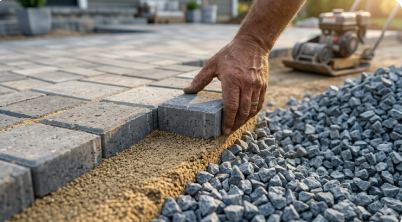
A compacted aggregate subbase supports the slab evenly and helps water move away from it. Uneven support is a leading cause of cracking, because concrete is strong in compression but vulnerable when parts of the slab sit on firmer ground than others.
Forms, Grading, and Reinforcement
Forms define the edges and set the slope. Many driveways include reinforcement, such as steel rebar or wire mesh, to help control cracks and keep them tight. The right approach depends on the design and use, so ask what your contractor recommends and why.
Placing and Finishing
Concrete is placed, leveled, and finished. The surface texture is chosen here. A broom finish, for instance, adds traction, which matters on a surface that will see rain, ice, and snow.
Jointing and Curing
Joints are cut or tooled to create planned weak points so that shrinkage cracking occurs along straight lines rather than randomly. Curing is the process of keeping the concrete moist and at a suitable temperature as it gains strength. It is often the most neglected step, and concrete that dries too fast can develop a weak, flaky, or crack-prone surface.
Why Concrete Cracks, and What Helps
Some cracking is normal. Concrete shrinks as it cures, which is why joints are placed deliberately. The cracks to worry about are the ones that signal a bigger problem.
Common causes include:
- Inadequate or uneven base. Settlement under part of the slab.
- Poor joint spacing or timing. Joints placed too far apart or cut too late.
- Rapid drying. Poor curing in hot, windy, or dry conditions.
- Water trapped under the slab. Drainage problems that soften the base or freeze.
- Overloading. Heavy vehicles on a slab designed for light use.
Preventing problems comes down to the same fundamentals: a prepared base, sensible jointing, suitable reinforcement, and controlled curing. Hairline cracks along joints are generally cosmetic. Wide cracks, vertical displacement where one side sits higher than the other, or cracks that keep growing deserve a professional look.
Drainage and Freeze-Thaw Considerations
Water is the main threat to any exterior slab, and in New York it also freezes.
When water enters a crack or sits on the surface, freezing causes expansion that can widen openings and scale the surface over repeated winters. Poor drainage also lets water saturate the base, which can lead to heaving or settling.
A well-planned driveway includes:
- A slope that carries water away from the house, garage, and neighboring property
- Attention to where runoff ends up, including sidewalks and adjacent lots
- Connection to existing drains or downspouts where appropriate
- Drainage solutions such as channels or regrading when natural flow is inadequate
Ask your contractor to explain, in plain terms, where the water will go after the work is done. A confident answer should mention slope and discharge, not just the surface.
Winter Care and Maintenance
Concrete is low-maintenance but not no-maintenance. A few habits extend its life.
- Seal the surface if your contractor recommends it. Sealers can help limit moisture absorption, though the right product and reapplication schedule vary.
- Be careful with deicers. Some deicing products can contribute to surface scaling, especially on young concrete. Check guidance for your slab and avoid applying them during the first winter unless advised otherwise.
- Shovel promptly. Use plastic blades where possible to avoid scraping the surface.
- Fill cracks early. Sealing small cracks keeps water out before it freezes.
- Keep drainage clear. Clean gutters, downspouts, and surface channels so water does not pool on the slab.
A walk around the driveway each spring and fall, looking for new cracks, pooling, or edge breakdown, catches most issues while they are inexpensive to fix.
Timing and Curing Expectations
New concrete needs time before it can take traffic, and that timeline depends on mix, temperature, and moisture. A reliable contractor will explain when foot traffic and vehicles can return and what weather could change that schedule. Extreme heat, cold, or rain can compromise placement and curing, so a willingness to reschedule is a good sign rather than a nuisance.
Projects involving curb cuts, aprons, or sidewalks can also involve public property and additional approvals. Requirements vary and change, so confirm current obligations with the relevant city agencies and ask how the contractor handles permitting.
Questions to Ask Before You Hire
A focused list reveals how a contractor works:
- What does the written estimate cover, including demolition, base, reinforcement, finishing, and cleanup?
- How thick will the slab and base be, and why for this use?
- How will joints be laid out?
- What is the curing plan, and how does weather change it?
- How will drainage be handled?
- What licensing and insurance documentation can you provide? Verify it independently.
- What does the warranty cover, in writing, and for how long?
Be cautious of unusually low bids, pressure to decide quickly, or reluctance to put details on paper. Cheaper estimates often reflect thinner bases or skipped steps.
Final Takeaway
A concrete driveway in New York is only as good as the work beneath and around the slab. Base preparation, jointing, drainage, and curing matter more than finish, and they determine how the surface handles repeated freeze-thaw cycles. Ask contractors to explain their process, get specifics in writing, and plan simple seasonal care. Some cracking is normal, but a driveway built on sound fundamentals gives you the best chance of staying solid and attractive through many winters.