
Introduction
The global demand for clean and sustainable energy is increasing as industries, governments, and researchers work toward reducing carbon emissions and developing environmentally friendly technologies. Green hydrogen has emerged as a promising alternative energy source because it can be produced using renewable electricity and water without generating carbon dioxide during the production process. Among the advanced materials supporting this technology, platinum nanoparticles are attracting significant attention because of their exceptional catalytic properties, electrical conductivity, and chemical stability.
Platinum nanoparticles play an important role in improving the efficiency of electrochemical reactions involved in hydrogen production and fuel cell applications. Their nanoscale structure provides a large surface area, allowing more active catalytic sites to participate in chemical reactions. As research into renewable energy continues to advance, platinum nanoparticles are expected to contribute to the development of efficient, reliable, and sustainable green hydrogen technologies.
Understanding Platinum Nanoparticles
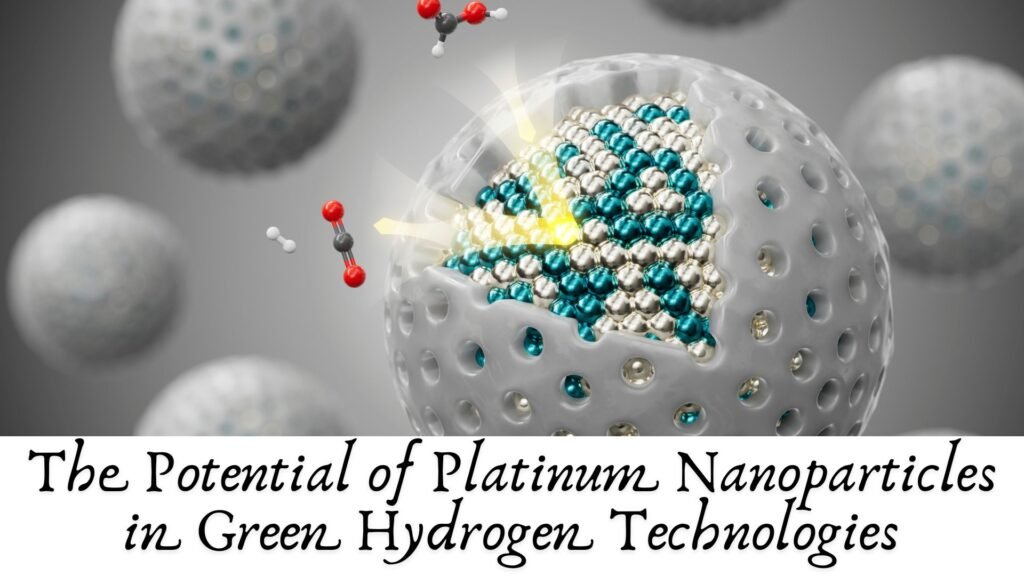
Platinum nanoparticles are extremely small particles of platinum, typically engineered at the nanoscale to provide distinctive physical, chemical, and catalytic properties. Compared with conventional platinum materials, nanoparticles offer a significantly higher surface-area-to-volume ratio, which can improve their performance in catalytic applications.
One of their most valuable characteristics is their ability to accelerate chemical reactions while remaining relatively stable under demanding operating conditions. These properties make platinum nanoparticles suitable for various energy-related applications, including water electrolysis, hydrogen fuel cells, and advanced electrocatalytic systems.
Researchers are exploring different particle sizes, shapes, surface structures, and support materials to improve catalytic activity while reducing the amount of platinum required in energy technologies.
Role of Platinum Nanoparticles in Green Hydrogen Production
Green hydrogen is commonly produced through water electrolysis, a process that uses electricity to separate water into hydrogen and oxygen. When the electricity comes from renewable sources such as solar or wind power, the resulting hydrogen can be produced with very low operational carbon emissions.
Electrochemical water splitting involves two important reactions: the hydrogen evolution reaction (HER) and the oxygen evolution reaction (OER). Platinum is particularly effective as a catalyst for the hydrogen evolution reaction, helping hydrogen ions or water molecules gain electrons and form hydrogen gas.
Platinum nanoparticles provide numerous accessible catalytic sites that can support this reaction. Their nanoscale dimensions allow researchers to improve the utilization of platinum and potentially achieve higher catalytic performance with smaller quantities of the precious metal.
In acidic electrolysis systems, platinum-based catalysts are especially valuable because of their strong hydrogen evolution activity. Researchers are also investigating platinum-based alloys, supported nanoparticles, and alternative catalyst structures to improve performance and reduce overall material costs.
Improving Hydrogen Fuel Cell Performance
Hydrogen fuel cells convert the chemical energy of hydrogen into electrical energy through electrochemical reactions. They are increasingly being investigated for applications in transportation, stationary power generation, and backup electricity systems.
Platinum nanoparticles are widely studied for their role in fuel cell catalysts, particularly at the electrodes. At the anode, platinum helps facilitate hydrogen oxidation, while platinum-based catalysts at the cathode can support the oxygen reduction reaction.
The high catalytic activity of platinum nanoparticles can improve reaction rates and support efficient energy conversion. Their small particle size also helps distribute catalytic material across suitable support structures, increasing the number of available reaction sites.
Advanced platinum nanoparticle catalysts may contribute to improved fuel cell efficiency, durability, and power output. These developments are important for expanding the practical use of hydrogen-powered vehicles and renewable energy storage systems.
Advantages of Platinum Nanoparticles in Green Energy Technologies
Platinum nanoparticles offer several important advantages for green hydrogen research and development.
High Catalytic Activity:
Platinum nanoparticles can accelerate hydrogen-related electrochemical reactions, helping improve the efficiency of hydrogen production and fuel cell operation.
Large Surface Area:
Their nanoscale structure provides a high surface-area-to-volume ratio, increasing the number of catalytic sites available for chemical reactions.
Chemical Stability:
Platinum demonstrates strong resistance to corrosion in many electrochemical environments, making it useful for demanding energy applications.
Improved Material Utilization:
Nanoparticle engineering can improve the exposure and utilization of platinum atoms, potentially reducing the quantity of precious metal needed for a particular catalytic performance.
Versatile Applications:
Platinum nanoparticles can be incorporated into different catalyst architectures, electrode materials, and electrochemical systems.
These characteristics make platinum nanoparticles an important material for researchers developing advanced hydrogen technologies.
Applications in Advanced Electrochemical Systems
Beyond conventional water electrolysis and fuel cells, platinum nanoparticles have potential applications in several emerging electrochemical technologies. Researchers are investigating their use in proton exchange membrane electrolysers, advanced hydrogen generation systems, and integrated renewable energy platforms.
In proton exchange membrane electrolysis, platinum-based catalysts are commonly used at the cathode to support hydrogen evolution. Their catalytic performance can help electrolysers operate efficiently, particularly in systems designed to respond to variable renewable electricity supplies.
Platinum nanoparticles are also being studied for integration into advanced electrode structures and conductive support materials. Combining platinum with carbon-based materials, metal oxides, or engineered nanostructures may improve catalyst distribution, electrical connectivity, and operational stability.
Such developments could support the design of more compact and efficient electrochemical devices for future clean energy infrastructure.
Challenges and Future Research Opportunities
Despite their advantages, platinum nanoparticles face several challenges that must be addressed before green hydrogen technologies can achieve wider commercial adoption.
The high cost and limited availability of platinum remain significant concerns. Large-scale deployment of electrolysers and fuel cells could require substantial quantities of platinum, making material efficiency and recycling important research priorities.
Another challenge involves nanoparticle degradation, agglomeration, and changes in catalyst structure during long-term operation. These processes can reduce the number of accessible catalytic sites and negatively affect performance.
To overcome these limitations, scientists are exploring platinum alloys, core-shell nanoparticles, optimized particle distributions, and advanced support materials. Researchers are also investigating catalyst recycling and improved manufacturing methods to reduce material waste.
Future developments in nanotechnology, materials science, and electrochemical engineering may enable more efficient platinum utilization and help lower the overall cost of hydrogen technologies.
Supporting a Sustainable Energy Future
The transition toward renewable energy requires advanced materials that can improve energy conversion, storage, and distribution. Platinum nanoparticles offer valuable catalytic properties that support the development of green hydrogen production systems and hydrogen fuel cells.
As solar and wind energy capacity expands, efficient electrolysers will become increasingly important for converting surplus renewable electricity into hydrogen. This hydrogen can potentially be stored and used in industrial processes, transportation, and electricity generation.
Continued research into platinum nanoparticle engineering may help improve catalyst efficiency, extend equipment lifetimes, and reduce precious-metal consumption. These improvements could strengthen the economic and technical potential of hydrogen as part of a cleaner global energy system.
Conclusion
Platinum nanoparticles represent an important class of advanced materials for the future of green hydrogen technologies. Their excellent catalytic activity, high surface area, and chemical stability make them particularly useful in hydrogen evolution reactions, water electrolysis, and fuel cell applications.
Although challenges related to cost, availability, and long-term catalyst durability remain, ongoing research into nanoparticle design, platinum alloys, and advanced support materials offers promising opportunities for improvement.
By supporting more efficient hydrogen production and energy conversion, platinum nanoparticles could contribute significantly to the development of sustainable energy technologies. Explore advanced platinum nanoparticle materials and research possibilities at ssnano.com, where nanomaterials support innovation across modern science, engineering, and clean energy development.