

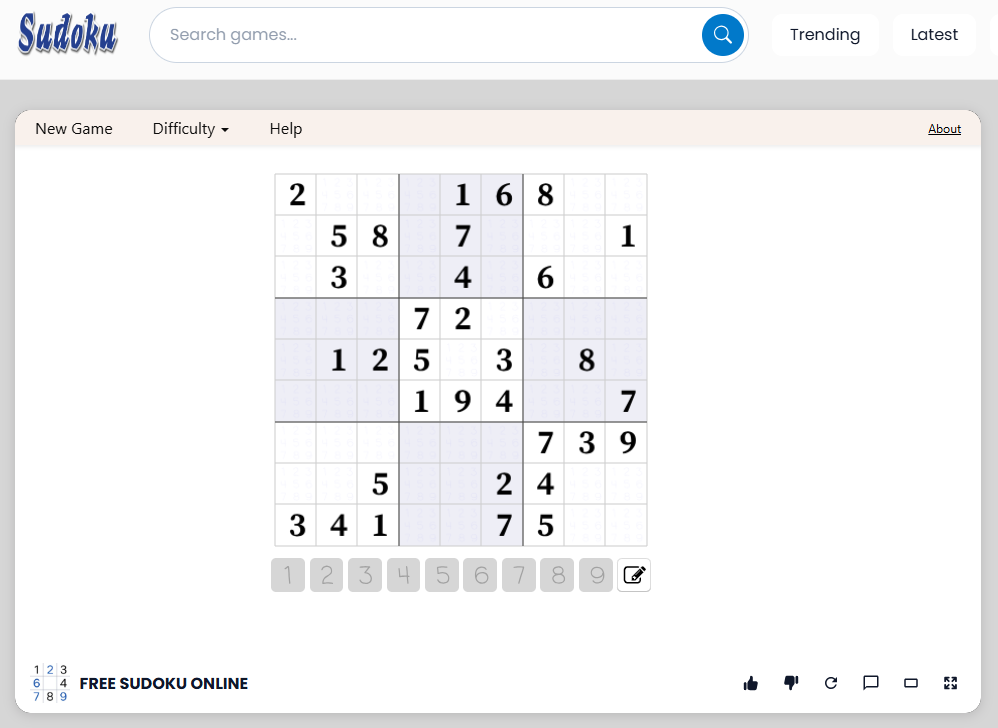

Sudoku is one of the most popular number puzzles in the world. The game looks simple at first because it uses only numbers from 1 to 9, but solving a difficult grid requires concentration, logical thinking, patience, and careful planning. Sudoku does not require advanced mathematics. Instead, the main challenge comes from understanding patterns, eliminating possibilities, and making logical decisions.
Today, Sudoku can be played in newspapers, puzzle books, mobile applications, and online platforms. Players can choose different difficulty levels, making the game suitable for beginners as well as experienced puzzle enthusiasts. Whether played for a few minutes during a break or for a longer relaxing session, Sudoku offers an engaging way to exercise the mind.
What Is Sudoku?
Sudoku is a logic-based number puzzle built around a 9×9 grid. The grid contains 81 cells divided into nine smaller 3×3 boxes. Some numbers are already placed in the grid, while the remaining cells must be completed by the player.
The main goal is to fill every empty cell with a number from 1 to 9. Each number can appear only once in every row, every column, and every 3×3 box. These simple rules create a surprisingly complex puzzle.
Basic Sudoku Rules
A completed Sudoku grid must follow three important rules. Every row must contain the numbers 1 through 9 without repetition. Every column must also contain the numbers 1 through 9 without repetition. Finally, every 3×3 box must contain the numbers 1 through 9 exactly once.
Because the rules are consistent, players can solve the puzzle through logical deduction. A correct solution does not depend on guessing randomly. Instead, each placement should be supported by information already available in the grid.
Why Sudoku Is Easy to Understand
Sudoku has very few rules, which makes the game accessible to almost anyone. A beginner can learn the basic concept within a few minutes. However, learning the rules is much easier than mastering advanced solving techniques.
Easy puzzles usually provide many starting numbers, allowing players to identify missing values quickly. Harder puzzles provide fewer obvious clues and require several layers of deduction. This gradual increase in difficulty gives Sudoku strong long-term appeal.
How to Solve a Sudoku Puzzle
Solving Sudoku effectively requires a systematic approach. Randomly entering numbers can quickly create mistakes and make the grid more difficult to understand. A logical method allows players to work through the puzzle with greater confidence.
Start With Easy Numbers
The best place to begin is often a row, column, or box that already contains many numbers. Look for missing values and compare them with the numbers already present in related rows and columns.
For example, if a 3×3 box is missing only one number, the solution can usually be identified immediately. These simple discoveries create progress and may reveal new opportunities in nearby areas.
Use Candidate Numbers
When a cell cannot be solved immediately, players can consider possible numbers called candidates. A candidate is a number that does not conflict with the existing values in the same row, column, or box.
Writing down possible candidates can make complex puzzles easier to analyze. As more cells are completed, some candidates become impossible and can be removed. Eventually, one candidate may remain as the only logical choice.
Look for Hidden Patterns
Experienced Sudoku players often search for patterns involving candidate numbers. A number may have only one possible position within a particular row, column, or box, even when several cells remain empty.
Another useful technique involves pairs or groups of candidates. When two cells in the same unit can contain exactly the same two numbers, those numbers can sometimes be eliminated from other cells in that unit. Learning these patterns can significantly improve solving speed.
Different Sudoku Difficulty Levels
Sudoku puzzles are commonly divided into several difficulty categories. The exact system may vary between puzzle platforms, but the general idea remains similar.
Easy Sudoku
Easy Sudoku puzzles are ideal for beginners. They usually contain enough starting clues to make many early placements obvious. These puzzles help new players understand rows, columns, boxes, and candidate elimination.
Easy grids can also be useful for experienced players who want a short and relaxing puzzle without a major time commitment.
Medium Sudoku
Medium Sudoku requires more attention and logical deduction. Players may need to use candidate notes and examine several related areas before finding the next correct number.
This level provides a good balance between accessibility and challenge. It is often suitable for players who already understand the basic solving process but want to improve their skills.
Hard Sudoku
Hard Sudoku puzzles can require advanced logical techniques and considerable concentration. Some grids contain very few obvious moves, meaning players must carefully analyze candidate relationships.
Hard puzzles are particularly rewarding because each successful deduction can unlock several additional moves. Completing a difficult grid can also help develop patience and systematic problem-solving habits.
Benefits of Playing Sudoku
Sudoku is more than a simple entertainment activity. Regular puzzle solving can encourage several useful mental habits.
Improved Concentration
A Sudoku grid requires continuous attention. Players must remember numbers, compare different sections, and avoid accidental repetition. This process encourages focused thinking and careful observation.
Stronger Logical Reasoning
Sudoku is based on deduction rather than calculation. Players constantly evaluate possibilities and eliminate incorrect options. This makes the game an enjoyable way to practice structured reasoning.
Better Problem-Solving Skills
Every difficult Sudoku puzzle presents a problem with incomplete information. Players must identify useful clues, determine possible solutions, and decide which step should come next. This process can strengthen a general problem-solving mindset.
Relaxation and Mental Exercise
Many people enjoy Sudoku because it provides a break from everyday distractions. Concentrating on a puzzle can create a calm and focused activity. At the same time, the brain remains actively engaged throughout the solving process.
Tips for Becoming Better at Sudoku
Improvement comes mainly through practice and learning from mistakes. Players should avoid rushing through difficult grids. A single incorrect placement can affect an entire row, column, and box.
It is useful to scan the complete grid regularly rather than focusing on only one section. Players should also check every new number against all three Sudoku restrictions. Using small candidate notes can help organize information when the puzzle becomes complicated.
Another important habit is patience. When no obvious move appears, taking a short pause can make hidden patterns easier to notice. With regular practice, many techniques that initially seem difficult become natural.
Why Sudoku Remains Popular
Sudoku has remained popular because the concept is simple while the challenge can be almost unlimited. Every puzzle presents a different arrangement of clues, creating a fresh problem for the player.
The game also works well across different formats. People can solve Sudoku on paper, on computers, or through mobile devices. Players can choose a quick puzzle or spend much longer working through an advanced grid.
Most importantly, Sudoku does not depend on language, complicated equipment, or specialized knowledge. The universal number system makes the puzzle easy to recognize and play almost anywhere.
Final Thoughts on Sudoku
Sudoku combines simple rules with deep logical challenges. The objective is easy to understand, but solving advanced puzzles can require patience, concentration, pattern recognition, and strategic thinking. From easy beginner grids to demanding expert challenges, Sudoku offers an enjoyable experience for a wide range of players.
For anyone looking for a stimulating puzzle that can be played almost anywhere, Sudoku is an excellent choice. With consistent practice and a logical approach, players can become faster, more accurate, and more confident while enjoying one of the most enduring number puzzles available today.