
Introduction
Live streaming applications have created new opportunities for startups, entrepreneurs, content creators, and digital entertainment businesses. From social broadcasting to influencer communities, users increasingly expect platforms that support real-time video interaction and engaging experiences.
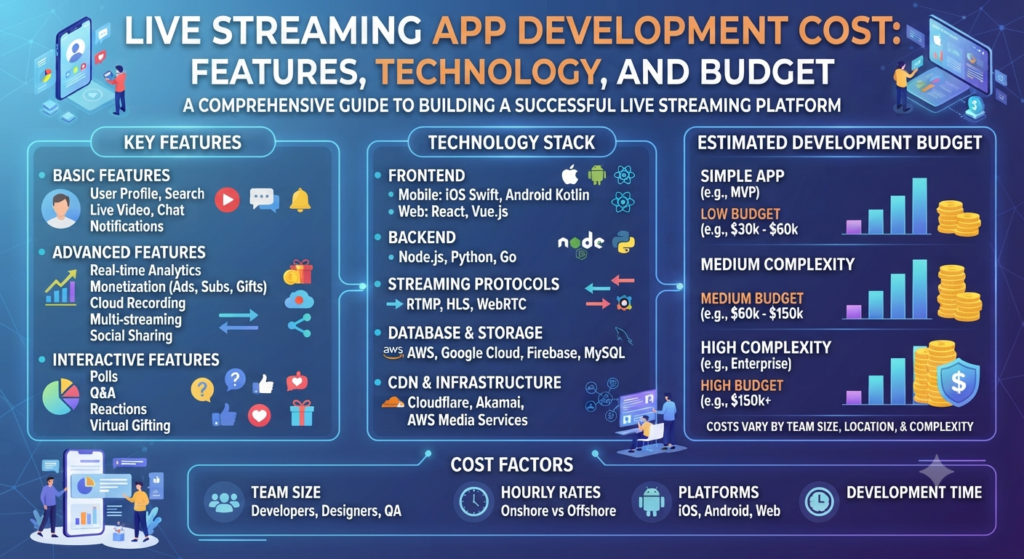
However, launching a live streaming platform requires careful financial planning. Development expenses can vary significantly depending on application complexity, streaming infrastructure, integrations, security requirements, and monetization features.
Understanding the live streaming app development cost before starting a project can help businesses select the right technology, prioritize features, and avoid unnecessary expenses.
This guide explains the major factors that influence development budgets and how startups can plan an efficient launch in 2027.
1. What Determines Live Streaming App Development Cost?
There is no single price for every live streaming application. The final budget depends on several technical and business requirements.
Application Complexity
A basic streaming application with registration, profiles, and one-to-many broadcasting requires fewer resources than a platform offering multiple broadcasters, virtual gifts, private calls, and advanced recommendations.
Number of Platforms
Building for Android and iOS simultaneously can increase development requirements. Businesses must also consider whether they need a web-based admin dashboard or browser-based streaming.
UI/UX Design
A simple interface is generally less expensive to design than a highly customized interface containing animations, interactive features, and personalized recommendations.
Backend Infrastructure
The backend manages user accounts, streaming sessions, messages, transactions, notifications, and application data.
As the number of users increases, backend performance and infrastructure requirements become more important.
2. Essential Features and Their Budget Impact
Features directly influence development time and overall project expenses.
User Registration and Authentication
Users should be able to register, log in, reset passwords, and manage their accounts.
Social login and phone verification may require additional integrations.
Live Video Broadcasting
This is the core functionality of a live streaming application. It requires suitable streaming protocols, encoding, video delivery, and real-time communication infrastructure.
Real-Time Messaging
Chat functionality allows viewers to interact with broadcasters. Additional requirements may include message moderation, emojis, and spam prevention.
Virtual Gifts and Wallet
A virtual gifting system can include coin purchases, gift animations, wallet balances, and transaction records.
Payment gateway integration and financial transaction management increase implementation complexity.
Notifications
Push notifications inform users about live sessions, new followers, messages, and account activities.
Admin Dashboard
An administrative dashboard helps business owners manage users, content, transactions, reports, and platform settings.
3. Technology Choices That Affect Your Budget
Choosing suitable technologies can influence both development and long-term maintenance expenses.
Common technology options include:
- Frontend: Flutter, React Native, Swift, and Kotlin.
- Backend: Node.js, Python, Java, and PHP.
- Database: PostgreSQL, MySQL, and MongoDB.
- Streaming: WebRTC and suitable live video streaming services.
- Cloud: AWS, Google Cloud, and Microsoft Azure.
- Notifications: Firebase Cloud Messaging and Apple Push Notification Service.
The best technology depends on your expected audience, application requirements, development expertise, and scalability goals.
For example, a cross-platform framework may help reduce duplicated frontend development work, while native development may be preferable for specific performance requirements.
4. Custom Development vs Ready-Made Solutions
Your development approach can significantly affect the initial investment.
Custom Development
Custom development provides complete control over the application’s architecture, interface, features, and integrations.
It is suitable for businesses with unique requirements or long-term plans that demand specialized functionality.
However, it generally involves more planning, development hours, testing, and technical management.
Ready-Made Solutions
A ready-made app source code package provides an existing application foundation with pre-developed functionality.
Startups can use this approach to reduce initial development work and concentrate on branding, customization, and marketing.
Before purchasing, evaluate the code quality, documentation, security, licensing terms, available features, and technical support.
5. Streaming Infrastructure and Server Expenses
Streaming infrastructure is one of the most important ongoing expenses.
Unlike traditional applications, live streaming platforms transmit large amounts of video and audio data in real time.
Your infrastructure budget may include:
Cloud Hosting: Servers support authentication, APIs, databases, and other backend services.
Bandwidth: Video delivery requires sufficient bandwidth, particularly when many users watch simultaneously.
Content Delivery Networks: CDNs help distribute content efficiently across different geographic locations.
Storage: Recorded broadcasts, profile images, and other media files require storage resources.
Monitoring: Performance monitoring helps identify streaming delays, server failures, and unusual activity.
The actual cost depends on usage, video quality, traffic patterns, and service provider pricing.
6. Additional Features That Can Increase Development Expenses
Startups often begin with basic streaming functionality and introduce advanced features after validating their business model.
Examples include:
- Multi-guest streaming
- Private video communication
- AI-based recommendations
- Advanced analytics
- Creator subscription systems
- Live shopping
- Language translation
- Content moderation tools
A Video Call App Source Code solution may also be evaluated when private video communication is part of the product roadmap.
Similarly, businesses exploring premium creator communities can study a OnlyFans Clone Script to understand subscription-based content monetization.
These features should be prioritized according to audience demand rather than added simply because competitors offer them.
7. How to Create a Practical Development Budget
A realistic budget should cover more than the initial application development.
Consider the following expense categories:
| Budget Category | What It Covers |
| Planning | Research and requirements |
| UI/UX Design | Screens and user journeys |
| Development | Frontend and backend |
| Streaming | Video infrastructure |
| Integrations | Payments and notifications |
| Testing | Performance and security |
| Deployment | App store and server setup |
| Maintenance | Updates and technical support |
| Marketing | User acquisition and promotion |
Keep a contingency reserve for unexpected technical requirements and infrastructure changes.
8. Ways to Reduce Development Costs
Reducing expenses does not mean compromising on essential quality.
Start With an MVP
Launch a minimum viable product containing only the features required to test your business idea.
Prioritize Features
Separate essential features from optional improvements. Develop advanced functionality when user feedback justifies the investment.
Select Scalable Infrastructure
Choose infrastructure that can grow with your application rather than purchasing excessive resources at the beginning.
Evaluate Existing Solutions
Compare custom development with ready-made app source code options to determine which approach offers better value for your requirements.
Test Early
Early testing can identify performance and usability issues before they become expensive to fix.
9. Plan for Maintenance and Long-Term Growth
After launch, your application will require regular updates, security improvements, server monitoring, and technical support.
You should also monitor:
- Monthly active users
- Streaming hours
- Average viewing duration
- Infrastructure consumption
- User retention
- Revenue per user
- Subscription conversion rates
These metrics help businesses understand operating costs and identify profitable growth opportunities.
Conclusion
Live streaming app development cost depends on application complexity, features, technology, streaming infrastructure, and long-term business requirements.
Startups should define their target audience, prioritize essential features, compare development approaches, and prepare a realistic operating budget.
A well-planned MVP and scalable infrastructure can help businesses enter the live streaming market efficiently while creating opportunities for future expansion.