

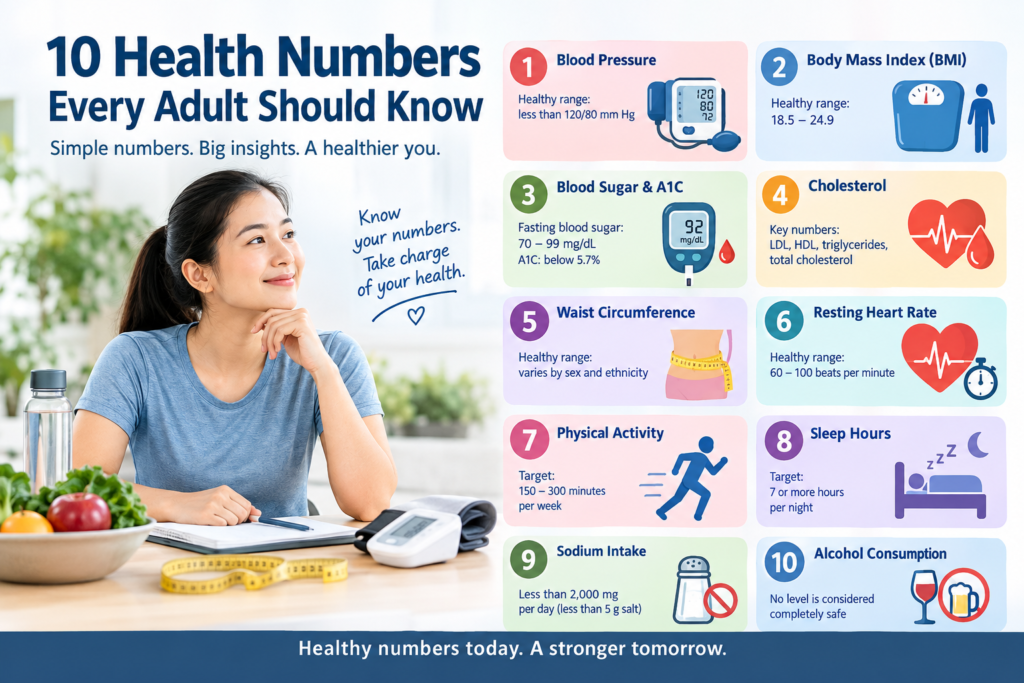

10 Health Numbers Every Adult Should Know
Your health can tell a story through numbers. From blood pressure and blood sugar to cholesterol, waist measurements, sleep, and physical activity, these figures can reveal important changes before you notice obvious symptoms. Knowing your medical numbers gives you a clearer picture of your health and helps you have more informed conversations with a healthcare professional.
These health numbers are not meant to diagnose disease on their own. They are useful measurements that can help you monitor trends, recognize potential concerns, and make informed choices about your lifestyle. Some numbers are measured during routine medical visits, while others can be tracked at home.
Here are 10 important numbers every adult should know and understand.
1. Blood Pressure
Blood pressure is one of the most important medical numbers to monitor because high blood pressure often causes no noticeable symptoms. A blood pressure reading has two numbers: systolic pressure, which is the upper number, and diastolic pressure, which is the lower number.
For adults, the American Heart Association classifies a normal reading as less than 120/80 mm Hg. A systolic reading of 120 to 129 with a diastolic reading below 80 is considered elevated. Readings of 130 to 139 systolic or 80 to 89 diastolic fall into stage 1 hypertension, while 140 or higher systolic or 90 or higher diastolic falls into stage 2 hypertension.
| Blood pressure category | Systolic | Diastolic |
|---|---|---|
| Normal | Less than 120 | Less than 80 |
| Elevated | 120–129 | Less than 80 |
| Stage 1 hypertension | 130–139 | 80–89 |
| Stage 2 hypertension | 140 or higher | 90 or higher |
One unusual reading does not necessarily mean you have high blood pressure. Measurements can change because of stress, activity, caffeine, medications, or the circumstances in which the reading is taken. A healthcare professional can help interpret repeated readings.
What is a high blood pressure number?
A reading of 140/90 mm Hg or above falls within stage 2 hypertension under the American Heart Association classification. A reading above 180/120 mm Hg requires particular attention, especially when accompanied by symptoms such as chest pain, shortness of breath, weakness, vision changes, or difficulty speaking.
Knowing your blood pressure numbers is one of the simplest ways to keep track of an important cardiovascular health indicator.
2. Body Mass Index (BMI)
Body Mass Index, commonly called BMI, is a measurement based on your weight and height. It is widely used as a screening tool for assessing weight categories in adults.
BMI is calculated by dividing weight in kilograms by height in meters squared:
BMI = weight (kg) ÷ height² (m²)
The number can then be compared with standard BMI categories. However, BMI does not directly measure body fat and does not distinguish between muscle, bone, and fat. That means the number needs to be considered alongside other health measurements and personal circumstances.
For a more detailed explanation, a dedicated BMI guide can explain how to calculate BMI, understand BMI ranges, and interpret the result.
BMI is therefore one of the useful health numbers to know, but it should not be viewed as a complete measure of health by itself.
3. Blood Sugar and A1C
Blood glucose is another group of medical numbers that can provide important information about metabolic health. Two commonly used measurements are fasting blood glucose and A1C.
A fasting blood glucose test measures blood sugar after fasting. According to the CDC, a fasting blood sugar level of 99 mg/dL or below is considered normal, 100 to 125 mg/dL falls in the prediabetes range, and 126 mg/dL or above falls in the diabetes range.
A1C provides a different perspective because it estimates average blood glucose over approximately the previous two to three months. The CDC lists:
- Below 5.7%: normal
- 5.7% to 6.4%: prediabetes
- 6.5% or above: diabetes
These numbers are useful health indicators, but diagnosis should be made by a qualified healthcare professional using appropriate testing and clinical context.
4. Cholesterol
Cholesterol is a waxy substance that the body needs, but the amount and type of cholesterol in your blood matter for cardiovascular health.
A cholesterol test, often called a lipid panel, can include several health numbers, including:
- LDL cholesterol
- HDL cholesterol
- Triglycerides
- Total cholesterol
LDL is often referred to as “bad” cholesterol because higher levels can contribute to plaque buildup in arteries. HDL is commonly known as “good” cholesterol because it plays a role in transporting cholesterol away from the arteries. Triglycerides are another type of fat found in the blood.
Rather than focusing on one number in isolation, cholesterol results should be interpreted as a group and considered alongside factors such as age, blood pressure, diabetes, smoking status, family history, and overall cardiovascular risk.
If you have not had a cholesterol test recently, ask your healthcare professional whether it is appropriate for you.
5. Waist Circumference
Your weight does not tell the entire story. Waist circumference provides information about abdominal fat, which is associated with metabolic and cardiovascular health risks.
This makes waist circumference one of the important health measurements to know alongside your BMI.
To measure it consistently, use a tape measure around your waist according to the method recommended by your healthcare professional or a recognized health guideline. Keep the measurement conditions consistent if you are tracking changes over time.
A changing waist measurement can provide useful information even when body weight does not change dramatically.
However, waist circumference thresholds vary according to sex, ethnicity, and guideline. For that reason, it is better to interpret the measurement in the appropriate population context rather than relying on a single universal cutoff.
6. Resting Heart Rate
Resting heart rate is the number of times your heart beats per minute while you are resting.
For many adults, a resting heart rate between 60 and 100 beats per minute is considered a typical range. However, trained athletes may have lower resting heart rates, and medications, fitness level, illness, stress, caffeine, and other factors can influence the number.
Instead of worrying about one isolated reading, pay attention to your usual pattern.
For example, if your resting heart rate is normally stable but changes noticeably without an obvious explanation, it may be worth discussing the change with a healthcare professional.
Your resting heart rate is therefore one of the personal health numbers that can be useful to track over time.
7. Physical Activity Minutes
Not every useful health number comes from a blood test or medical device. The amount of physical activity you complete each week is also an important health metric.
For adults, the World Health Organization recommends at least 150 to 300 minutes of moderate-intensity aerobic activity per week, or 75 to 150 minutes of vigorous-intensity activity, or an equivalent combination. Adults should also perform muscle-strengthening activities involving major muscle groups on at least two days each week.
That means you can turn physical activity into a simple number to monitor:
Weekly activity target: 150–300 minutes of moderate activity
Walking, cycling, swimming, recreational activities, and many other forms of movement can contribute.
You do not have to achieve the maximum target immediately. Building regular movement into your week is more useful than focusing only on a perfect number.
8. Sleep Hours
Sleep is another area where tracking a simple number can help you understand your routine.
For most adults, a useful target is around 7 or more hours of sleep per night, although individual needs vary with age and circumstances.
Rather than looking only at one night’s sleep, consider your average sleep duration over several days or weeks. A consistent pattern of insufficient sleep may be more meaningful than an occasional short night.
You can track:
- Average hours of sleep
- Bedtime
- Wake time
- Sleep consistency
Sleep is connected with many aspects of physical and mental well-being, so it belongs among the health numbers everyone should know.
9. Sodium Intake
Sodium is essential for normal body functions, but consuming too much can contribute to higher blood pressure and increase cardiovascular and other health risks.
The World Health Organization recommends that adults consume less than 2,000 mg of sodium per day, equivalent to less than 5 grams of salt per day.
This is an especially useful number to understand because sodium can come from foods that do not necessarily taste extremely salty. Processed foods, packaged foods, sauces, condiments, and restaurant meals can all contribute substantial amounts.
Checking nutrition labels and becoming familiar with serving sizes can make sodium intake easier to monitor.
If you are trying to improve your diet, your daily sodium number is one of the important numbers for health worth keeping in mind.
10. Alcohol Consumption
Alcohol consumption is another health-related number worth knowing, although there is an important distinction between tracking a quantity and assuming that a particular amount is risk-free.
The World Health Organization states that there is no level of alcohol consumption that can be considered completely safe for health. Alcohol is associated with risks including several cancers and other health problems.
Instead of treating a drinking limit as a guaranteed “healthy number,” consider how frequently and how much alcohol you consume and discuss your individual situation with a healthcare professional when appropriate.
For people who drink alcohol, tracking consumption can help reveal patterns that may otherwise be easy to overlook.
Health Numbers Chart: A Simple Reference
Keeping your medical numbers in one place can make changes easier to notice. Your personal health record might include measurements such as these:
| Health measurement | Number to know | Why it matters |
|---|---|---|
| Blood pressure | Systolic and diastolic | Cardiovascular health |
| BMI | Weight and height-based value | Weight-category screening |
| Fasting blood glucose | Blood glucose level | Blood sugar assessment |
| A1C | Percentage | Average blood glucose over recent months |
| Cholesterol | LDL, HDL, triglycerides, total cholesterol | Cardiovascular risk assessment |
| Waist circumference | Waist measurement | Abdominal fat assessment |
| Resting heart rate | Beats per minute | Heart and fitness monitoring |
| Physical activity | Minutes per week | Activity level |
| Sleep | Hours per night | Sleep and recovery habits |
| Sodium | Milligrams per day | Dietary intake and blood-pressure considerations |
These are health measurements to know, not a checklist that determines whether someone is healthy or unhealthy. Your age, sex, medical history, medications, family history, and other circumstances can change how individual numbers should be interpreted.
Why Knowing Your Health Numbers Matters
Understanding your health numbers gives you a baseline. Once you know your usual measurements, it becomes easier to notice meaningful changes.
For example, you might discover that:
- Your blood pressure has gradually increased.
- Your resting heart rate has changed.
- Your waist measurement is increasing even though your weight is stable.
- Your weekly physical activity has decreased.
- Your average sleep has fallen.
- Your blood glucose or A1C has moved into a different range.
The value is not simply in knowing a number. The real benefit comes from understanding what the number measures, watching trends, and taking appropriate action when something changes.
This is why health by numbers should be viewed as a way of monitoring your health rather than judging it from a single measurement.
What Is a High Number?
There is no single definition of a “high number” that applies to every health measurement.
For example, a high blood pressure reading is interpreted differently from a high triglyceride level, a high blood glucose result, or a high waist measurement. Even within the same measurement, thresholds can vary depending on the guideline, population, and clinical situation.
This is why searching for a list of “numbers high” enough to indicate a problem can be misleading.
Instead, learn the meaning of each measurement and use the appropriate reference range.
If a result is outside the expected range, do not automatically assume that you have a disease. Some measurements require repeat testing or professional interpretation.
How to Keep Track of Your Important Health Numbers
You do not need a complicated system to monitor your personal health data.
Create a simple record containing:
- The measurement
- Your result
- The date
- The unit
- The reference range, when applicable
- Any relevant notes
For example, you could record your blood pressure readings at consistent times, keep laboratory results together, and track weekly activity and average sleep.
Keeping these personal health measurements organized can make appointments more productive because you have a record of your trends rather than relying on memory.
When Should You Talk to a Healthcare Professional?
Health numbers are useful for monitoring, but they are not a substitute for medical advice.
Speak with a healthcare professional if:
- A measurement repeatedly falls outside its expected range.
- Your results change significantly without an obvious explanation.
- You have symptoms together with an abnormal measurement.
- You have been diagnosed with a condition that requires monitoring.
- You are unsure how to interpret a test result.
- You are taking medication that may affect a measurement.
Some results require prompt medical attention. For example, the American Heart Association advises immediate attention to blood pressure readings above 180/120 mm Hg when certain concerning symptoms are present.
The Bottom Line
Knowing your medical numbers can make it easier to understand your health and recognize changes over time. Blood pressure, BMI, blood sugar, A1C, cholesterol, waist circumference, resting heart rate, physical activity, sleep, sodium, and alcohol consumption can all provide useful pieces of information.
The goal is not to chase perfect health numbers. It is to understand what your measurements mean, track meaningful trends, and use that information to make sensible decisions about your health.
Your numbers are most useful when they are considered together rather than individually. If something looks unusual or you are concerned about a result, a healthcare professional can help determine what it means in the context of your overall health.