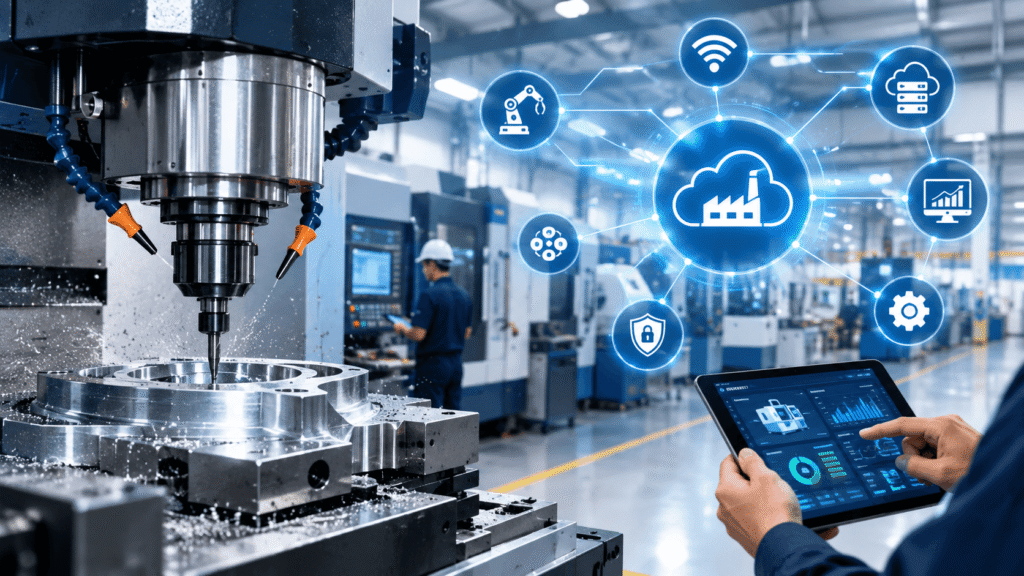

A few years ago, if you asked a shop owner in Ambattur how he knew a machine was healthy, the honest answer was “I can hear it.” Plenty of owners still trust their ears, and they should. But there’s now often a tablet mounted beside the control panel, quietly logging spindle load, cycle times, and idle minutes. That small screen is the front door to Industry 4.0, and it’s changing how parts get made, quoted, and delivered across Tamil Nadu.
What “Connected” Actually Means on the Shop Floor
Forget the buzzwords for a moment. Connected manufacturing means machines, software, and people working from the same live information. A connected machine doesn’t just cut metal. It reports how long the job really took, when a tool started wearing, and why it sat idle for forty minutes on Tuesday.
If you’re sourcing CNC Machining Chennai suppliers, this isn’t just a tech story. A shop that measures its own floor can promise lead times it can actually keep, and that’s what you’re buying.
Here’s how the two worlds compare day to day:
| Area | Traditional Shop | Connected Shop |
| Machine status | Walk the floor, check the logbook | Live dashboard on a phone or screen |
| Maintenance | After the breakdown | Alerts before the failure |
| Inspection | End of the batch | During the run |
| Quoting | A few days, often a few emails | Hours, with data behind it |
| Traceability | Paper, memory, hope | Batch-level digital records |
| Delay explanations | “Machine issue” | Exact cause, exact minutes |
Why Chennai Is Ready for This
Chennai’s automotive base, the aerospace and defence suppliers, medical device makers, and the growing EV cluster around Sriperumbudur and Oragadam have all raised expectations. Export buyers now treat inspection reports and material traceability as routine paperwork. A shop that can’t produce them loses the order, however skilled its machinists are.
The good news is that Tamil Nadu has the engineering talent to meet that bar. Small and mid-sized workshops don’t need a full smart-factory overhaul. Most start by monitoring two or three machines and build from there.
Four Technologies Doing the Heavy Lifting
Machine monitoring (IIoT). Sensors and software track utilisation, alarms, and cycle times. It’s the cheapest entry point, and usually the most eye-opening. Many owners discover their machines run far fewer productive hours than they assumed.
Predictive maintenance. Vibration and temperature data flag trouble early. A bearing replaced on a planned Sunday costs far less than a spindle failure mid-order.
Digital simulation. CAM verification and digital twins let programmers catch collisions and poor toolpaths before the first chip flies, which means less scrap on expensive material.
Integrated planning. When ERP or MES systems talk to the machines, schedules reflect reality rather than optimism.
What’s Trending Right Now
- Multi-axis and mill-turn machines are replacing several setups with one, which cuts both error and lead time.
- EV and battery components are pulling precision orders into the state, with tighter tolerances and bigger volumes.
- Energy and carbon reporting is creeping into buyer questionnaires, especially from European customers. Energy per part is becoming a selling point.
- Digital RFQs are replacing the endless email-and-WhatsApp loop of drawings, revisions, and “please resend the STEP file.”
Metal and Plastic Run on the Same Logic
Connected thinking isn’t limited to machining. Injection molding lines now track cycle time, mold temperature, and reject rates the same way. If your assembly needs machined housings and molded covers, a Plastic Molding Company In Chennai that also records production digitally can save you weeks of back-and-forth, because both parts arrive with documentation you can actually compare.
Practical Tips for Buyers and Procurement Teams
- Ask for numbers, not adjectives. On-time delivery rate, rejection rate, and OEE tell you more than any brochure.
- Test traceability. Pick a part number and ask how fast they can trace it to a raw material batch. The pause before they answer says a lot.
- Compare total cost. A slightly higher quote that avoids rework and late deliveries is usually the cheaper job.
- Match certifications to your sector. ISO 9001 is the baseline. IATF 16949 matters for automotive, AS9100 for aerospace.
- Visit, even virtually. A clean floor and organised tooling say more than a polished presentation.
- Invest in operators. Hardware without trained people is just expensive decoration.
On the supplier discovery side, Indust helps buyers and procurement teams compare verified manufacturers instead of cold-calling from a directory.
Questions to Ask Before You Award the Job
Keep these handy during supplier calls. Do they simulate toolpaths before cutting? Can they share live job status without being chased? What inspection equipment do they use, and is a CMM part of it? How do they handle design changes mid-order? And how fast is their typical RFQ turnaround? Clear, confident answers to all five usually point to a mature process.
FAQs
Is connected manufacturing only for big factories?
No. Many small shops begin with low-cost sensors and a basic dashboard, then scale as the payback shows up.
Will automation replace machinists?
Unlikely. The work shifts toward programming, setup, and problem-solving. Experienced people become more valuable because someone has to interpret the data.
How do I know if a supplier is genuinely digital?
Ask for a live demonstration or a sample report. Real systems are easy to show. Vague answers usually mean a spreadsheet.
Does a Plastic Molding Company In Chennai need the same digital capabilities?
Increasingly, yes. Cycle monitoring and defect tracking matter just as much when parts must fit machined components.
The Human Side of It
Here’s what years of watching factories teaches you: technology rarely fails on its own. Projects stall because buyer and supplier don’t share the same information. Connected manufacturing helps most when both sides see the same numbers, because arguments about who delayed what quietly disappear.
Final Thoughts
The shift is steady and practical, not dramatic. Buyers should look for partners who can show real data, quote quickly, and hold quality. Shops should start small, measure honestly, and keep their people involved. Whether you’re comparing quotes for CNC Machining Chennai or planning your next sourcing round, choose suppliers who can prove their performance.
And if you’re tired of chasing quotes, Indust connects customers and suppliers to make manufacturing faster, easier, and smarter, so your next project starts with the right partner.