

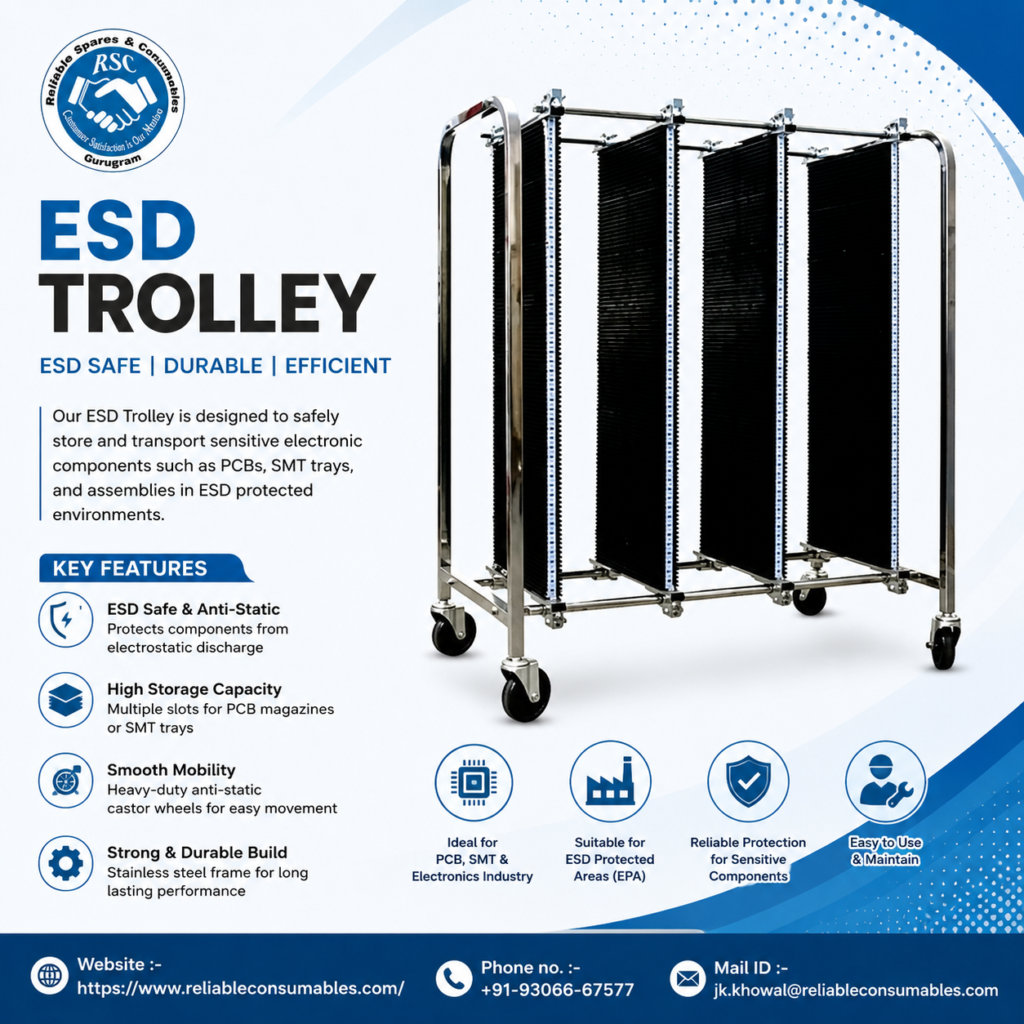

A batch of PCBs fails static testing on a Tuesday. Nobody remembers touching them wrong. Nobody remembers grounding failures either — because the trolley moving them between stations wasn’t conductive to begin with. That’s how most ESD damage happens. Quietly, mid-transport, long before anyone opens a defect report.
An ESD trolley isn’t a nice-to-have cart with a warning sticker slapped on it. It’s a grounded, conductive-material workstation on wheels, built to keep static charge from ever reaching a sensitive board. ESD trolley manufacturers who understand this build for the transfer point, not just the storage point — because that’s where 60% of preventable static incidents in electronics assembly actually happen, according to industry ESD control audits.
Specification
ESD trolleys typically fall into three categories, and mixing them up is where a lot of procurement teams go wrong.
-
Static Dissipative Trolleys
Surface resistance between 10^6 and 10^9 ohms. Used where controlled, gradual discharge matters more than instant grounding — most PCB assembly lines fall here.
-
Conductive Trolleys
Resistance below 10^5 ohms. Faster discharge. Preferred for high-sensitivity components, military-grade electronics, and anything MIL-STD-1686 governs.
-
Multi-Tier PCB Storage Trolleys
Built for in-process storage between stations, usually 3–5 tiers, load capacity ranging 100–250 kg depending on tier count.
Here’s the detail most buyers skip entirely: wheel material. A trolley can have a perfectly conductive tabletop and still fail static tests if the castors are standard rubber instead of conductive polyurethane. The charge has to travel from the surface to the floor. Rubber wheels break that path completely.
Objective — 5 Criteria Before You Sign a PO
- Can they show you a resistance test certificate, not just a claim?
Bad answer: “All our products are ESD safe, trust us.” No certificate, no traceability — that’s not a spec, that’s a slogan.
- Do they manufacture the frame or just assemble bought-in parts?
Bad answer: vague deflection when asked about their fabrication unit. If they can’t describe their welding process, they’re a trading company, not a manufacturer.
- What’s their tolerance for load capacity variance?
Bad answer: “It’ll hold whatever you put on it.” Every conductive trolley has a rated limit tied to shelf material gauge — anyone dodging the number is dodging accountability.
- Can they customize tier height and grounding points?
Bad answer: “We only do standard sizes.” Factory floors aren’t standard. A supplier locked into one configuration is a supplier who hasn’t visited enough plants.
- What happens if a unit arrives damaged?
A supplier who says “we’ll handle defects case by case” doesn’t have a policy. That’s a negotiation you’ll lose after the shipment lands.
Benefits
- Fewer field returns. Static damage often shows up as intermittent failure weeks later — a returned unit, an angry OEM, a warranty claim traced back to handling, not design.
- Lower requalification costs. Every failed ESD audit means re-testing a batch. A properly conductive trolley fleet cuts audit failure rates significantly.
- Faster line changeover. Multi-tier storage trolleys reduce walking distance between stations — a real time cost most people never quantify.
- Longer component shelf life. Static-safe storage between processes protects boards sitting in WIP for 24–48 hours.
- Auditor confidence. ISO 9001 and ANSI/ESD S20.20 assessors check trolley grounding points specifically. Skipping this is an easy, avoidable finding.
Availability
We dispatch pan-India from our production facility, with regional stocking that cuts delivery time for high-density electronics manufacturing clusters — Noida, Pune, Chennai, and Bengaluru see the fastest turnaround, usually inside 5–7 working days for standard configurations. Coastal EMS units ordering for export-grade assembly lines should factor in humidity-related resistance drift; conductive coatings behave differently above 70% relative humidity, and we adjust material spec accordingly for southern and eastern clusters.
About Us
We’ve been manufacturing ESD and industrial production consumables since 2013, and most of what we know came from watching things go wrong on client floors, not from a textbook. We stopped supplying a certain grade of dissipative laminate in 2020 after two clients in Pune reported resistance drift within eight months of use in high-humidity conditions. We reformulated. That’s what a decade of factory feedback actually looks like — not a claim on a brochure, a change on a production line.
Our engineers visit client facilities before finalizing custom trolley configurations. We’ve walked enough shop floors to know a spec sheet rarely matches the actual walking path a PCB takes between stations.
Conclusion
Static damage rarely announces itself at the point of failure — it shows up downstream, expensive and hard to trace. Choosing the right ESD trolley manufacturer isn’t about the lowest quote; it’s about resistance certification, wheel material, and a supplier who’s actually walked a factory floor. Get that right, and the trolley stops being a line item and starts being a defect-prevention decision.
FAQs
- What’s the difference between an ESD trolley and a regular industrial trolley?
An ESD trolley uses conductive or static-dissipative materials throughout — surface, frame, and wheels — so charge has a continuous path to ground. A regular trolley has no such path, even if it looks identical. - Are your ESD trolley manufacturers certified for export?
Yes, though export documentation timelines add roughly 3–4 extra working days depending on the destination country’s compliance requirements — worth factoring in if you’re ordering against a tight installation date. - Can I get a trolley with mixed conductive and dissipative tiers?
Yes, this is a common request for lines that handle both raw components and finished boards at different sensitivity levels. - Do ESD trolley suppliers offer AMC or maintenance support?
We do, but honestly, most wear issues come from wheel damage, not surface degradation — replacement castors solve 80% of service calls we get. - What’s the typical lead time for standard versus custom orders?
Standard catalog units ship in 5–7 days. Custom configurations typically take 12–15 days depending on tier count and current production load.