

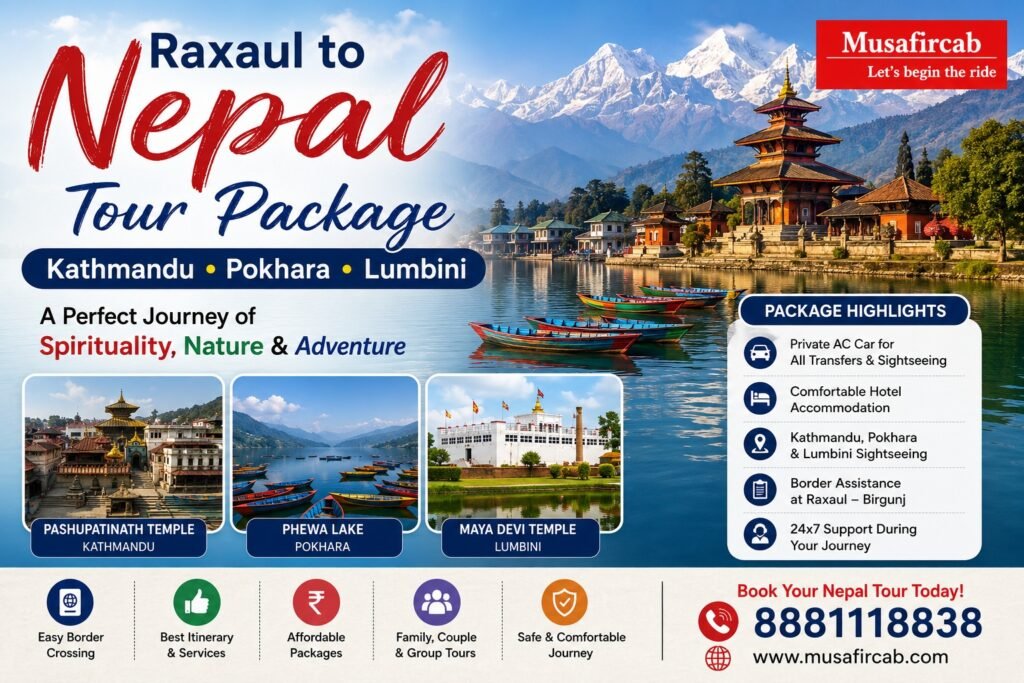

Nepal has long been a favorite destination for Indian travelers seeking a combination of spirituality, breathtaking landscapes, rich cultural heritage, and unforgettable road journeys. Sharing an open border with India, Nepal offers a hassle-free international travel experience where visitors can explore ancient temples, peaceful monasteries, snow-capped mountains, beautiful lakes, and wildlife reserves—all within a single trip.
For travelers from Bihar, Uttar Pradesh, Jharkhand, and neighboring states, Raxaul serves as one of the most convenient gateways to Nepal. Connected directly to Birgunj, Nepal’s major border city, Raxaul provides easy access to popular destinations like Kathmandu, Pokhara, Lumbini, Chitwan National Park, and Manakamana Temple.
Whether you’re planning a family vacation, honeymoon, pilgrimage, or weekend getaway, traveling to Nepal by road from Raxaul offers flexibility, affordability, and the opportunity to witness Nepal’s changing landscapes from the plains to the Himalayan foothills.
This guide explains everything you need to know before starting your journey, including border crossing information, top destinations, suggested itineraries, travel tips, and the best time to visit.
Why Start Your Nepal Journey from Raxaul?
Raxaul, located in Bihar, is one of the busiest land entry points between India and Nepal. It connects directly to Birgunj, an important commercial city that serves as the gateway to central Nepal.
Unlike air travel, entering Nepal by road allows visitors to experience local towns, countryside, rivers, and mountain roads while keeping travel costs relatively low.
Advantages of Traveling via Raxaul
- Convenient road access to Nepal
- Easy connectivity from Patna, Muzaffarpur, Motihari, Gorakhpur, Varanasi, and other Indian cities
- Budget-friendly compared to air travel
- Suitable for families, couples, and group travelers
- Flexible travel schedules
- Easy access to private taxis and tourist vehicles after crossing the border
For many travelers, the scenic drive itself becomes an enjoyable part of the overall Nepal experience.
Crossing the Raxaul–Birgunj Border
The Raxaul–Birgunj border is one of the most commonly used entry points for Indian tourists visiting Nepal. The crossing is generally straightforward and serves thousands of travelers every year.
After reaching Raxaul by train or road, visitors cross into Birgunj and continue towards Kathmandu or other destinations through Nepal’s highway network.
Although the process is relatively simple, it is always wise to carry valid identification and stay updated with the latest travel regulations before departure.
Essential Documents for Indian Travelers
Indian citizens generally enjoy simplified travel procedures when visiting Nepal. However, carrying proper identification helps ensure a smooth journey.
Recommended documents include:
- Valid Voter ID Card
- Passport (optional but useful)
- Aadhaar Card where accepted
- Passport-size photographs
- Hotel reservation details
- Emergency contact information
Keeping both printed and digital copies of important documents is also a good travel practice.
Why Nepal Attracts Every Type of Traveler
One of Nepal’s greatest strengths is its diversity. Few destinations offer such a unique blend of spirituality, adventure, history, wildlife, and natural beauty within relatively short travel distances.
In just one trip, travelers can:
- Visit UNESCO World Heritage Sites
- Explore centuries-old Hindu temples
- Experience Buddhist monasteries
- Admire Himalayan mountain views
- Enjoy peaceful lakes
- Discover local culture
- Experience thrilling adventure sports
- Observe diverse wildlife
Whether you’re seeking spiritual peace or outdoor adventure, Nepal offers experiences suitable for every age group.
Kathmandu – Nepal’s Cultural Heart
Most road trips from Raxaul begin with Kathmandu, Nepal’s historic capital.
The city beautifully combines ancient traditions with modern life. Historic temples, bustling markets, colorful festivals, and traditional architecture make Kathmandu one of South Asia’s most fascinating cultural destinations.
Every street tells a story of Nepal’s rich heritage.
Pashupatinath Temple
Among Kathmandu’s most respected landmarks is Pashupatinath Temple, dedicated to Lord Shiva.
Located on the banks of the Bagmati River, the temple is considered one of the holiest pilgrimage sites for Hindus.
Visitors come here to experience:
- Sacred religious rituals
- Traditional Nepalese architecture
- Peaceful spiritual surroundings
- Evening Aarati ceremony
- Historic temple complex
Early morning and evening visits offer the most memorable experiences.
Boudhanath Stupa
Just a short distance away stands Boudhanath Stupa, one of the world’s largest Buddhist stupas.
The massive white dome surrounded by colorful prayer flags creates a peaceful atmosphere where visitors often spend hours observing local traditions.
Highlights include:
- Tibetan monasteries
- Prayer wheels
- Meditation spaces
- Local handicraft shops
- Traditional cafés
Walking clockwise around the stupa is a common spiritual practice observed by pilgrims.
Swayambhunath (Monkey Temple)
Situated on a hilltop overlooking Kathmandu Valley, Swayambhunath is among Nepal’s oldest religious monuments.
Visitors climb a long staircase before reaching the temple complex, where panoramic views of Kathmandu reward their efforts.
The site features:
- Buddhist shrines
- Hindu temples
- Prayer flags
- Monkeys roaming freely
- Beautiful photography opportunities
The peaceful setting makes it one of Kathmandu’s most visited attractions.
Kathmandu Durbar Square
History lovers should not miss Kathmandu Durbar Square, once the royal palace complex of Nepal’s kings.
The square showcases remarkable examples of Newari architecture through beautifully carved wooden temples, courtyards, and historic monuments.
It provides valuable insight into Nepal’s royal history and artistic traditions.
Explore Thamel
After a day of sightseeing, head to Thamel, Kathmandu’s lively tourist district.
This vibrant neighborhood offers:
- Souvenir shopping
- Handicrafts
- Traditional Nepali cuisine
- Live music cafés
- Adventure gear stores
- Cultural experiences
Whether you’re shopping for handmade crafts or enjoying authentic local food, Thamel captures the energetic side of Kathmandu.
Pokhara – Nepal’s Most Beautiful City
After exploring Kathmandu, travelers usually continue west to Pokhara, often regarded as Nepal’s most scenic destination.
Surrounded by the Annapurna Mountain Range, Pokhara combines natural beauty with outdoor adventure and a relaxed atmosphere.
Unlike the busy capital, Pokhara encourages visitors to slow down and enjoy nature.
Phewa Lake
The centerpiece of Pokhara is Phewa Lake, where calm waters reflect the surrounding mountains.
Popular activities include:
- Boating
- Photography
- Lakeside walks
- Café hopping
- Visiting Tal Barahi Temple
The lakeside promenade becomes especially lively during sunset.
Davis Falls and Gupteshwor Cave
Located close to one another, these two attractions showcase Nepal’s natural beauty.
Davis Falls disappears into an underground tunnel, while Gupteshwor Cave houses impressive limestone formations and a sacred Shiva shrine.
Together they make one of Pokhara’s most popular sightseeing stops.
World Peace Pagoda
Perched on a hill overlooking Pokhara, the World Peace Pagoda offers sweeping views of:
- Phewa Lake
- Pokhara Valley
- Annapurna Range
- Dhaulagiri Mountains
The serene surroundings make it an ideal place for relaxation and reflection.
Sarangkot
Sarangkot is famous for offering one of Nepal’s most spectacular sunrise views.
Adventure enthusiasts also visit for:
- Paragliding
- Ziplining
- Hiking
- Mountain photography
Watching the morning sunlight illuminate the Himalayas is an unforgettable experience.
Lumbini – The Birthplace of Lord Buddha
After experiencing the mountains and lakes of Pokhara, your journey continues to Lumbini, one of the world’s most important pilgrimage destinations. Recognized as a UNESCO World Heritage Site, Lumbini is believed to be the birthplace of Siddhartha Gautama (Lord Buddha) and attracts visitors from across the globe.
Unlike the bustling cities of Kathmandu and Pokhara, Lumbini offers a peaceful atmosphere where spirituality and history blend beautifully.
Maya Devi Temple
The most sacred attraction in Lumbini is the Maya Devi Temple, built around the archaeological site traditionally identified as the birthplace of Lord Buddha.
Visitors can explore:
- Ancient ruins
- Sacred Marker Stone
- Meditation gardens
- Historic ponds
- Peaceful prayer areas
The calm surroundings make it an ideal place for reflection and spiritual exploration.
Ashoka Pillar
Near the temple stands the historic Ashoka Pillar, erected by Emperor Ashoka during his pilgrimage to Lumbini in the 3rd century BCE.
The inscriptions on the pillar are considered important historical evidence confirming Lumbini’s significance in Buddhist history.
International Monastic Zone
One of Lumbini’s most fascinating attractions is the International Monastic Zone, where different countries have built monasteries representing their unique architectural styles and Buddhist traditions.
Monasteries from countries such as Thailand, Japan, China, Germany, Myanmar, and South Korea create a peaceful environment where visitors can appreciate global Buddhist culture.
Chitwan National Park – Nepal’s Wildlife Destination
If you’re looking to add adventure to your Nepal itinerary, Chitwan National Park is an excellent choice.
As Nepal’s first national park and another UNESCO World Heritage Site, Chitwan protects diverse wildlife and lush forests in the country’s southern plains.
Nature lovers can enjoy a completely different side of Nepal compared to the Himalayan regions.
Popular Experiences
Visitors can enjoy:
- Jeep Safari
- Canoe Ride
- Bird Watching
- Nature Walks
- Village Tours
- Traditional Tharu Cultural Dance
Depending on the season and safari route, wildlife sightings may include one-horned rhinoceroses, deer, crocodiles, wild elephants, and a wide variety of bird species.
Manakamana Temple – A Spiritual Stop on the Journey
Located between Kathmandu and Pokhara, Manakamana Temple is one of Nepal’s most visited Hindu pilgrimage sites.
Dedicated to Goddess Bhagwati, the temple is believed to fulfill the wishes of devotees who visit with faith.
Cable Car Experience
Reaching the temple is an experience in itself.
The scenic cable car ride offers spectacular views of:
- Green hills
- Flowing rivers
- Mountain villages
- Forest landscapes
Many travelers consider the journey to the temple just as memorable as the destination itself.
Suggested 7-Day Itinerary
Day 1
- Arrive at Raxaul.
- Cross the Birgunj border.
- Drive to Kathmandu.
- Evening stroll through Thamel.
Day 2
Explore Kathmandu:
- Pashupatinath Temple
- Boudhanath Stupa
- Swayambhunath
- Kathmandu Durbar Square
Day 3
Travel to Pokhara via Manakamana Temple.
Day 4
Explore Pokhara:
- Phewa Lake
- Davis Falls
- Gupteshwor Cave
- World Peace Pagoda
- Sarangkot
Day 5
Drive to Lumbini and visit:
- Maya Devi Temple
- Ashoka Pillar
- International Monasteries
Day 6
Optional visit to Chitwan National Park before beginning the return journey.
Day 7
Travel back to Birgunj and cross the border to Raxaul.
This itinerary balances sightseeing, relaxation, and travel time, making it suitable for families, couples, and first-time visitors.
Best Time to Visit Nepal
Nepal welcomes visitors throughout the year, but each season offers a different experience.
Spring (March–May)
Spring is one of the best times to visit, with blooming rhododendrons, pleasant weather, and clear mountain views.
Best for:
- Sightseeing
- Nature lovers
- Photography
Autumn (September–November)
Autumn is considered Nepal’s peak travel season.
Travelers enjoy:
- Pleasant temperatures
- Excellent visibility of the Himalayas
- Major cultural festivals
- Comfortable road travel
Winter (December–February)
Winter offers quieter attractions and cool weather, making it ideal for cultural tours and pilgrimages in lower-altitude destinations.
Monsoon (June–August)
The monsoon transforms Nepal into a lush green landscape. While rainfall may affect road conditions in some areas, travelers who enjoy quieter destinations and lower accommodation prices may find this season appealing.
Practical Travel Tips
A little preparation can make your trip smoother and more enjoyable.
Carry Valid Identification
Always travel with a valid government-issued ID and keep digital copies of important documents.
Pack According to the Season
Your packing list should include:
- Comfortable walking shoes
- Light cotton clothing
- Warm jacket for hill stations
- Raincoat during monsoon
- Sunglasses
- Sunscreen
- Personal medicines
- Reusable water bottle
Respect Local Culture
When visiting temples and monasteries:
- Dress modestly.
- Remove footwear where required.
- Follow local customs and photography guidelines.
Keep Local Currency
Although Indian currency is accepted in many places, carrying Nepalese Rupees is helpful for small purchases, transportation, and local markets.
Frequently Asked Questions
Is Nepal a good destination for first-time international travelers?
Yes. Nepal is often considered one of the easiest international destinations for Indian travelers due to its cultural similarities, convenient road access, and diverse attractions.
How many days are ideal for a Nepal trip from Raxaul?
A 6 to 7-day itinerary is suitable for covering Kathmandu, Pokhara, and Lumbini comfortably. Travelers with additional time can also include Chitwan or Muktinath.
Is road travel from Raxaul comfortable?
Yes. The route is widely used by tourists. Although mountain roads require careful driving, the journey offers beautiful scenery and memorable travel experiences.
Can families and senior citizens enjoy this route?
Yes. With proper planning, comfortable transportation, and suitable accommodations, the route is convenient for families, senior travelers, and pilgrimage groups.
What type of experiences does Nepal offer?
Nepal combines:
- Spiritual tourism
- Cultural heritage
- Mountain scenery
- Wildlife adventures
- Adventure sports
- Local cuisine
- Historical landmarks
This variety makes it an excellent destination for travelers with different interests.
Conclusion
Traveling from Raxaul to Nepal is more than just crossing an international border—it’s the beginning of a journey through centuries of history, diverse cultures, sacred pilgrimage sites, and breathtaking natural landscapes. From the spiritual atmosphere of Pashupatinath Temple and Lumbini to the serene beauty of Pokhara and the wildlife-rich forests of Chitwan, each destination offers a unique experience that leaves lasting memories.
Whether you’re planning a peaceful pilgrimage, a family vacation, or a scenic road trip, thoughtful planning can help you make the most of your time in Nepal. If you’re looking for detailed itineraries and practical travel options, you can also explore the Raxaul to Nepal Tour Package offered by Musafircab, which provides additional planning information for travelers interested in this route.