

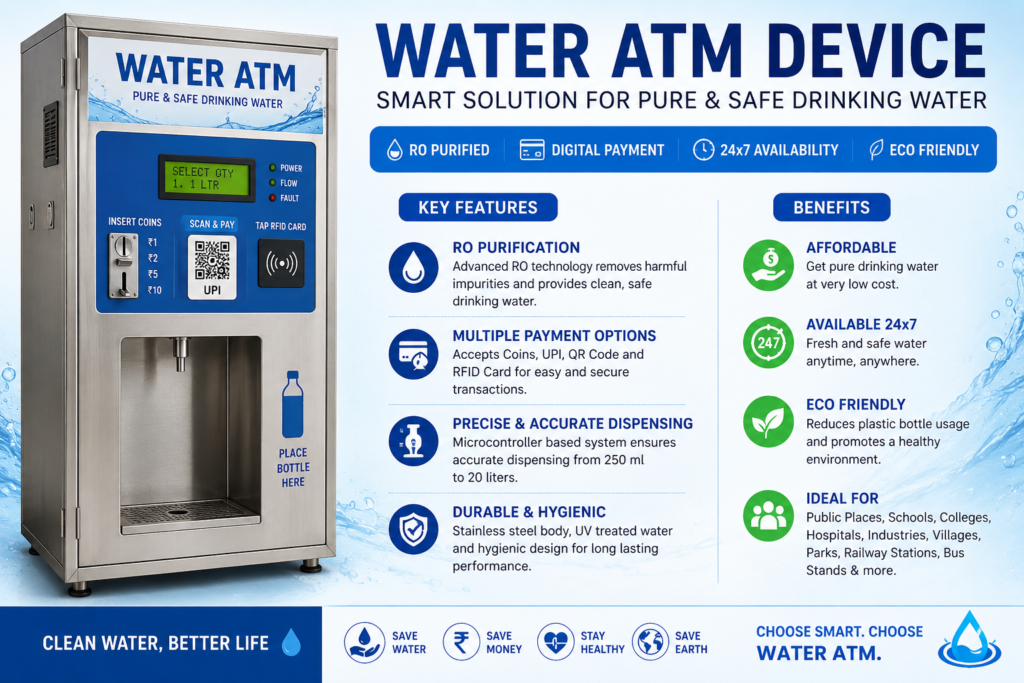

Water is essential for life, but access to safe and affordable drinking water remains a challenge in many public and commercial spaces. Every day, thousands of people rely on railway stations, hospitals, schools, factories, markets, and parks where clean drinking water is not always easily available. At the same time, the growing use of packaged water has created serious environmental concerns due to plastic waste.
The Water ATM Device has emerged as a modern solution that addresses both challenges. By combining RO water purification, automated dispensing, and cashless payment technology, it delivers purified drinking water whenever people need it. Whether it’s a village community, smart city project, residential society, or industrial campus, Water ATMs are making clean water more accessible, economical, and sustainable.
This article explains why Water ATM Devices are becoming an important part of India’s future water infrastructure.
What is a Water ATM Device?
A Water ATM Device is an automated water vending machine that dispenses RO-purified drinking water in measured quantities. The system is connected to a commercial RO plant and allows users to collect water through multiple payment methods such as:
-
QR Code
-
UPI
-
Coin
-
RFID Smart Card
-
Prepaid Recharge Card
The machine works without constant human supervision and ensures accurate, hygienic, and transparent water distribution.
Unlike bottled water, users refill their own containers, promoting an eco-friendly and cost-effective drinking water system.
Why India Needs Smart Water Vending Systems
India’s rapid urbanization has increased the demand for public drinking water. Traditional water coolers often face issues like poor maintenance, inconsistent hygiene, and lack of monitoring.
A Water ATM solves these challenges by offering:
-
Safe RO purified water
-
24×7 availability
-
Automated dispensing
-
Affordable pricing
-
Digital transaction records
-
Reduced operational manpower
It creates a dependable drinking water solution for both urban and rural communities.
How a Water ATM Device Works
The operation of a Water ATM is simple and efficient.
1. Raw Water Collection
Water is supplied from a borewell, municipal connection, or storage tank.
2. Multi-Stage Purification
The water passes through several treatment stages including sediment filtration, activated carbon filtration, reverse osmosis, and UV sterilization.
This removes:
-
Dust and sediments
-
Chlorine
-
Heavy metals
-
Excess TDS
-
Bacteria and viruses
3. Hygienic Storage
Purified water is stored inside food-grade stainless steel tanks to maintain quality.
4. Smart Payment
The user pays using QR, UPI, coin, or RFID card.
5. Automatic Dispensing
The controller releases the selected quantity with precise litre measurement.
The entire process is completed within seconds.
Key Features of a Modern Water ATM
Today’s Water ATM Devices are equipped with advanced technologies that improve convenience and reliability.
Important Features
-
RO + UV purified water
-
Stainless steel cabinet
-
LCD digital display
-
QR & UPI payment support
-
RFID card compatibility
-
Coin acceptor
-
Automatic litre dispensing
-
Leak-proof dispensing nozzle
-
Low maintenance design
-
Continuous 24×7 operation
These features make the system suitable for public, commercial, and institutional applications.
Best Places to Install Water ATM Devices
A Water ATM performs best in locations with consistent public demand.
Public Locations
-
Railway Stations
-
Bus Stands
-
Metro Stations
-
Public Parks
-
Tourist Destinations
Educational Institutions
-
Schools
-
Colleges
-
Universities
-
Student Hostels
Healthcare
-
Hospitals
-
Clinics
-
Community Health Centres
Commercial & Industrial
-
Factories
-
Warehouses
-
Office Complexes
-
Shopping Malls
Community Projects
-
Villages
-
Panchayat Buildings
-
Residential Societies
-
Smart City Developments
Proper location selection improves both public service and operational success.
Water ATM for Villages: A Game Changer
Rural communities often depend on groundwater that may contain excessive TDS, fluoride, or iron. Installing a Water ATM creates a reliable community water source.
Rural Benefits
-
Affordable drinking water
-
Better public health
-
Reduced travel for water collection
-
Digital payment convenience
-
Minimal manpower requirement
Many Panchayats and NGOs are adopting Water ATM projects to improve village water accessibility.
Why Schools Are Choosing Water ATMs
Healthy students need continuous access to clean drinking water.
A Water ATM provides schools with:
-
Hygienic RO water
-
RFID-based student access
-
Reduced plastic bottle usage
-
Better water monitoring
-
Lower long-term operational costs
It encourages students to carry reusable bottles while promoting sustainable habits.
Industrial Applications
Factories with hundreds of employees require uninterrupted drinking water throughout the day.
Industrial Advantages
-
High-capacity purified water
-
Fast refill stations
-
Improved employee welfare
-
Automated distribution
-
Reduced packaged water expenses
Industrial Water ATMs are commonly connected to 1000–5000 LPH RO plants depending on workforce size.
Digital Payments Make Water Access Easier
The rise of UPI has significantly improved Water ATM usability.
Benefits of Cashless Water ATMs
-
Instant QR payment
-
Secure transactions
-
Automatic revenue tracking
-
No cash handling
-
Faster customer experience
For operators, digital payments simplify accounting while increasing transparency.
Water ATM vs Packaged Drinking Water
|
Feature |
Water ATM Device |
Bottled Water |
|---|---|---|
|
RO Purified |
Yes |
Depends |
|
Cost |
Affordable |
Expensive |
|
Plastic Waste |
Very Low |
High |
|
Refillable |
Yes |
No |
|
Digital Payment |
Yes |
No |
|
Sustainable |
Yes |
Limited |
Water ATMs provide a smarter and greener alternative to disposable packaged water.
Environmental Impact
One of the biggest advantages of Water ATM Devices is their contribution to environmental sustainability.
Eco-Friendly Benefits
-
Reduces single-use plastic bottles
-
Encourages refill culture
-
Lowers transportation emissions
-
Minimizes packaging waste
-
Promotes responsible water consumption
Even one busy Water ATM can prevent thousands of plastic bottles from entering landfills every year.
Choosing the Right Capacity
Every project requires a different RO capacity based on daily demand.
|
Installation |
Recommended Capacity |
|---|---|
|
Small School |
250 LPH |
|
Apartment |
500 LPH |
|
Hospital |
1000 LPH |
|
Factory |
2000 LPH |
|
Village Community |
3000 LPH |
|
Railway Station |
5000 LPH |
Selecting the correct capacity improves efficiency and reduces waiting time during peak usage.
Maintenance for Long-Term Performance
Routine maintenance ensures consistent water quality and equipment reliability.
Daily
-
Clean dispensing nozzle
-
Check water leakage
-
Verify payment module
Weekly
-
Sanitize dispensing area
-
Inspect filters
-
Test valves
Monthly
-
Measure TDS
-
Check RO pressure
-
Inspect controller
Annual
-
Replace RO membranes
-
Service pumps
-
Calibrate sensors
Preventive servicing increases machine life and maintains customer trust.
Future of Water ATM Technology
The next generation of Water ATM Devices is becoming smarter through automation and IoT.
Upcoming Innovations
-
Remote cloud monitoring
-
Live water quality display
-
Mobile app management
-
Solar-powered systems
-
Touch-free dispensing
-
AI maintenance alerts
-
Digital consumption analytics
These innovations will make public drinking water systems more efficient and easier to manage remotely.
Conclusion
The Water ATM Device is revolutionizing the way India delivers clean drinking water. By combining advanced RO purification with automated dispensing and digital payment technology, it offers an affordable, hygienic, and environmentally responsible solution for communities, businesses, and public institutions.
Whether installed in villages, schools, hospitals, factories, railway stations, or smart cities, Water ATM Devices improve public health, reduce plastic waste, and create sustainable water infrastructure for the future. Investing in a smart Water ATM is not just a business decision—it is a step toward building healthier and more sustainable communities.