


BMI Calculator: How to Understand Your BMI Number
Your BMI number gives you a quick way to compare your weight with your height and identify a general weight category. BMI, or Body Mass Index, is calculated from weight and height and is commonly used as a screening measure for overweight and obesity. However, your BMI result is not a complete diagnosis of your health. It is one measurement that can be considered alongside factors such as age, body composition, waist circumference, medical history, and lifestyle.
If you have just used a BMI calculator, the next question is probably: What does my BMI number actually mean? The sections below explain BMI ranges, BMI categories, common BMI numbers, and the limitations you should understand before drawing conclusions from your result.
What Is BMI and What Does It Mean?
BMI stands for Body Mass Index. It is a weight-to-height measurement expressed in kilograms per square meter (kg/m²). For adults, BMI is commonly used to classify weight status into categories such as underweight, normal weight, overweight, and obesity.
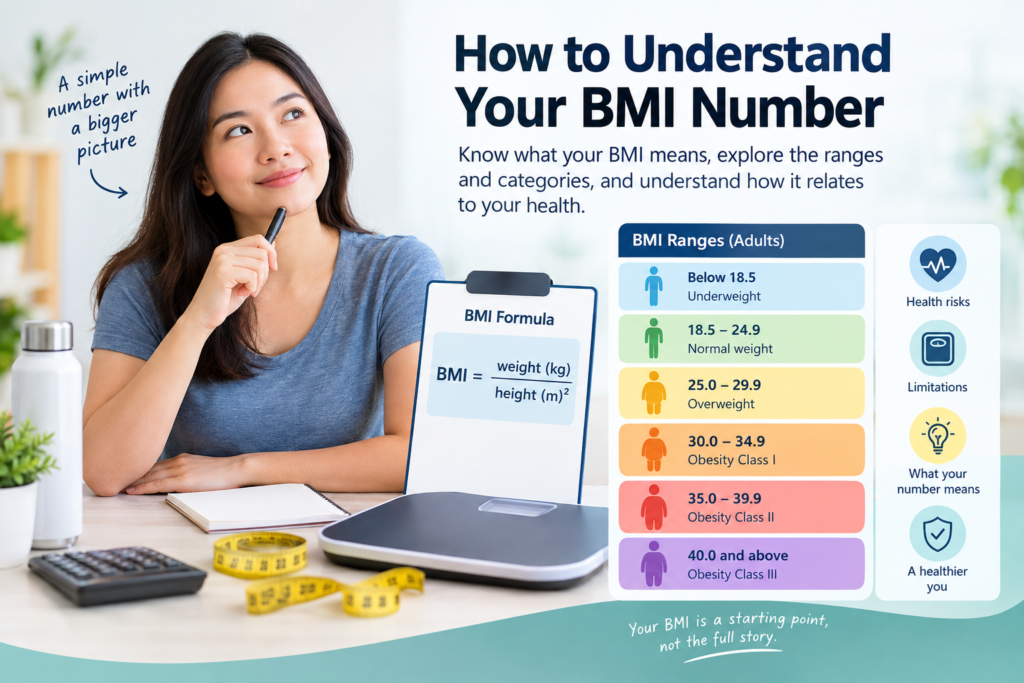
The basic BMI formula is:
BMI = weight in kilograms ÷ height in metres²
For example, someone who weighs 70 kg and is 1.70 m tall has a BMI of approximately 24.2.
The number itself is only the starting point. Its meaning depends on which BMI standards or cutoff values are being used and the characteristics of the person being assessed.
What Do BMI Ranges Mean?
For adults, the commonly used WHO BMI classification is:
| BMI | General classification |
|---|---|
| Below 18.5 | Underweight |
| 18.5–24.9 | Normal weight |
| 25.0–29.9 | Overweight |
| 30.0–34.9 | Obesity, Class I |
| 35.0–39.9 | Obesity, Class II |
| 40.0 or higher | Obesity, Class III |
These BMI ranges are general adult categories. WHO uses BMI of 25 or higher to define overweight and 30 or higher to define obesity in adults.
A BMI in the 18.5 to 24.9 range is commonly described as the normal or healthy BMI range for adults under this classification. That does not mean every person in this range has perfect health, nor does a BMI outside it automatically mean that someone is unhealthy.
What Is a Healthy BMI Range?
Under the standard adult WHO classification, a healthy BMI range is generally 18.5 to 24.9. This range is sometimes called the normal BMI range.
For example:
- BMI 20.4: within the standard healthy range
- BMI 22: within the standard healthy range
- BMI 24: within the standard healthy range
- BMI 24.8: within the standard healthy range
- BMI 25: reaches the standard overweight cutoff
These examples show why a small difference in the BMI number can move a person from one category to another. The category is useful for screening, but it should not be interpreted as a precise measurement of body fat or overall health.
BMI Overweight and Obesity Categories
A BMI of 25 or higher is classified as overweight under the standard WHO adult classification. A BMI of 30 or higher falls into the obesity category.
The obesity BMI categories are commonly divided into:
- BMI 30–34.9: Class I obesity
- BMI 35–39.9: Class II obesity
- BMI 40 or higher: Class III obesity
So, if you are wondering what BMI is considered obese, the standard adult cutoff is 30 or higher. A BMI of 30 is therefore at the beginning of the obesity category under the standard WHO classification.
A BMI of 35 falls into Class II obesity, while a BMI of 40 or above falls into Class III obesity. These classifications describe ranges; they do not by themselves determine an individual’s health status or treatment needs.
How to Understand Common BMI Numbers
People often search for a specific BMI number because they want to know whether their result is normal, overweight, or obese.
What Does a BMI of 24 Mean?
A BMI of 24 falls within the standard adult normal-weight range of 18.5 to 24.9. It is close to the upper end of that range, but the number alone does not tell you how much body fat you have or whether you are healthy overall.
What Does a BMI of 25 Mean?
A BMI of 25 reaches the standard WHO adult overweight cutoff. This does not mean that a person suddenly becomes unhealthy at exactly 25. BMI categories are screening thresholds rather than precise boundaries between healthy and unhealthy individuals.
What Does a BMI of 28 Mean?
A BMI of 28 falls within the standard overweight BMI range of 25.0 to 29.9. The result can indicate that further assessment of weight and other health factors may be useful.
What Does a BMI of 30 Mean?
A BMI of 30 reaches the standard adult obesity cutoff. It is classified as Class I obesity under the commonly used BMI classification.
What Does a BMI of 35 Mean?
A BMI of 35 falls into Class II obesity under the standard adult classification. A higher BMI can be associated with increased risk for several health conditions, but BMI should still be interpreted alongside other health information.
What Does a BMI Above 40 Mean?
A BMI of 40 or higher is generally classified as Class III obesity. Numbers such as BMI 48, BMI 50, or BMI 55 are therefore well above the standard obesity threshold. The exact number should not be used by itself to determine an individual’s health or medical needs.
What BMI Range Applies in Malaysia?
This is an important consideration for a BMI calculator used in Malaysia.
The standard WHO adult classification uses 25 kg/m² as the overweight cutoff and 30 kg/m² as the obesity cutoff. However, Malaysia’s Clinical Practice Guidelines for the Management of Obesity, Second Edition (2023) recommend lower BMI cutoffs for identifying pre-obesity and obesity in the Malaysian clinical context: 23 kg/m² for pre-obesity and above 27.5 kg/m² for obesity.
This difference exists because BMI does not have exactly the same relationship with health risks across all populations. Therefore, when interpreting BMI in Malaysia, it is important to know which classification or guideline is being used.
A result can therefore have different labels under different standards. That is one reason a BMI number should be interpreted in context rather than treated as a universal diagnosis.
Does BMI Matter for Your Health?
BMI can be useful because it provides a simple and inexpensive way to screen for weight-related health risk at the population and individual level. Higher BMI is associated with increased risk for conditions including cardiovascular disease, high blood pressure and type 2 diabetes.
However, BMI and health are not the same thing.
A BMI result does not measure:
- Body-fat percentage
- Where body fat is stored
- Muscle mass
- Fitness level
- Diet quality
- Blood pressure
- Blood glucose
- Cholesterol
- Family history
- Every aspect of an individual’s health
For this reason, BMI is better understood as a screening measurement rather than a complete health assessment.
What Is a Low BMI?
A BMI below 18.5 is classified as underweight under the standard adult WHO classification.
A low BMI can sometimes be associated with inadequate nutrition or other health concerns. Cleveland Clinic notes that people with BMI below 18.5 may have increased risks related to conditions such as malnutrition, anemia, weakened immunity and osteoporosis.
A particularly low BMI should therefore not simply be viewed as a desirable number. If you have an unexpectedly low BMI, unexplained weight loss, or concerns about nutrition, discussing the situation with a healthcare professional can provide more useful context.
What Is a High BMI?
A high BMI generally means the BMI number is above the standard healthy range. Under the WHO adult classification, 25 or higher is overweight and 30 or higher is obesity.
A higher BMI can be associated with a greater risk of several health conditions. However, the number does not explain why the BMI is high.
For example, BMI does not distinguish between muscle and fat. A muscular person can have a high BMI without having the same body-fat level as another person with the same BMI.
This is one reason a high body mass index should be considered alongside other measurements and health information.
What Are the Limitations of BMI?
One of the most important things to understand about BMI is that it has limitations.
BMI Does Not Measure Body Fat Directly
BMI uses height and weight. It does not directly measure body-fat percentage or body composition. Two people with the same BMI can have different amounts of muscle and body fat.
BMI Does Not Show Where Fat Is Stored
The location of body fat can matter for health, but BMI does not tell you whether fat is concentrated around the abdomen or elsewhere on the body. Waist circumference can provide additional information in some assessments.
BMI Does Not Give a Complete Picture of Health
A person can have a BMI in the normal range and still have a health condition. Conversely, someone with a BMI outside the normal range may have factors that the BMI calculation does not capture.
Cleveland Clinic notes that factors such as age, sex, ethnicity, family history and activity level are not fully represented by the standard BMI calculation.
BMI Is Not Interpreted the Same Way for Everyone
Standard adult BMI categories should not simply be applied to children and teenagers. For younger people, BMI is interpreted using age- and sex-specific growth references. Pregnancy also requires a different approach.
Athletes and people with unusually high muscle mass may also need additional assessment because BMI cannot distinguish muscle from fat.
Is BMI a Good Measurement of Health?
BMI is a useful screening tool, but it is not a complete measurement of health.
Its main advantage is simplicity. Height and weight are easy to measure, and the calculation provides a standardized number that can be used to identify broad weight categories.
Its main limitation is that it reduces a complex subject, body composition and health risk, to two measurements: height and weight.
Therefore, asking “Is my BMI good?” is less useful than asking what the BMI indicates and what other information should be considered alongside it.
What Should You Do With Your BMI Result?
Your BMI result can be used as a starting point for understanding your weight category.
If your BMI is within the standard healthy range, you can continue considering other aspects of health rather than assuming the BMI number tells you everything.
If your BMI is above or below the usual range, consider the result alongside factors such as:
- Waist circumference
- Physical activity
- Diet and nutrition
- Blood pressure
- Blood glucose
- Cholesterol
- Medical history
- Family history
- Changes in weight over time
If you are concerned about your BMI, significant weight changes, or related health risks, a healthcare professional can assess the broader picture.
Frequently Asked Questions About BMI
What BMI is considered normal?
For adults using the standard WHO classification, a BMI from 18.5 to 24.9 is classified as normal weight. Malaysia’s clinical obesity guideline uses different thresholds for pre-obesity and obesity, so the applicable standard matters.
What BMI is considered overweight?
Under the standard WHO adult classification, a BMI from 25.0 to 29.9 is classified as overweight.
Is BMI 25 overweight?
Yes. Under the standard WHO adult classification, BMI 25 reaches the overweight cutoff. In Malaysia’s 2023 obesity guideline, BMI 23 kg/m² is used as the cutoff for pre-obesity, so the Malaysian clinical context uses a different threshold.
Is BMI 30 obese?
Under the standard WHO adult classification, yes. A BMI of 30 reaches the obesity cutoff and is within Class I obesity under the commonly used adult categories.
Is a BMI of 35 bad?
A BMI of 35 falls within Class II obesity under the standard adult classification. However, the BMI number alone cannot determine an individual’s overall health or provide a personal diagnosis.
What is a dangerous BMI?
There is no single BMI number that can determine whether a person is in immediate danger. Very low or very high BMI can be associated with increased health risks, but individual risk depends on many factors. A healthcare professional can assess those factors more accurately.
Does BMI change with age?
The BMI calculation itself uses height and weight, but the way BMI is interpreted differs between adults and children. For children and adolescents, BMI must be interpreted according to age and sex rather than using adult BMI categories.
Does BMI differ for men and women?
The standard adult BMI formula is the same for men and women. However, BMI does not account for differences in body composition between individuals, which is one of its limitations.
What is BMI used for?
BMI is primarily used as a screening measure to classify weight status and help identify potential health risks associated with underweight, overweight and obesity. It is not intended to provide a complete diagnosis of an individual’s health.
The Bottom Line
Your BMI number is useful for understanding where your weight falls within a set of BMI ranges, but it should not be treated as a complete measure of your health. Under the standard adult classification, 18.5 to 24.9 is the normal BMI range, 25 to 29.9 is overweight, and 30 or higher is obesity.
For people in Malaysia, it is also important to recognize that Malaysian clinical guidance uses lower BMI cutoffs for pre-obesity and obesity than the standard WHO classification.
Use your BMI result as a starting point. Consider it together with other health measurements and personal circumstances rather than relying on one number alone.