

A rework station that drifts 15°C off its display reading doesn’t announce itself. It just quietly ruins a batch of boards, and nobody notices until the failure rate report lands on someone’s desk three weeks later. That’s the real cost buyers face when they choose the wrong soldering station supplier — not a bad product on day one, but a slow leak of quality nobody can trace back. Sourcing from serious soldering station manufacturers isn’t about ticking a procurement box. It’s about protecting every board that touches that iron for the next five years.
The Spec Detail Most Buyers Skip
Most spec sheets read the same. Wattage, temperature range, display type. Fine. But almost nobody asks about recovery time — how fast the tip returns to set temperature after contact with a large ground plane. A station can hit 350°C at idle and still sag badly under real thermal load.
-
Temperature Range and Calibration Drift
A genuine Temperature Controlled Soldering Station should hold within ±2°C under load, not just at rest. Ask for calibration drift data after 500 hours of use — most suppliers won’t have it ready, and that tells you something.
-
ESD and Lead-Free Compatibility
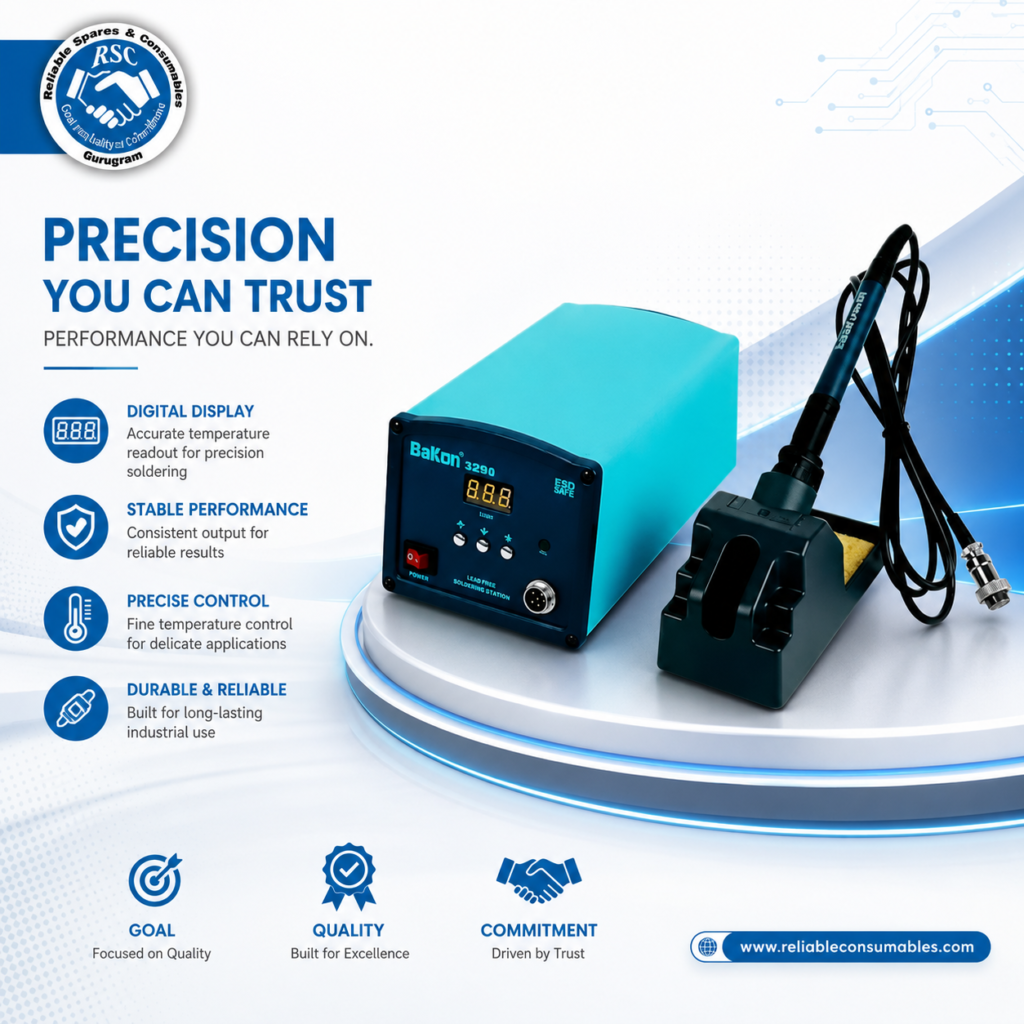
Any station sold into a PCB assembly environment needs to be an ESD Safe Soldering Station by design, not by an add-on mat. Pair that with lead-free tip compatibility, since RoHS lines run hotter and eat cheap tips fast.
-
Digital Control and Tip Availability
A Digital Soldering Station is only as good as its tip ecosystem. If replacement tips take six weeks to land from a supplier’s overseas warehouse, your “fast” station just becomes a bottleneck.
Five Questions That Actually Separate Real Soldering Station Manufacturers From Traders
- Do they manufacture, or repackage? A bad answer sounds like “we work with our factory partners.” That’s a trader with a label maker.
- What’s their tip replacement lead time? Anything past 10 days for a Pan-India order is a warning sign for anyone running a production floor.
- Can they show ESD compliance test reports, not just certificates? A supplier who says the certificate “should still be valid” doesn’t actually know. That’s not confidence — that’s a guess wearing a lab coat.
- What happens when a unit fails in month four? If the answer involves “case by case,” you’ll lose that negotiation the day your shipment lands, not before.
- Do they support bulk calibration checks before dispatch? Most don’t. The ones who do usually say so first, unprompted.
Why This Isn’t Just About the Iron Anymore
Buyers evaluate soldering equipment like it’s a commodity. It isn’t, not when defect rates are on the line.
- Fewer cold joints from consistent tip temperature under real thermal load, not lab conditions
- Lower tip spend because compatible, stocked replacements cost less than proprietary lock-in parts
- Faster line changeovers with digital presents instead of manual dial resets between operators
- Audit-ready documentation for ISO and customer quality reviews, pulled in minutes, not chased for weeks
- Reduced ESD-related returns, which matter more once a client’s RMA data starts flagging your line specifically
- Predictable Pan-India delivery that doesn’t stall a production schedule waiting on customs clearance
Each of those is a margin decision disguised as a spec sheet line.
Why Location Is a Supply Chain Decision, Not Just an Address
Being based in India isn’t a marketing line — it’s the difference between a two-day replacement and a six-week import delay. We ship across the country from stock, not from a promise. Industrial buyers in Pune, Chennai, and the NCR belt already know this: a supplier three states away who answers the phone beats one overseas who answers an email.
About Us
We’ve been manufacturing ESD and industrial electronics tools since 2013, and soldering stations are one product line we refuse to outsource testing on. Every unit gets a load test before it ships — we started doing that in 2019 after a batch of returns traced back to a calibration issue nobody caught at the factory. We don’t advertise that story often, but it’s why the process exists today.
What To Send Us Before Friday
Send your required wattage range, tip type, and monthly order volume, and we’ll quote within 24 hours. Minimum order quantity starts at 25 units for standard configurations; custom builds run higher. No sales call required to get pricing.
Conclusion
A soldering station is a small line item that decides whether your defect rate stays flat or creeps upward over a fiscal year. Reliable & Consumables builds for that reality, not for a spec sheet comparison. The next production run either absorbs a bad iron’s cost quietly, or it doesn’t — that choice happens now, at sourcing.
FAQs
- Are you soldering station manufacturers or just a reseller?
We manufacture. We also stock replacement tips and accessories in-house, which most traders can’t offer.
- What’s the difference between your stations and cheaper imports?
Mainly recovery time under load and ESD compliance documentation. Cheaper units often pass at idle and fail under real use — we won’t pretend otherwise.
- Do you supply Pan-India, or specific regions only?
We supply Pan-India. Northeast states occasionally see longer transit windows; we flag that upfront rather than promise something we can’t hold to.
- Are you soldering station suppliers for bulk EMS orders?
Yes, bulk orders are our core business, not an afterthought.
- How do soldering station suppliers in India typically handle warranty claims?
Poorly, honestly — most delay or dispute. We process replacements within 5 business days of inspection.
- Do you offer ESD Safe Soldering Station models specifically for cleanroom use?
Yes, with documented compliance reports available on request, not just a printed certificate.