

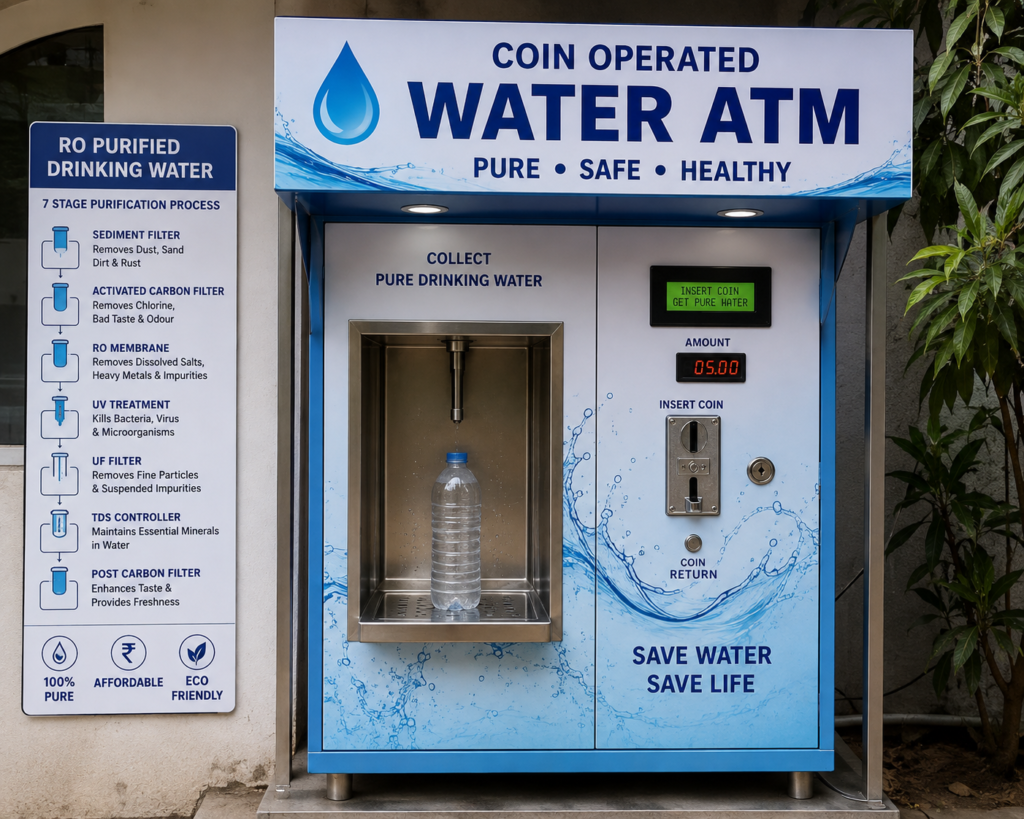

Access to clean and affordable drinking water is essential for healthy communities. As cities grow and the demand for safe drinking water increases, innovative dispensing solutions are becoming increasingly important. One such solution is the coin operated water ATM, a convenient system that allows people to purchase purified drinking water at an affordable price.
What Is a Coin Operated Water ATM?
A coin operated water ATM is an automated water dispensing machine that provides purified or treated drinking water after the user inserts a coin or makes an approved payment. Similar to an ATM for cash, the system allows users to access a specific quantity of water without requiring assistance from an operator.
Depending on the model and treatment system, a water ATM may use technologies such as reverse osmosis (RO), ultraviolet (UV) purification, filtration, or other water-treatment methods before dispensing the water.
How Does a Water ATM Work?
The process is designed to be simple for users. After inserting a coin or making a payment, the customer selects the required quantity of water. The machine then dispenses the corresponding amount of treated water.
Behind the scenes, the system can incorporate several stages of purification, including sediment filtration, activated-carbon filtration, RO treatment, UV disinfection, and other processes depending on the source-water quality and machine design.
This automated approach can make purified water available for extended hours with minimal human intervention.
Benefits of Coin Operated Water ATMs
1. Affordable Drinking Water
One of the biggest advantages of water ATMs is affordability. Instead of purchasing bottled water repeatedly, customers can obtain purified water in their own reusable containers, potentially reducing the overall cost of drinking water.
2. Convenient Access
Water ATMs can be installed in locations where people regularly need drinking water, including residential areas, markets, railway stations, bus terminals, schools, workplaces, and community spaces. Their automated operation can also allow access beyond conventional shop hours.
3. Reduced Plastic Waste
When users refill reusable bottles and containers rather than buying single-use plastic bottles, water dispensing systems can help reduce plastic consumption. This makes water ATMs an interesting option for communities looking for more sustainable ways to distribute drinking water.
4. Automated Operation
Because the dispensing process is automated, a coin operated water ATM can reduce the need for continuous on-site staff. Depending on the system, operators can monitor water production, payments, maintenance requirements, and other operational parameters.
5. Scalable Solution
Water ATMs can be deployed individually or as part of a larger network. This makes the concept suitable for both small communities and larger urban environments.
Where Can Water ATMs Be Installed?
The ideal location depends on local demand, water availability, infrastructure, and applicable regulations. Potential locations include:
- Residential communities
- Public markets
- Schools and educational institutions
- Factories and industrial facilities
- Hospitals and healthcare facilities
- Transportation hubs
- Rural communities
- Offices and commercial buildings
- Community centers
A successful installation generally requires reliable access to a suitable water source, electricity where required, appropriate drainage, regular maintenance, and compliance with local drinking-water standards.
Why Water ATMs Can Support Sustainable Water Access
A major advantage of the water ATM concept is its combination of technology, affordability, and convenience. Instead of distributing packaged drinking water, a dispensing system can treat water and make it available for customers to collect in reusable containers.
For communities facing challenges with the cost or availability of packaged drinking water, this model can provide an alternative distribution mechanism. However, the effectiveness of any water ATM depends heavily on proper water treatment, routine maintenance, quality testing, and responsible operation.
Choosing the Right Coin Operated Water ATM
Before installing a water ATM, buyers and operators should consider several factors:
Water purification technology: The treatment system should be appropriate for the quality and characteristics of the available source water.
Dispensing capacity: The machine should be able to meet expected demand without unnecessary downtime.
Payment system: Depending on the target users, the machine may support coins, tokens, cards, QR payments, or other digital payment methods.
Maintenance requirements: Filters, membranes, UV components, pumps, and other parts may require periodic inspection or replacement.
Water-quality monitoring: Regular testing and monitoring are important to ensure that the treated water remains safe and meets applicable standards.
Energy and operating costs: Electricity consumption, consumables, maintenance, and water wastage should be considered when evaluating the total operating cost.
The Future of Automated Water Dispensing
As consumers and communities become more conscious of affordability, convenience, sustainability, and water quality, automated water dispensing systems have significant potential. Modern machines can also incorporate digital payment systems, remote monitoring, smart sensors, automated alerts, and data tracking.
These features can make water ATM networks easier to manage while giving operators better visibility into usage and maintenance requirements.
Conclusion
Coin operated water ATMs offer a practical approach to making treated drinking water accessible through automated dispensing. By combining water purification technology with convenient payment and dispensing systems, they can serve a wide range of locations and users.
For organizations considering a water ATM project, the most important priorities should be water quality, reliable treatment technology, regular maintenance, user convenience, and compliance with applicable standards. When these factors are properly addressed, water ATMs can become a useful part of modern and sustainable drinking-water infrastructure.