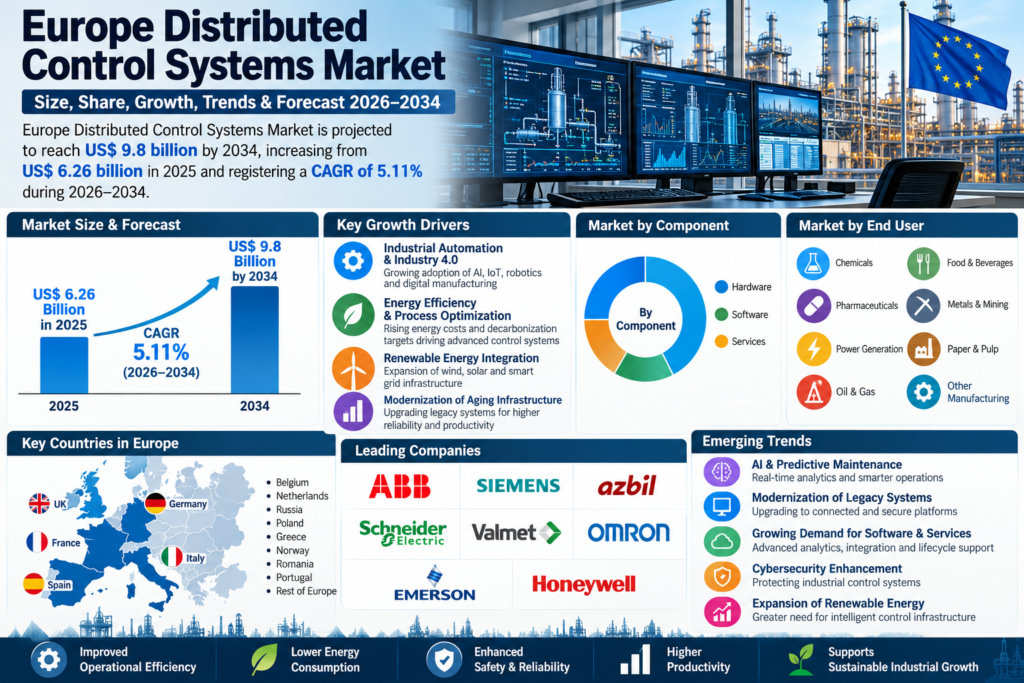

Europe Distributed Control Systems Market Overview
The Europe Distributed Control Systems Market is projected to grow from US$6.26 billion in 2025 to US$9.8 billion by 2034, registering a compound annual growth rate (CAGR) of 5.11% during 2026–2034. Market expansion is supported by increasing industrial automation, modernization of aging control infrastructure, Industry 4.0 adoption, renewable energy integration, and rising demand for energy-efficient manufacturing operations.
Distributed Control Systems (DCS) are essential technologies for industries that require continuous monitoring, accurate process regulation, and reliable operational performance. These systems connect controllers, sensors, human-machine interfaces, communication networks, and software to manage complex industrial processes. Their applications span chemicals, oil and gas, power generation, pharmaceuticals, food and beverages, metals and mining, and other manufacturing sectors.
European industries are increasingly adopting digitally connected production environments to improve productivity, minimize downtime, optimize resource utilization, and strengthen operational safety. The integration of artificial intelligence (AI), industrial Internet of Things (IIoT), advanced analytics, and predictive maintenance is creating additional opportunities for DCS providers. However, high implementation costs, legacy-system integration challenges, cybersecurity risks, and digital skills shortages remain important barriers to adoption.
What Is a Distributed Control System (DCS)?
A Distributed Control System is an industrial automation architecture that manages manufacturing and process operations through multiple interconnected controllers distributed across a facility. Unlike a system that depends on one central controller, a DCS distributes control functions while providing operators with coordinated monitoring and management capabilities.
Key components include industrial controllers, sensors, actuators, communication networks, operator workstations, human-machine interfaces, and process-control software.
DCS platforms help industrial operators maintain consistent production conditions, monitor equipment performance, manage critical process parameters, and respond quickly to operational changes. They are particularly valuable in facilities where uninterrupted operations, process accuracy, and safety are essential.
In Europe, the growing emphasis on digital manufacturing and industrial modernization is strengthening the importance of advanced control systems. According to the supplied source, 20% of EU enterprises used AI technologies in 2025, compared with 13.5% in 2024. This wider digital transformation supports demand for connected industrial platforms capable of converting operational data into actionable insights.
Key Growth Drivers of the Europe Distributed Control Systems Market
1. Industrial Automation and Industry 4.0 Adoption
Industrial automation is one of the major growth drivers of the European DCS market. Manufacturers are investing in connected production systems to improve operational visibility, reduce manual intervention, and enhance production efficiency.
Industry 4.0 technologies, including AI, IIoT, robotics, cloud computing, and advanced analytics, are transforming conventional industrial facilities into data-driven production environments. DCS platforms provide the control infrastructure required to connect field equipment with monitoring systems and higher-level analytical applications.
According to the European Commission figures cited in the source, 20% of EU enterprises with 10 or more employees used AI in 2025. Additionally, 33.2% used data analytics and 38.9% used cloud technologies.
These developments create opportunities for DCS vendors to deliver intelligent automation solutions, real-time process monitoring, predictive maintenance, and improved production consistency. As European manufacturers continue their digital transformation, demand for flexible and interconnected control architectures is expected to increase.
2. Growing Focus on Energy Efficiency and Process Optimization
Energy efficiency is becoming increasingly important for European industrial operators because of operating costs, sustainability objectives, and pressure to reduce emissions. Energy-intensive industries such as chemicals, steel, cement, refining, paper, plastics, and glass require precise control over production conditions and resource consumption.
DCS platforms enable operators to monitor temperature, pressure, flow rates, energy consumption, and production output in real time. This visibility helps businesses identify inefficiencies, adjust operating parameters, reduce waste, and improve equipment utilization.
Advanced control systems can also support predictive maintenance by identifying abnormal operating conditions before they lead to costly equipment failures.
As European industries pursue greater operational efficiency and lower environmental impact, demand for advanced process-control solutions is expected to remain an important contributor to market growth.
3. Renewable Energy Integration and Smart Infrastructure
Europe’s energy transition is creating additional opportunities for distributed control technologies. Increasing deployment of wind and solar power, energy storage systems, decentralized generation, and smart-grid infrastructure requires reliable monitoring and coordinated operational control.
DCS platforms can help power-generation facilities and industrial energy users manage equipment, monitor operating conditions, and coordinate information across multiple systems.
The supplied source highlights the European Commission’s expectation that EU electricity consumption could increase by approximately 60% by 2030. It also reports that wind and solar generation capacity would need to rise from around 400 GW in 2022 to at least 1,000 GW by 2030.
These developments increase the importance of intelligent control infrastructure, particularly in power generation, utilities, and energy-intensive industries. As energy systems become more interconnected, DCS solutions that support operational flexibility, reliability, and real-time visibility are expected to gain importance.
Major Challenges Facing the European DCS Industry
High Initial Investment and System Integration Costs
Implementing a DCS can require substantial investment in controllers, sensors, industrial networks, software licenses, cybersecurity measures, engineering, installation, and employee training.
Integrating modern systems with legacy PLCs, SCADA platforms, field instruments, and enterprise applications can further increase project complexity. Industrial facilities may also need phased implementation or temporary production interruptions during modernization.
These costs can discourage smaller manufacturers from adopting advanced control technologies. Vendors can address this challenge by demonstrating measurable improvements in energy efficiency, productivity, equipment reliability, and maintenance costs.
Cybersecurity Risks and Digital Skills Shortages
As industrial control systems become more connected to cloud platforms, IoT devices, and enterprise networks, cybersecurity becomes increasingly important.
Unauthorized access, malware, ransomware, and other cyber incidents can disrupt industrial operations, damage equipment, and create safety concerns. Industrial operators therefore need secure network architectures, access controls, continuous monitoring, and regular system updates.
A shortage of professionals with expertise in industrial automation, cybersecurity, AI, and data analytics can also slow implementation. Training employees and developing multidisciplinary technical capabilities will remain essential for successful DCS deployment.
Emerging Trends in the Europe Distributed Control Systems Market
Artificial Intelligence and Predictive Maintenance
AI-enabled analytics are creating opportunities to improve industrial process control and equipment maintenance. By analyzing operational data, industrial operators can identify abnormal conditions, anticipate equipment problems, and make more informed maintenance decisions.
The integration of analytics with DCS platforms can support improved process consistency, reduced unplanned downtime, and more efficient resource utilization.
Modernization of Legacy Control Infrastructure
Many European industrial facilities operate established control systems that require modernization. Replacing or upgrading legacy platforms allows manufacturers to improve connectivity, strengthen cybersecurity, and integrate modern monitoring and analytics capabilities.
Recent projects involving ABB and Emerson illustrate the continuing importance of DCS migration and modernization across European industrial facilities.
Growing Demand for Software and Lifecycle Services
DCS software is increasingly important for process visualization, real-time monitoring, data analysis, and operational optimization. At the same time, demand for services is supported by engineering, commissioning, system integration, maintenance, cybersecurity, and upgrades.
As industrial automation becomes more sophisticated, vendors with comprehensive hardware, software, and lifecycle service capabilities can address a wider range of customer requirements.
Distributed Control Systems Product Launches and Developments in Europe
Several product developments and industrial projects demonstrate the direction of innovation in the European DCS market.
- ABB Ability Symphony Plus — February 2023: An updated DCS offering enhanced digital connectivity, secure OPC UA integration, HTML5-based mobile operations, and a new process controller for power generation and water applications.
- Emerson DeltaV Bioreactor Integration — August 2023: Collaboration with Sartorius supported bioreactor integration with the DeltaV DCS for biopharmaceutical manufacturing.
- ABB System 800xA Version 6.2 — May 2024: Enhancements included OPC UA capabilities, Ethernet-APL device integration, expanded PROFINET support, and greater engineering flexibility.
- ABB Freelance 2024 — October 2024: Improvements included connectivity, device communication, Windows 11 compatibility, Microsoft Defender integration, and PROFINET support.
- Yokogawa CENTUM VP R7 — 2025: The platform introduced enhancements involving cybersecurity, integrated plant data, early detection of process conditions, and AI-supported autonomous operations.
- ABB System 800xA Migration at Ravago Greece — July 2025: The project demonstrated the modernization of legacy process-control infrastructure at a Greek chemical facility.
These developments highlight the industry’s focus on connectivity, cybersecurity, system integration, digitalization, and the modernization of industrial operations.
Europe Distributed Control Systems Market by Component
The market is segmented into hardware, software, and services.
Hardware: Includes controllers, communication equipment, field interfaces, and related physical components required to monitor and control industrial processes.
Software: Supports process visualization, control logic, monitoring, analytics, reporting, and operational optimization.
Services: Covers engineering, installation, integration, commissioning, maintenance, upgrades, cybersecurity, consulting, and technical support.
The increasing complexity of industrial automation is creating demand across all three categories. Services are particularly relevant to facilities upgrading existing systems while seeking to minimize operational disruption.
Europe Distributed Control Systems Market by End User
Chemicals
The chemical industry requires accurate monitoring of temperature, pressure, flow, and other critical process variables. DCS platforms help manufacturers improve process stability, operational safety, energy efficiency, and production consistency.
Pharmaceuticals
Pharmaceutical manufacturing requires controlled production conditions, traceability, and consistent quality. DCS solutions support real-time monitoring, process automation, operational records, and integration with digital manufacturing systems.
Power Generation
Power plants require coordinated monitoring and control of complex equipment and operating conditions. DCS platforms support reliable plant operations, process optimization, and the integration of modern energy infrastructure.
Oil and Gas
Oil and gas facilities use distributed control technologies to monitor and manage complex processing operations. System reliability, operational visibility, and safety remain important considerations for adoption.
Food and Beverages, Metals and Mining, and Paper and Pulp
These industries use DCS solutions to improve production consistency, equipment utilization, quality control, and resource efficiency. The specific requirements vary according to manufacturing processes and operating environments.
Country Outlook: Major European DCS Markets
Germany: Germany’s advanced manufacturing base and Industry 4.0 initiatives support demand for industrial automation. Chemicals, pharmaceuticals, energy, and other process industries offer opportunities for DCS modernization and integration.
United Kingdom: Investment in digital manufacturing, energy, pharmaceuticals, water management, and process industries supports the use of connected control technologies.
France: Industrial modernization, digitalization, and sustainability initiatives are creating opportunities for automation platforms across energy, chemicals, pharmaceuticals, food processing, and water management.
Italy: Growing adoption of AI, cloud computing, and data analytics is supporting the modernization of industrial operations and increasing interest in integrated process-control solutions.
Other markets covered include Spain, Belgium, the Netherlands, Russia, Poland, Greece, Norway, Romania, Portugal, and the rest of Europe.
Competitive Landscape and Key Companies
The Europe Distributed Control Systems Market includes established industrial automation providers offering control hardware, software, integration, and lifecycle services.
Key companies covered in the source include:
- ABB
- Siemens AG
- Azbil Corporation
- Schneider Electric SE
- Valmet Oyj
- Omron Corporation
- Emerson Electric Co.
- Honeywell International Inc.
Competition is shaped by product reliability, cybersecurity capabilities, software integration, digital connectivity, technical support, and the ability to modernize legacy infrastructure. Vendors are increasingly focused on connected automation platforms that integrate process control with analytics, maintenance, and plant-wide operational management.
Future Outlook for the Europe Distributed Control Systems Market
The Europe Distributed Control Systems Market is expected to experience steady growth through 2034, increasing from US$6.26 billion in 2025 to a projected US$9.8 billion by 2034 at a CAGR of 5.11% during 2026–2034.
Industrial automation, energy efficiency, renewable energy integration, and the modernization of existing facilities are expected to remain important growth drivers. AI-enabled process optimization, predictive maintenance, improved connectivity, and cybersecurity enhancements are also creating opportunities for technology providers.
However, market participants must address high capital requirements, integration complexity, cybersecurity risks, and the shortage of specialized digital skills. Vendors that combine reliable control technologies with flexible integration, lifecycle services, and measurable operational benefits will be better positioned to serve Europe’s evolving industrial requirements.
Frequently Asked Questions (FAQs)
1. What is the projected size of the Europe Distributed Control Systems Market by 2034?
The market is projected to reach US$9.8 billion by 2034, increasing from US$6.26 billion in 2025.
2. What is the CAGR of the European DCS market?
The Europe Distributed Control Systems Market is forecast to register a CAGR of 5.11% during 2026–2034.
3. What are the major factors driving market growth?
Key drivers include industrial automation, Industry 4.0 adoption, energy efficiency requirements, renewable energy integration, predictive maintenance, and the modernization of aging industrial control infrastructure.
4. Which industries use distributed control systems in Europe?
Major end users include oil and gas, power generation, chemicals, pharmaceuticals, food and beverages, metals and mining, and paper and pulp.
5. What are the main challenges in the European DCS market?
High initial investment, integration with legacy systems, cybersecurity threats, production disruption during upgrades, and shortages of digital skills are important challenges.
6. Which companies are key players in the Europe Distributed Control Systems Market?
Key companies include ABB, Siemens AG, Azbil Corporation, Schneider Electric SE, Valmet Oyj, Omron Corporation, Emerson Electric Co., and Honeywell International Inc.
7. What trends will influence the European DCS market through 2034?
Important trends include AI-enabled process control, predictive maintenance, industrial IoT integration, cybersecurity improvements, advanced automation software, renewable energy integration, and lifecycle services.
8. Why are Germany, the UK, France, and Italy important DCS markets?
These countries have established industrial and manufacturing bases, with demand arising from process industries, digital transformation, automation investments, and modernization of existing facilities.
About Renub Research
Renub Research provides market intelligence, industry analysis, and strategic insights to help businesses understand market developments, growth opportunities, competitive landscapes, and industry trends.
Explore the full report: Europe Distributed Control Systems Market