


Choosing between an FHA loan and a conventional loan often comes down to a single question: which one costs less after you add mortgage insurance? The answer is not always the loan with the lower rate, and it is not always the loan with the smaller down payment. Mortgage insurance quietly adds thousands of dollars over the first decade, and it works very differently on each loan.
This guide compares FHA mortgage insurance premiums (MIP) with conventional private mortgage insurance (PMI) over a 10-year window. You will see the rules, a full worked example with two down payment levels, and a way to test your own numbers with a mortgage payment calculator before you pick a loan.
Quick Answer: Which Costs Less Over 10 Years?
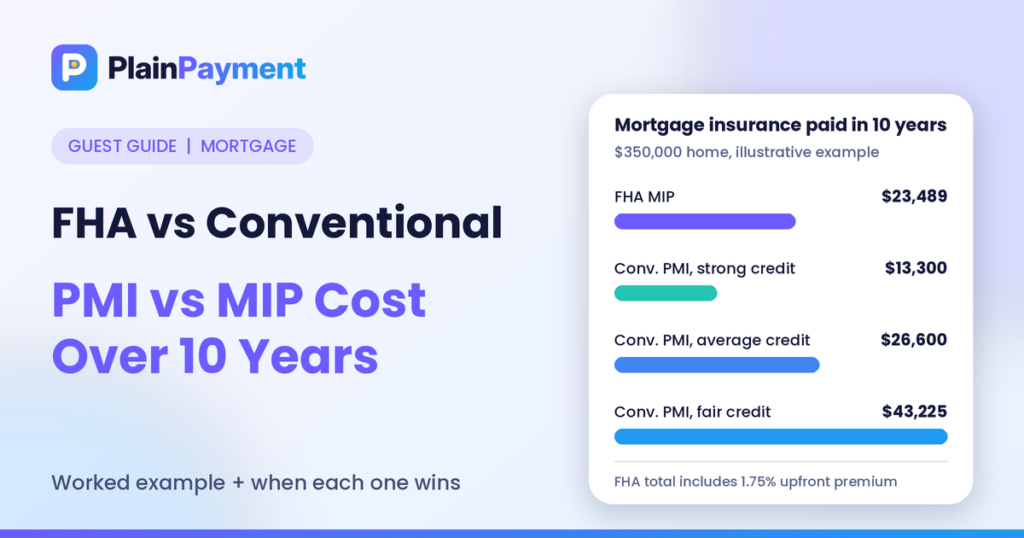
It depends mostly on your credit score and your down payment. In the first example below, a $350,000 home with a small down payment, conventional PMI was cheaper for a borrower with strong credit, about equal for average credit, and far more expensive for fair credit. FHA MIP stays steady no matter how your credit looks, which is why it can win for buyers whose PMI quotes come back high.
The other big difference is duration. FHA annual MIP lasts the life of the loan for most borrowers who put down less than 10%. Conventional PMI can be cancelled once you build enough equity. Ten years is a useful window because it shows both the early cost and the point where those rules start to matter.
PMI vs MIP: What Each One Is
Both are insurance that protects the lender, not you, if you stop paying. You pay the premium, and the lender is covered. The two products are built differently.
| Feature | FHA MIP | Conventional PMI |
|---|---|---|
| Who requires it | Every FHA loan | Conventional loans with less than 20% down |
| Upfront charge | 1.75% of the base loan, often financed | Usually none |
| Annual cost | Set rates, commonly 0.50% to 0.55% on standard 30-year loans | Varies by credit score, down payment, and lender |
| Depends on credit score | No | Yes, strongly |
| How long it lasts | 11 years with 10% or more down, otherwise the life of the loan | Until you reach about 78% to 80% loan-to-value |
| Can you cancel it | Only by refinancing, or after 11 years with 10% down | Yes, on request at 80% or automatically at 78% |
Remember that these are the standard rules for typical 30-year loans within standard loan limits. Larger loans and shorter terms can carry different rates, so always check your own quote.
How FHA MIP Works
FHA mortgage insurance has two parts:
- Upfront MIP (UFMIP): 1.75% of the base loan amount. Most borrowers add it to the loan instead of paying cash at closing.
- Annual MIP: A percentage of the loan balance, divided into monthly payments. On a standard 30-year loan, the rate is commonly 0.55% when the down payment is under 5% and 0.50% when the down payment is 5% or more.
The duration rule is the part buyers miss:
- With less than 10% down, annual MIP lasts for the life of the loan.
- With 10% or more down, annual MIP ends after 11 years.
Because the rate does not move with your credit score, two buyers with very different credit histories pay the same MIP on the same FHA loan.
How Conventional PMI Works
PMI is priced by the lender and the insurer based on risk. The main inputs are:
- Credit score. This is the biggest driver. Strong scores can cut the premium sharply.
- Down payment. More equity means lower risk and a lower rate.
- Loan size and debt-to-income ratio. Both can nudge the price.
- Payment structure. Most borrowers pay monthly. Some pay a single upfront premium, and some take a slightly higher interest rate so the lender pays the insurance.
The removal rules are friendlier than FHA:
- You can ask your servicer to cancel PMI once your balance reaches 80% of the home’s original value, if your payment history is good.
- PMI must end automatically when the scheduled balance reaches 78% of the original value.
- Rising home values can help. A new appraisal may let you request removal sooner, subject to lender rules.
Worked Example 1: Small Down Payment on a $350,000 Home
Here are the assumptions. They are illustrations, not quotes. Real rates and premiums depend on your lender and your profile.
- Home price: $350,000
- FHA loan: 3.5% down ($12,250), base loan $337,750, 6.25% rate, 30-year fixed
- Conventional loan: 5% down ($17,500), loan $332,500, 6.50% rate, 30-year fixed
- FHA rates are often a bit lower than conventional rates, so the example gives FHA the lower rate
- FHA upfront MIP: 1.75% ($5,911), financed into the loan, so the FHA balance starts at $343,661
- FHA annual MIP: 0.55% of the balance
- Conventional PMI: three credit tiers at 0.40%, 0.80%, and 1.30% of the original loan per year
- No home price growth, so PMI does not drop off early
Monthly payment in year one
| Loan | Principal and interest | Mortgage insurance | Total payment |
|---|---|---|---|
| FHA (3.5% down) | $2,116 | about $157 | about $2,273 |
| Conventional, strong credit (0.40%) | $2,102 | $111 | $2,212 |
| Conventional, average credit (0.80%) | $2,102 | $222 | $2,323 |
| Conventional, fair credit (1.30%) | $2,102 | $360 | $2,462 |
The FHA payment is lower than the average and fair credit conventional payments, even though the FHA loan is larger.
What you pay over 10 years
| Loan | Interest | Mortgage insurance | Interest plus insurance |
|---|---|---|---|
| FHA | $199,749 | $23,489 (upfront $5,911 plus annual $17,578) | $223,237 |
| Conventional, strong credit | $201,576 | $13,300 | $214,876 |
| Conventional, average credit | $201,576 | $26,600 | $228,176 |
| Conventional, fair credit | $201,576 | $43,225 | $244,801 |
The 10-year winner by credit tier
- Strong credit: Conventional costs about $8,361 less than FHA.
- Average credit: FHA costs about $4,939 less than conventional.
- Fair credit: FHA costs about $21,564 less than conventional.
Two details change the picture slightly. First, the FHA borrower put down $5,250 less. Second, the FHA balance after 10 years is about $289,492, compared with $281,881 for the conventional loan, so the FHA borrower owes about $7,611 more. Neither number is a cost by itself, but both belong in your comparison.
What happens after year 10
- Conventional: With no price growth, the balance reaches 80% of the original value around month 124, a little past year 10. It reaches 78% around month 135, so PMI ends shortly after the 10-year mark. Any home price growth would end it sooner.
- FHA: MIP keeps going. With less than 10% down, you would keep paying it until you refinance or pay off the loan.
That is why the first 10 years can understate FHA’s true cost. The premiums continue while your balance, and therefore the premium, slowly shrinks.
Worked Example 2: 10% Down on the Same Home
A larger down payment changes the FHA rules in your favor. With 10% down, annual MIP drops to 0.50% and ends after 11 years.
Assumptions:
- Down payment: $35,000 on both loans
- FHA loan: base loan $315,000, upfront MIP $5,513 financed, balance $320,513, 6.25% rate, annual MIP 0.50%
- Conventional loan: $315,000 at 6.50%, PMI tiers of 0.30%, 0.60%, and 1.00% of the original loan per year
- No home price growth
| Loan | Year one total payment | Insurance paid over 10 years | Interest plus insurance |
|---|---|---|---|
| FHA | about $2,106 | $20,416 (upfront $5,513 plus annual $14,904) | $206,710 |
| Conventional, strong credit (0.30%) | about $2,070 | $8,584 | $199,550 |
| Conventional, average credit (0.60%) | about $2,149 | $17,168 | $208,134 |
| Conventional, fair credit (1.00%) | about $2,254 | $28,612 | $219,579 |
Compared with FHA:
- Strong credit: Conventional costs about $7,160 less.
- Average credit: Conventional costs about $1,424 more.
- Fair credit: Conventional costs about $12,869 more.
Notice two things. The gap between FHA and conventional shrinks with 10% down, because PMI prices fall as equity rises. Also, conventional PMI in this example ends around month 109, about nine years in, because the lower starting balance reaches 78% sooner. FHA MIP continues through year 11 even with 10% down.
How Credit Score Changes the Winner
Your credit score is the single input that most often flips the result. Use this table as a rough guide.
| Your situation | Likely better fit | Why |
|---|---|---|
| Strong credit, 5% down or more | Conventional | PMI prices are low, and PMI can be cancelled |
| Average credit, 3% to 5% down | Compare both closely | The totals are often within a few thousand dollars |
| Fair credit, small down payment | FHA | MIP does not rise with a lower score |
| Lower credit, hard to qualify | FHA | FHA has more flexible credit and debt rules |
| 10% or more down, strong credit | Conventional | PMI is cheap and ends sooner |
| Planning to keep the loan 15+ years | Conventional, or FHA with a refinance plan | Life-of-loan MIP adds up |
Minimum requirements also differ. FHA allows a 3.5% down payment with a credit score of 580 or higher, and lower scores generally need a larger down payment. Conventional loans can start at 3% down for some programs, but they usually expect higher credit scores.
Check That You Can Afford the Payment First
Mortgage insurance is only one piece of the monthly cost. Property tax, homeowners insurance, and maintenance also count. Lenders often look for housing costs under about 28% of gross income and total debts under about 36%. A mortgage affordability calculator can show which price range fits your income and your debts once insurance is included.
A lower payment today does not always mean a lower cost over time. FHA can look cheaper each month and still cost more over 15 years if the premium never ends.
Four Ways to Cut Your Mortgage Insurance Cost
- Increase your down payment. Even a few extra percentage points can lower PMI rates or shorten FHA MIP from life of loan to 11 years.
- Improve your credit before you apply. Paying down card balances and fixing report errors can lower PMI pricing. It does not change FHA MIP.
- Pay down principal faster. Extra payments get you to 80% loan-to-value sooner. An extra payment calculator shows how much time and interest you save.
- Refinance out of FHA when you have equity. Once you have about 20% equity and a good credit profile, a conventional refinance can remove MIP completely. Use a refinance break-even calculator to confirm the savings repay the closing costs.
If you are unsure whether a refinance makes sense, read is refinancing worth it for a plain-language walkthrough of the break-even math.
The FHA-to-Conventional Refinance Plan
Many buyers choose FHA with the plan to refinance later. That plan can work, but it carries risks:
- Rates may be higher later. A refinance only helps if the new rate and removed MIP outweigh the costs.
- Home values may not rise. Without growth, you may not reach 80% loan-to-value soon.
- Closing costs apply again. A refinance has lender fees and title work, just like a purchase.
- Credit must hold up. You need a score and income that qualify you for conventional terms.
Treat the refinance as a possible bonus, not a guaranteed exit.
Common Mistakes to Avoid
- Comparing only the interest rate. A lower FHA rate can still cost more once MIP is added.
- Ignoring the upfront premium. Financing the 1.75% charge feels painless, but it grows your balance and your interest.
- Assuming FHA MIP can be cancelled like PMI. For most low down payment loans, it cannot.
- Skipping real PMI quotes. Rates vary a lot by lender, so ask for several.
- Forgetting the time you will keep the loan. A short stay favors the lower upfront cost. A long stay favors the loan whose insurance ends.
- Judging by the monthly payment alone. Look at total cost over 5, 10, and 15 years.
Quick Decision Checklist
- Get Loan Estimates for both an FHA loan and a conventional loan from at least two lenders.
- Ask for the PMI quote at your exact credit score and down payment.
- Compare total cost over 10 years, not only the first payment.
- Check how long each insurance type will last.
- Decide whether you can refinance or pay down faster to remove it.
- Keep cash in reserve after closing.
Bottom Line
FHA and conventional loans are not good or bad in general. FHA gives you flexible qualifying and a fixed insurance price. Conventional gives you a cheaper premium if your credit is strong, and PMI that eventually disappears. In the examples here, the winner flipped with credit tier, and the gap shrank as the down payment grew.
Run your own numbers, ask for quotes, and compare the full 10-year cost. The estimates in this article are for education and are not financial advice. A licensed lender or financial professional can review your own situation before you commit.
FAQs
Is PMI cheaper than MIP?
Often yes for borrowers with strong credit and at least 5% down, and often no for borrowers with fair credit and a small down payment. FHA MIP is the same regardless of credit score, while PMI changes a lot with it.
Can I remove FHA mortgage insurance?
If you put down 10% or more, annual MIP ends after 11 years. With less than 10% down, it generally lasts for the life of the loan. The usual way to remove it is to refinance into a conventional loan once you have enough equity.
When does PMI go away?
You can ask for cancellation when your balance reaches 80% of the home’s original value, if your payments are current. It ends automatically when the scheduled balance reaches 78%. A new appraisal may let you remove it sooner if your home has gained value.
Which is better for a low credit score, FHA or conventional?
FHA is often the better fit, because its qualifying rules are more flexible and MIP does not rise as your score falls. FHA allows a 3.5% down payment with a score of 580 or higher, and lower scores generally require more down. Compare quotes anyway, because the result depends on your numbers.
Are FHA interest rates lower than conventional rates?
They often are, but not always. FHA rates can be a bit lower, but upfront and annual MIP raise the total cost. That is why the APR and the full 10-year cost matter more than the headline rate.
Is the FHA upfront premium refundable?
In limited cases, part of it may be refunded if you refinance into another FHA loan within a few years. Rules vary by situation, so ask your lender before you assume a refund.
Is mortgage insurance tax deductible?
Rules for deducting mortgage insurance have changed several times and depend on whether you itemize and on your income. A tax professional can tell you what applies to you for the current tax year.