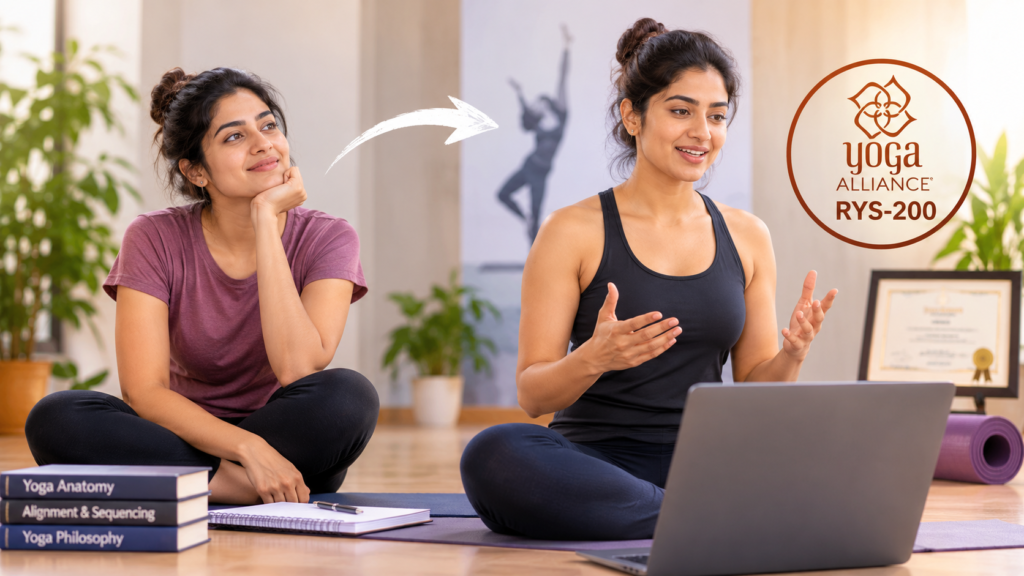

You have been on the mat for a few years now. The poses no longer feel foreign, your breath has found a rhythm, and somewhere along the way a friend asked, “Could you show me how to do that?” You said yes, and then realized you could demonstrate the pose but could not quite explain it. That small, slightly humbling moment is where most aspiring teachers begin.
The Moment Your Own Practice Stops Being Enough
Practicing yoga and teaching yoga are two different skills. A practitioner asks, “How does this feel in my body?” A teacher has to ask, “What is happening in the body of the person in front of me, and what single instruction will help them?” Moving from one question to the other takes structured study, honest feedback, and supervised practice, which is exactly what a teacher training course is meant to provide.
For many students the barrier used to be geography. Training meant leaving work, family, and routine for weeks. That has shifted. A well-run 200 hour online yoga certification lets you study from home while still working with teachers in real time, so the training can fit around a life already in progress rather than replacing it. The format only works, though, if the teaching is live, personal, and demanding. A folder of pre-recorded videos is not the same thing, and it is worth knowing the difference before you commit.
A Screen, a Mat, and a Teacher Who Is Actually Watching
The biggest fear students carry into an online course is simple: will anyone notice if I’m doing it wrong?
In a live format, they can. At Ganga Yogshala, the 200-hour program runs as real-time classes on Zoom, led by Abhishek Pokhriyal and the school’s teaching team from Rishikesh. The emphasis is on live posture correction rather than watch-and-copy instruction. Students who have attended the school’s online classes often describe the same experience in their reviews: a teacher who watches each person, speaks to them by name, and adjusts alignment on the spot, which many did not expect from a screen.
That matters for a future teacher in a particular way. You are not only receiving corrections. You are learning how corrections are given: which cue comes first, how much to say, when to stay quiet and let a student feel the pose for themselves.
Alignment as a Teaching Language
The course is rooted in alignment-based yoga inspired by the principles of the Iyengar method, where precision, awareness, and intelligent sequencing come before speed or spectacle. For someone planning to teach, this has practical consequences.
Alignment gives you a vocabulary. When a student’s knee drifts inward in a standing pose, you do not have to improvise. You can name what you see, explain why it matters, and offer a specific change. Sequencing, meanwhile, teaches you to build a class with a logic of its own, where each pose prepares the body for the next instead of simply following the last one.
Anatomy study sits alongside this, so that your cues come from understanding rather than imitation. It is the difference between telling someone to “lift the chest” because that is what your teacher said, and knowing what you are actually asking their body to do.
Two Months, Six Days a Week: What the Rhythm Looks Like
According to the school’s course page at the time of writing, the training runs for two months, Monday to Saturday, in English, with morning and evening batches in Indian Standard Time (6:00 to 8:00 AM, or 6:00 to 8:00 PM). Please confirm current batch dates and timings with the school directly, since these can change.
Two things are worth noticing about that structure.
First, the pace is steady rather than extreme. Daily sessions build a habit, and a habit is what turns knowledge into instinct. Second, the evening and morning options matter more than they sound. Students joining from different time zones, or balancing office hours, are the ones who most often drop out of long programs. A schedule you can actually keep is part of the curriculum.
Why Some Schools Make You Talk Before They Take Your Enrollment
Here is something unusual: at Ganga Yogshala you cannot simply pay and begin. Every applicant first completes an eligibility assessment, a one-on-one conversation with a senior teacher.
It is not an exam. The school describes it as a way to understand your yoga background, your grasp of basic concepts, your reasons for wanting to teach, your willingness to practice daily, and any injuries or physical conditions that need attention. The aim is to place people in a course where they can succeed, and to make sure expectations on both sides are realistic.
If you have ever felt uneasy about programs that accept everyone instantly, this approach may be reassuring. A school that asks questions before enrolling you is usually a school that intends to teach you seriously afterward. The application path is short: send an enquiry, book the assessment call, attend the conversation, receive confirmation and course details, then enroll.
Reading the Word “Certified” Without Getting Dazzled
The course is run by a school that lists itself as a Yoga Alliance RYS-200 program, and graduates who complete all requirements receive a certificate under that framework. Yoga Alliance is a widely recognized international registry for yoga schools and teachers, and many studios and training bodies look for it.
A few honest points for any student weighing options:
- A certificate opens a door, but it does not teach you how to walk through it. Teaching confidence comes from the hours you spend practicing cues, sequences, and corrections.
- Recognition requirements differ between countries, studios, and insurers. If you plan to teach in a specific place, check what local employers expect.
- Ask any school you are considering who the teachers are, how many students are in a live session, and how feedback is given. Those answers will tell you more than a logo will.
The Version of You at the End of It
Imagine the last week of the course. You are no longer the student who nervously stood in front of a friend and could not explain a pose. You can look at a body, notice what is happening, choose a cue, and sequence a class that makes sense from the first breath to the last. You also know your own practice far better, because you have had to teach it.
That shift from dedicated student to capable, responsible instructor does not happen through inspiration alone. It happens through structure, supervision, and steady daily work. If you feel ready for that, the practical first step is not a payment form. It is a conversation, and a good school will want to have it with you.