

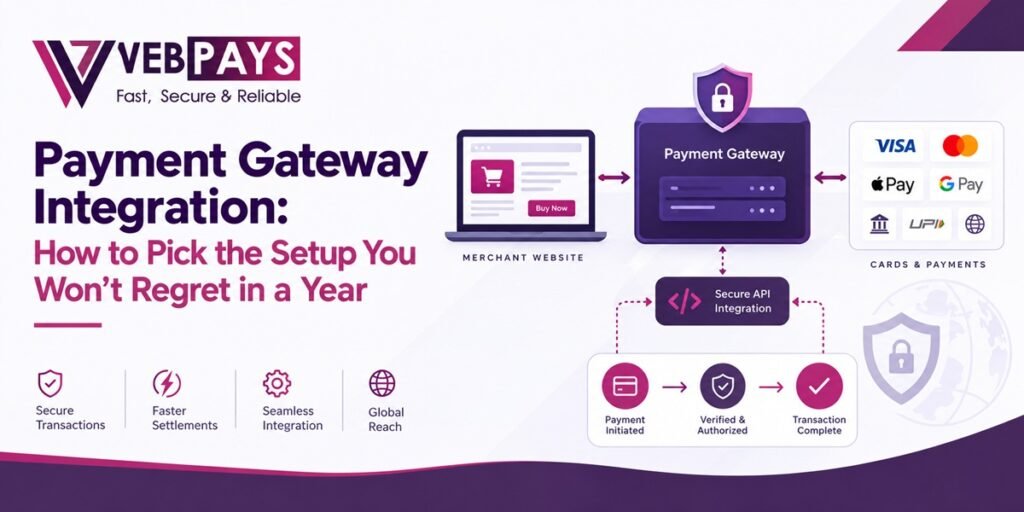

High risk payment gateway integration is the process of connecting your website or app to a gateway that routes transactions to acquirers willing to serve high-risk merchants, using a hosted page, a plugin or an API. Getting it right matters more than in low-risk commerce, because integration mistakes show up as declines, duplicate charges, failed 3-D Secure flows and disputes, all of which put a high-risk account under pressure. This guide covers integration models, prerequisites, the technical flow, testing and go-live, and notes where WebPays supports each approach.
Quick answer: Choose the integration model by how much control and PCI scope you want: hosted page for speed and the smallest scope, plugin for common platforms, embedded fields for a branded checkout, direct API for full control. Whichever you choose, build for idempotency, webhooks and 3-D Secure, then test declines as thoroughly as approvals.
Choose an Integration Model
| Model | Effort | Typical PCI scope | Best for |
| Hosted payment page | Low | Smallest (SAQ A) | Fast launch, lean teams |
| Plugin | Low to medium | Usually small | Merchants on common ecommerce platforms |
| Embedded fields or JavaScript | Medium | Small to moderate | Branded checkout without handling raw card data |
| Direct API | High | Largest (SAQ D) | Custom flows, enterprise control |
PCI scope is the main trade-off. The less card data your servers touch, the less compliance work you carry. WebPays offers API, plugin and hosted-page options, so you can start simple and move to a deeper integration as volume grows. Confirm your exact scope with your provider and a qualified assessor.
Before You Write Code
A few items prevent most integration delays:
- An approved merchant account or confirmed underwriting status. See the high risk payment gateway guide for how accounts and gateways fit together.
- Sandbox credentials, test card numbers and API documentation.
- Your billing descriptor, supported currencies and settlement currency.
- A public HTTPS endpoint for webhooks.
- A decision on 3-D Secure and retry rules.
The Integration Flow
- Obtain sandbox keys and confirm which endpoints and regions you will use.
- Create the order or payment session on your server with amount, currency and reference.
- Collect payment details through the hosted page, embedded fields or API.
- Handle 3-D Secure if the issuer requests authentication.
- Interpret the response: approved, declined, pending or requires action.
- Receive the webhook confirming the final status and update your order system.
- Store transaction references so finance can reconcile settlements.
- Build refund, void and partial-capture paths before launch.
Never mark an order as paid based only on a browser redirect. Confirm through the server-side response or a verified webhook.
Webhooks, Idempotency and Failure Handling
Three habits separate stable integrations from fragile ones. First, use idempotency keys or unique references so a retry or double-click cannot charge a customer twice. Second, verify webhook signatures and process each event once, because gateways resend events when your endpoint is slow. Third, plan for timeouts: if a request times out, query the transaction status before retrying. Duplicate charges are a leading cause of disputes, and in high-risk categories every dispute counts toward your ratio.
3-D Secure and Strong Customer Authentication
3-D Secure adds an authentication step with the cardholder’s bank. In the European Economic Area, strong customer authentication rules under PSD2 make it mandatory for many card-not-present payments, subject to exemptions. Done well, it shifts fraud liability and cuts fraudulent chargebacks. Done badly, it hurts conversion. Use risk-based flows so low-risk payments pass without a challenge, make sure the challenge window works on mobile and test failed and abandoned authentications. The multi-currency payment gateway guide covers how currencies interact with authentication and settlement.
Tokenisation and Recurring Billing
Tokenisation replaces card numbers with tokens, which lets returning customers pay quickly and lets you run subscriptions without storing sensitive data. For recurring billing, flag initial and subsequent payments correctly, send clear descriptors and make cancellation easy. Subscription disputes are a leading cause of high-risk account trouble, and obvious cancellation paths reduce them.
Testing Checklist
Test declines as seriously as approvals:
- Approved payment, soft decline and hard decline.
- 3-D Secure challenge passed, failed and abandoned.
- Network timeout and duplicate submission.
- Full and partial refunds, and voids.
- Chargeback and dispute notifications.
- Currency rounding, including zero-decimal currencies such as the Japanese yen.
- Webhook retries and out-of-order events.
- Mobile checkout on slow connections.
Go-Live and Monitoring
Launch gradually. Start with controlled volume, watch approval rates by country, card type and issuer, and set alerts for sudden decline spikes. Track dispute and refund ratios daily, since card network monitoring programs focus on ratios. Review fraud rules after the first two weeks using real data, not assumptions. Gaming operators should also read the iGaming payment gateway guide, while casino teams can see how this fits their account setup in the casino merchant account article.
Common Integration Mistakes
- Trusting client-side redirects instead of server-confirmed status.
- Skipping idempotency and creating duplicate charges.
- Hard-coding a single currency format.
- Ignoring declined-payment messaging, which leaves customers guessing.
- Going live without testing failover or retry paths.
- Using a vague billing descriptor customers do not recognise.
FAQs About High Risk Payment Gateway Integration
How long does high risk payment gateway integration take?
Plugin or hosted-page setups can be quick, while custom API builds depend on your team, scope and testing. Ask your provider for a realistic plan based on your platform.
Which integration method is best?
Hosted pages suit speed and minimal PCI scope, plugins suit common platforms and direct API suits custom flows. Many merchants start hosted and migrate later.
Does the integration affect PCI compliance?
Yes. The more card data your systems handle, the larger your PCI scope. Hosted and embedded options reduce it.
Do I need 3-D Secure? In the EEA it is required for many payments under PSD2, and elsewhere it is a useful fraud and liability tool. Use it in a risk-based way.
What causes duplicate charges?
Usually retries without idempotency, double-clicks and mishandled timeouts. Unique references and status checks prevent them.
Conclusion
A clean integration protects approval rates, reduces disputes and keeps a high-risk account in good standing. Pick the model that fits your team and PCI appetite, build around webhooks and idempotency, test failure paths thoroughly and launch in stages. WebPays provides API, plugin and hosted-page options to match. Start with the Apply Now form and ask for sandbox access early.