

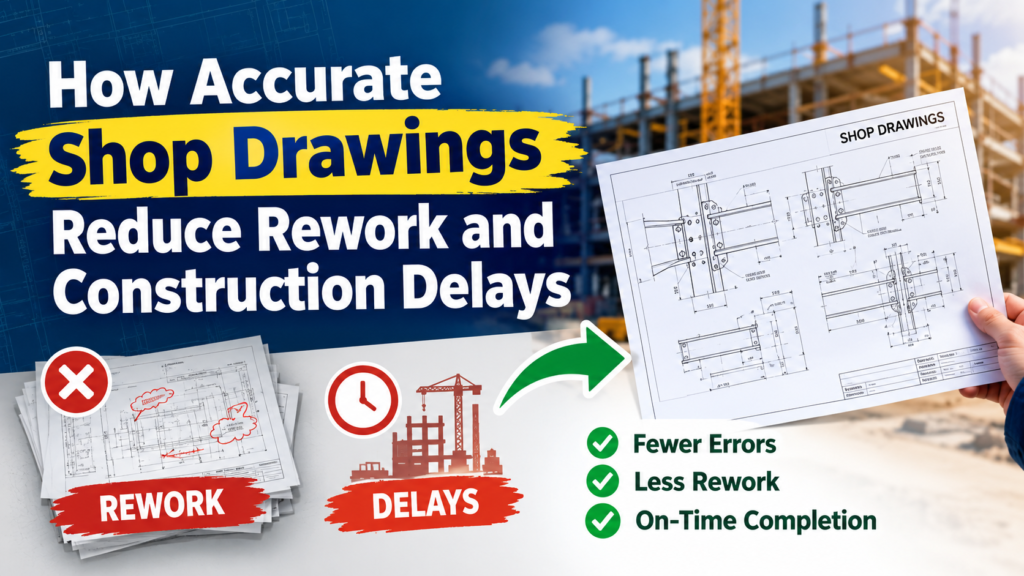

Ask anyone who has managed a job site about their worst week, and there is a decent chance it started with a shop drawing where nobody caught a problem. A window opening that was two inches short. A detail that looked fine on paper but could not actually be built the way it was drawn. These are not rare, dramatic failures; they are the ordinary kind of mistake that quietly adds days to a schedule and dollars to a budget. Good Architectural Shop Drawings Services exist specifically to stop this from happening, and once you have watched a project suffer without them, you understand why they matter.
Chudasama Outsourcing sees this pattern across a lot of projects, and the honest truth is that most rework is preventable. It just requires someone to catch the problem before material gets cut or concrete gets poured.
Rework Rarely Comes From One Big Mistake
People imagine construction rework as the result of some dramatic error, but it is usually smaller than that. A note that got missed. A dimension that was correct on one sheet and wrong on another. A detail that made sense to the person who drew it but was unclear to the crew trying to build from it. None of these sound like a big deal individually, but on a busy site, even a small unclear detail stops work while someone figures out what was actually intended.
What a Shop Drawing Is Actually Supposed to Do
A shop drawing is supposed to remove ambiguity. It takes the architect’s design intent and turns it into something specific enough that a fabricator or installer does not have to guess. Exact sizes, exact materials, exact connection details. When this is done well, the crew on site has no reason to stop and ask a question, because the answer is already on the page.
When it is done poorly, or rushed, the drawing technically exists but does not actually answer the questions people will have once they are standing in front of the real wall or window opening.
Where the Time Actually Gets Lost
A single unclear shop drawing rarely causes a huge, visible disaster. What it causes is smaller and more constant: a crew waiting half a day for clarification, a piece getting fabricated wrong and needing to be remade, an installer improvising a fix that was never approved by the design team. None of these show up as one big headline, but add them up across a project and they are often the real reason a schedule slips.
Catching Problems Before Fabrication Begins
The cheapest time to fix a mistake is before anything has been cut, poured, or welded. This is the whole value of a careful review process on shop drawings. Chudasama Outsourcing builds this review into every project, checking drawings against the design documents and against each other before they ever reach a fabricator, because a mismatch caught at this stage costs almost nothing to fix compared to catching it after material has already been ordered.
Coordination Between Trades Matters More Than People Expect
A lot of rework actually comes from drawings that were accurate on their own but did not account for what another trade was doing in the same space. A millwork piece that did not leave room for an electrical outlet. A structural connection that conflicted with ductwork nobody checked against. Good Architectural Shop Drawings Services cross-reference other disciplines as a normal part of the process, not as an afterthought once a conflict has already been built.
Why Firms Choose to Outsource Shop Drawings
Producing accurate shop drawings takes time and a specific kind of attention that is hard to maintain when staff is also juggling five other responsibilities. This is the main reason so many firms outsource shop drawings instead of trying to squeeze this work into an already full in-house schedule. A dedicated team is not distracted by client calls or site visits mid-drawing, which tends to show in the final accuracy.
What a Rushed Drawing Actually Costs
It helps to put a number on this, even roughly. A delayed crew sitting idle for a day costs real money. A remade piece of custom fabrication can cost thousands and push back everything scheduled after it. A missed detail discovered during a walkthrough can mean tearing something apart that was already finished. None of these costs show up as a single clear bill labeled “bad shop drawing,” but they are there, hidden inside the overall project cost.
Building a Habit of Catching Problems Early
The firms that deal with the least rework are not the ones who are lucky. They are the ones who built a habit of checking drawings carefully before anything moves to fabrication, and who treat that review step as non-negotiable rather than something to skip when the schedule gets tight.
What to Look for in a Shop Drawing Partner
Ask how they catch errors before drawings go out, not just whether they do. Ask how they handle coordination between trades on a shared project. And ask how fast they turn around corrections when something does need to change, since revisions are a normal part of construction, not a sign that something went wrong.
Conclusion
Most construction delays trace back to something smaller and more avoidable than people expect, usually a shop drawing that was not quite clear enough or not checked carefully enough before it reached the field. Getting this step right is one of the simplest ways to protect both schedule and budget.
Firms that outsource shop drawings to Chudasama Outsourcing do it for exactly this reason: careful, accurate Architectural Shop Drawings Services catch problems while they are still cheap to fix, instead of letting them turn into delays once construction is already underway.