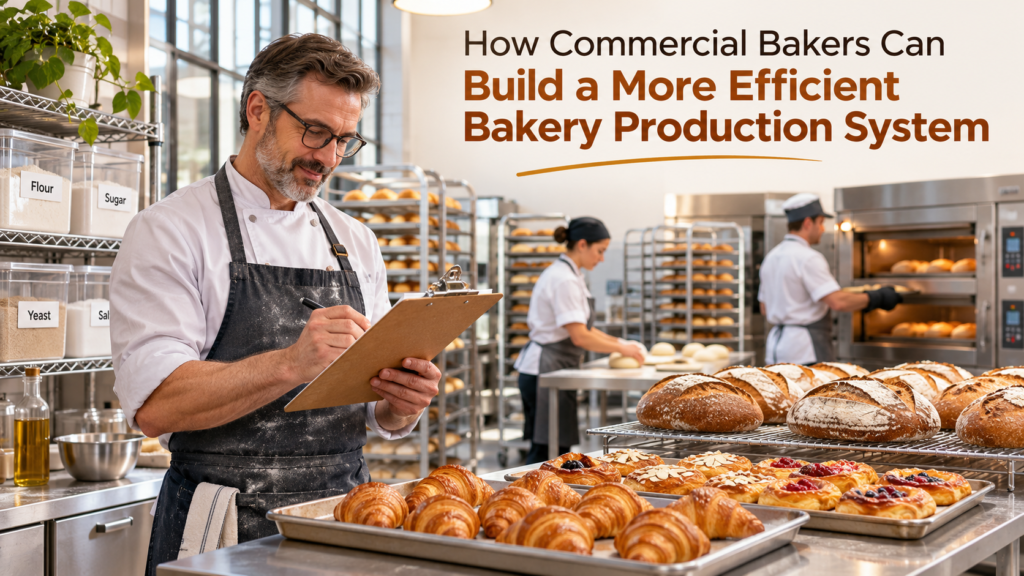

Commercial baking is not just about knowing how to make good bread, cakes or pastries.
The real challenge is producing them consistently, in the right quantities, at the right time, without creating unnecessary waste or exhausting the bakery team.
That requires production planning.
An experienced baker eventually learns that better systems can be just as important as better recipes.
Start With the Production Schedule
A bakery should not begin every shift by deciding what needs to be made.
The production plan should already be clear.
A useful schedule considers:
- expected sales
- wholesale orders
- customer bookings
- production time
- proofing requirements
- oven availability
- cooling time
- finishing
- packaging
This allows the team to work in the correct sequence rather than constantly reacting.
Understand Which Products Control the Schedule
Not every bakery product requires the same amount of time.
Some products may need:
- overnight fermentation
- several proofing stages
- extended cooling
- refrigeration
- multiple finishing steps
These products should shape the production schedule.
If a bread requires several hours before baking, it cannot be treated the same way as an item that can be mixed and baked quickly.
Strong bakers work backwards from the required completion time.
Standardise Your Core Products
Consistency becomes difficult when every baker uses slightly different methods.
For high-volume products, document the important variables.
That may include:
- ingredient quantities
- mixing time
- dough temperature
- proofing conditions
- portion weight
- baking temperature
- baking duration
- expected finished appearance
This does not remove professional judgement.
It creates a consistent starting point.
Weigh Instead of Guessing
Small inconsistencies become expensive when repeated across hundreds of products.
Overportioning by a small amount may seem insignificant.
Across daily production, it can mean substantial additional ingredient cost.
Accurate scaling improves:
- consistency
- cost control
- yield
- production planning
Experienced bakers may be able to estimate quantities visually, but commercial production still benefits from measurable standards.
Keep the Oven Working Efficiently
Oven capacity can become one of the biggest production bottlenecks.
Poor scheduling may leave the oven empty at one point and overloaded later.
Plan baking around:
- temperature requirements
- product compatibility
- batch size
- baking duration
- cooling requirements
Where practical, group products requiring similar conditions.
The goal is not simply to keep the oven full.
It is to use its capacity intelligently.
Track Waste Every Day
Do not treat unsold or damaged products as something that simply happens in bakeries.
Record the waste.
Look for patterns.
You may discover that:
- too much bread is produced on certain weekdays
- one pastry regularly remains unsold
- trimming produces excessive waste
- products are damaged during handling
- batches are being rejected because of inconsistent quality
Once the cause is visible, production can be adjusted.
Separate Sales Problems From Production Problems
If a product is repeatedly left over, it does not automatically mean the bakery produced too much.
The real problem could be:
- poor display
- incorrect pricing
- weak customer demand
- inconsistent quality
- poor product positioning
Before reducing production, understand why the product is not selling.
Production decisions should be based on information rather than assumptions.
Build a Better Prep System
Commercial bakeries often lose time because staff repeatedly search for ingredients, equipment or information.
Preparation can be improved through:
- clearly labelled ingredients
- standard storage locations
- organised tools
- accurate prep lists
- ready production sheets
- clean workstations
Five minutes lost repeatedly throughout a shift becomes a significant productivity problem.
Good organisation makes speed easier.
Train Staff to Recognise Product Problems
Junior bakery workers should not simply follow instructions mechanically.
They should gradually learn to identify when something is wrong.
For example:
- dough texture is incorrect
- proofing is too fast
- batter consistency has changed
- product colour is unusual
- oven temperature is unstable
- finished size is inconsistent
The earlier a problem is identified, the easier it is to correct.
Strong bakery teams understand the product rather than simply following steps.
Do Not Let One Baker Hold All the Knowledge
Some bakeries become dependent on one highly experienced person.
Only that person knows:
- the formulas
- production quantities
- supplier arrangements
- oven behaviour
- troubleshooting techniques
That creates operational risk.
If they are sick or leave the business, production can collapse.
Document important processes and train other team members gradually.
A strong bakery should not depend entirely on one person’s memory.
Use Sales Data to Guide Production
Yesterday’s production quantities should not automatically become today’s quantities.
Consider actual sales patterns.
For example:
Monday: lower retail demand
Friday: strong afternoon sales
Saturday: high bread and pastry volume
Holiday period: increased specialty orders
Adjust production accordingly.
Even a simple spreadsheet can reveal useful patterns after several weeks.
Review Wholesale and Retail Production Separately
Wholesale production and retail production behave differently.
Wholesale orders may be confirmed in advance.
Retail demand is less predictable.
Separating the two can improve planning.
Start with confirmed orders, then add realistic retail quantities based on recent demand.
This reduces the risk of producing too much simply because a large batch feels efficient.
Keep Product Range Under Control
Large menus look impressive.
They can also create:
- more ingredients
- more preparation
- greater storage requirements
- more waste
- more staff training
- more production complexity
A smaller range of consistently strong products may outperform a huge range of average ones.
Periodically ask:
Does this product sell enough to justify the work required to produce it?
If not, reconsider its place in the range.
Prepare for Equipment Failure
Commercial bakery production depends heavily on equipment.
A mixer, proofer or oven failure can interrupt the entire day.
Develop basic contingency planning.
Know:
- who services the equipment
- where emergency contact details are kept
- which products can still be produced
- whether production can be rearranged
- which orders need immediate communication
Problems are inevitable.
The goal is reducing their impact.
Formal Recognition Can Be Part of Career Development
Some bakers build extensive commercial experience through employment, supermarket bakeries, wholesale production, overseas work or their own businesses without following a traditional Australian training pathway.
Professionals who have already developed substantial practical capability may want to explore Baking RPL Australia as part of their longer-term career development.
Formal recognition should reflect genuine existing skills rather than replace the need to develop them.
Move From Baker to Production Thinker
The biggest career shift often happens when an experienced baker stops focusing only on the product in front of them.
They begin thinking about:
- tomorrow’s production
- stock availability
- labour
- waste
- equipment
- customer demand
- team performance
That broader perspective becomes particularly valuable when moving into senior bakery roles.
Final Thoughts
Commercial bakery efficiency does not come from making everyone work faster.
It comes from removing unnecessary problems.
Better schedules reduce rushing.
Standardised products improve consistency.
Waste tracking improves profitability.
Training improves team capability.
Sales data improves production decisions.
The strongest commercial bakers eventually learn to manage not only how products are made, but also how the entire bakery production system works.