



Introduction
Cryptographic keys represent some of the most important security assets in an enterprise environment. Organizations use them to encrypt sensitive information, authenticate systems, create digital signatures, secure communications, and protect digital identities.
However, a key does not remain secure simply because an organization generates it using a strong algorithm.
Organizations must protect the key throughout its entire lifecycle.
This includes secure generation, storage, access, usage, rotation, backup, recovery, retirement, and destruction.
Effective Key management provides the structure organizations need to control these activities.
At the same time, key management in cryptography gives security teams a framework for managing cryptographic keys across databases, applications, cloud platforms, and enterprise systems.
What Is the Cryptographic Key Lifecycle?
A cryptographic key moves through several stages during its existence.
The lifecycle typically includes:
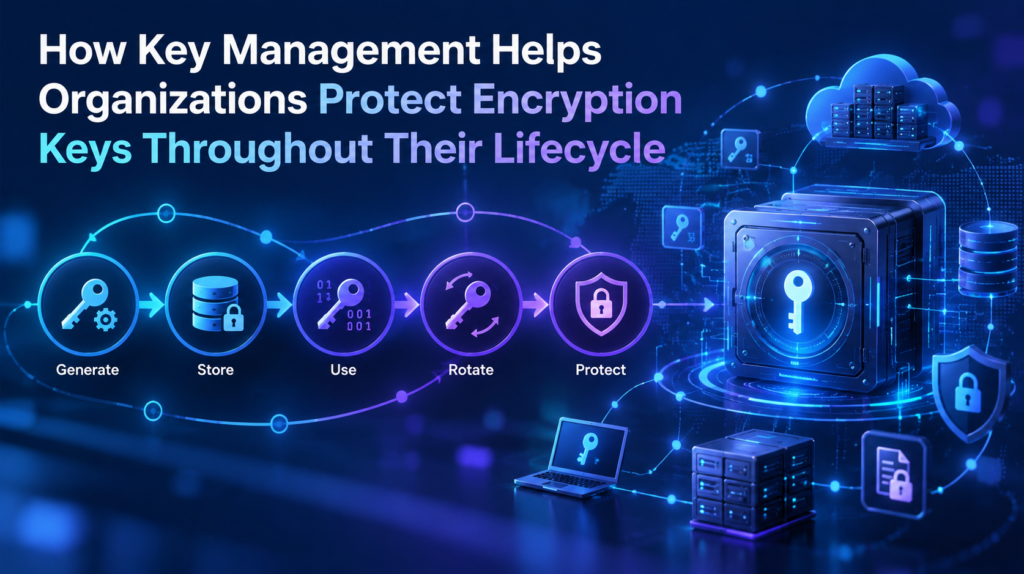
Generation → Storage → Distribution → Usage → Rotation → Backup → Recovery → Retirement → Destruction
Each stage creates different security requirements.
Organizations should establish controls that match the purpose and risk associated with each key.
Stage 1: Key Generation
Key generation begins the lifecycle.
Organizations should generate cryptographic keys using secure and approved mechanisms.
They should also determine the intended use of every key.
For example, organizations may use separate keys for:
- Database encryption
- Application encryption
- Authentication
- Digital signatures
- Certificate protection
Separating key purposes can help organizations establish clearer controls.
Stage 2: Key Storage
Once generated, cryptographic keys require secure storage.
Organizations should avoid exposing sensitive keys through application code, configuration files, or ordinary storage systems.
Security teams should evaluate the sensitivity of each key and apply appropriate protection.
High-value cryptographic keys may require dedicated hardware-based security mechanisms.
Stage 3: Key Distribution
Some systems require access to cryptographic keys to perform approved operations.
Organizations should control how keys become available to authorized users or applications.
They should establish secure processes for distributing keys and avoid unnecessary exposure.
Stage 4: Key Usage
Organizations should monitor how cryptographic keys are used.
A key should perform only its approved function.
Security teams should restrict applications and users according to the principle of least privilege.
This limits unnecessary access.
Stage 5: Key Rotation
Organizations should rotate keys according to their security policies and requirements.
Key rotation replaces an existing cryptographic key with a new one.
Businesses should carefully plan rotation because applications may depend on existing keys.
They should test the process before implementing it across critical production systems.
Stage 6: Key Backup
Organizations should protect backup copies of critical cryptographic keys.
Without appropriate backups, hardware failures or other incidents may result in permanent loss of access to encrypted information.
Key backups should receive appropriate security controls.
Stage 7: Key Recovery
Recovery procedures allow authorized personnel to restore access to critical cryptographic keys when necessary.
Organizations should document recovery procedures and test them regularly.
Testing can help identify problems before an actual incident occurs.
Stage 8: Key Retirement
Cryptographic keys should not remain active forever.
Organizations should retire keys when:
- Applications become obsolete
- Systems are replaced
- Keys reach the end of their approved lifecycle
- Security policies require replacement
Retirement procedures should prevent unnecessary use of obsolete keys.
Stage 9: Key Destruction
Organizations may need to securely destroy keys that are no longer required.
The destruction process should follow organizational security policies and applicable requirements.
This prevents obsolete cryptographic assets from remaining available unnecessarily.
Why Key Management in Cryptography Matters
Key management in cryptography connects technical cryptographic controls with operational processes.
Organizations can use it to establish consistent policies for:
- Key ownership
- Access
- Rotation
- Backup
- Recovery
- Retirement
- Destruction
Without this framework, encryption systems can become difficult to manage at enterprise scale.
Centralized Key Management
Large organizations may manage thousands of cryptographic keys.
These keys can exist across:
- Databases
- Cloud storage
- Applications
- APIs
- Digital certificates
- Identity systems
- Backup platforms
Centralized Key management can provide a unified approach to managing these assets.
Security teams can maintain greater visibility into key status and lifecycle activities.
Key Ownership and Accountability
Every critical key should have clear ownership.
Organizations should document:
- Key owner
- Key purpose
- Associated application
- Protected data
- Access permissions
- Rotation schedule
Clear ownership makes lifecycle management more accountable.
Access Control
Key access should follow least-privilege principles.
Organizations should determine which users and applications require access.
Administrative permissions should receive stronger controls.
Security teams should also review access periodically.
Monitoring
Organizations should monitor key-related activity.
Useful events include:
- Key creation
- Key access
- Key rotation
- Administrative changes
- Failed access attempts
- Key retirement
Monitoring can help security teams identify unusual behavior.
Thales Key Management
Thales key management can support organizations that need centralized capabilities for managing encryption keys across distributed environments.
Organizations can use centralized management to coordinate lifecycle activities and maintain greater visibility.
The specific implementation depends on the organization’s infrastructure, applications, security requirements, and integrations.
Key Management and Cloud Environments
Cloud adoption increases the number of systems that may require cryptographic keys.
Organizations may operate multiple cloud platforms alongside on-premises infrastructure.
A centralized Key management strategy can help businesses maintain consistent policies across these environments.
Key Management and Database Encryption
Organizations often use database encryption to protect sensitive information.
The corresponding encryption keys must receive appropriate protection.
Security teams should document which keys protect which databases and establish clear rotation and recovery procedures.
Common Lifecycle Management Problems
Forgotten Keys
Organizations may lose track of keys associated with older systems.
Inconsistent Rotation
Different systems may use different rotation schedules.
Excessive Access
Users may receive more access than necessary.
Poor Recovery Planning
Organizations may not test whether they can recover critical keys.
Unclear Ownership
Teams may not know who is responsible for specific keys.
Best Practices
Organizations can improve lifecycle management by:
- Maintaining a centralized key inventory
- Assigning ownership
- Applying least privilege
- Separating keys from protected data
- Automating appropriate processes
- Monitoring cryptographic activity
- Testing recovery
- Reviewing key access
- Retiring obsolete keys
- Documenting lifecycle policies
Conclusion
Encryption keys require protection throughout their entire lifecycle.
Effective Key management ensures that organizations do not focus only on generating strong keys but also control how they store, distribute, use, rotate, recover, retire, and destroy them.
Key management in cryptography provides the framework for managing these activities consistently across enterprise environments.
Organizations can also use centralized technologies such as Thales key management to improve visibility and administrative control across distributed infrastructure.
By adopting structured lifecycle policies, strong access controls, secure storage, monitoring, recovery procedures, and appropriate automation, businesses can maintain stronger control over the cryptographic keys that protect their most sensitive information.