

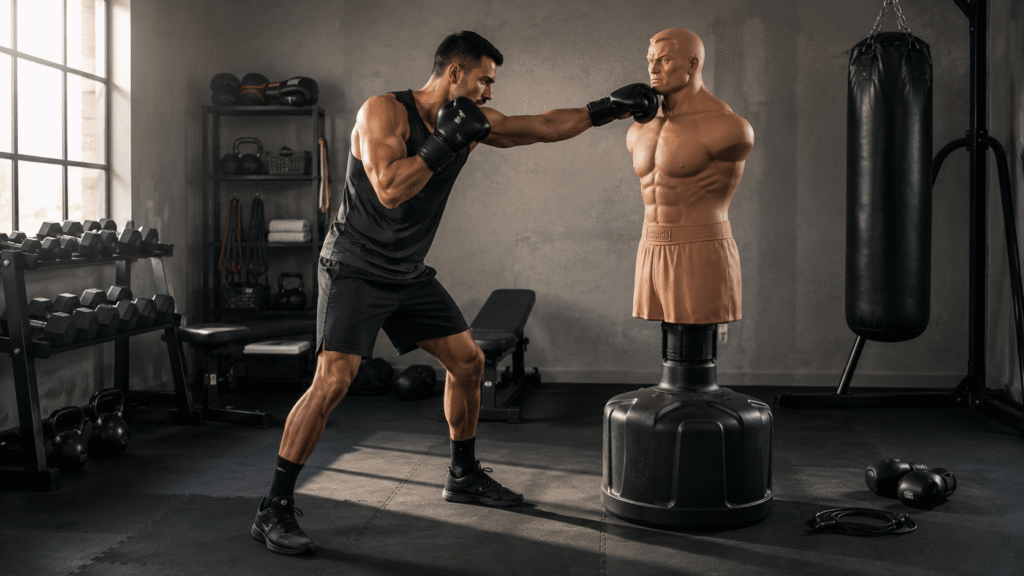

Brazilian Jiu-Jitsu is a technical martial art that requires consistent practice, movement, positioning, timing, and repetition. While regular academy classes and live training partners remain essential, practitioners can also use home training to review techniques and maintain consistency between classes.
A home BJJ training routine does not need to be complicated. With enough space, a suitable training surface, and a few useful pieces of equipment, athletes can practice movement drills, positional transitions, technique repetitions, mobility exercises, and conditioning.
The most important principle is to view home training as a supplement to proper instruction and live practice. A home routine can provide additional repetition, but it cannot completely reproduce the resistance, reactions, timing, and unpredictability of a live training partner.
Why Train BJJ at Home?
One of the biggest advantages of home BJJ training is convenience. There will be days when attending an academy is difficult because of work, school, travel, family responsibilities, or scheduling conflicts.
A short home session can help maintain momentum during those periods.
Home training can be useful for:
- Reviewing techniques learned during BJJ classes
- Practicing fundamental movement patterns
- Repeating positional transitions
- Improving mobility and coordination
- Developing conditioning
- Practicing selected techniques without a partner
- Maintaining a consistent training schedule
The objective is not to replace academy training. Instead, home practice can give practitioners additional opportunities to work on movements they have already learned.
Start With Fundamental BJJ Movements
Before focusing on advanced techniques, it is useful to develop a strong foundation of basic movements.
BJJ practitioners can practice movements such as bridges, hip escapes, shrimping, technical stand-ups, sprawls, and controlled ground transitions.
These exercises can be performed on an appropriate training mat or other suitable surface.
For example, a practitioner can practice several controlled hip escapes while paying attention to hip movement and body positioning. Bridges can be performed with a focus on creating efficient movement rather than simply completing as many repetitions as possible.
Quality should come before speed. Once the movement becomes familiar, the practitioner can gradually increase the pace while maintaining proper technique.
Using a BJJ Grappling Dummy
A grappling dummy can be a useful tool for people who want to add more repetition to their home BJJ training.
A BJJ grappling dummy provides a human-shaped training surface that can be used for selected positional drills, transitions, and technique practice.
Depending on the design of the dummy and the practitioner’s experience, it can be used to review movements related to:
- Guard positions
- Mount
- Side control
- Back control
- North-south
- Guard passing
- Positional transitions
- Armbar movements
- Triangle positioning
- Kimura and Americana sequences
- Selected wrestling and MMA movements
The exact drills should depend on what the practitioner has already learned through qualified instruction.
A grappling dummy does not move or react like a real opponent. It cannot defend, escape, scramble, or provide realistic resistance. For this reason, it should be treated as a repetition tool rather than a replacement for live training.
Practicing Positional Transitions
Positioning is a major part of Brazilian Jiu-Jitsu. Practitioners constantly move from one position to another while trying to maintain control or improve their position.
A grappling dummy can be useful for reviewing these transitions.
Instead of attempting to practice dozens of techniques during one session, choose one simple sequence and repeat it carefully.
For example, a practitioner could work on:
Side Control → Mount → Positional Adjustment → Back Control
The goal is not simply to complete the sequence quickly. Pay attention to hand placement, hip positioning, balance, and body control throughout each transition.
If a particular movement feels difficult, make a note of it and ask an instructor for feedback during the next academy session.
This approach helps connect home practice with formal BJJ instruction.
Practicing Submission Techniques
Many BJJ submissions involve a sequence of movements rather than one isolated action.
An armbar, for example, requires appropriate positioning, control, angle, and movement. A grappling dummy can provide a stable surface for reviewing those movements after they have been taught by an instructor.
Similar practice can be used for selected triangle, kimura, Americana, and other submission sequences.
The purpose of this type of training is to become more familiar with the movement and positioning. Practitioners should avoid trying to teach themselves advanced submissions solely through solo practice.
Proper instruction is particularly important for techniques involving joint manipulation or positions that could cause injury if performed incorrectly.
Creating a Simple Home BJJ Workout
A practical home BJJ session can be divided into several sections.
1. Warm-Up
Start with light movement and mobility exercises to prepare the body for training.
2. Movement Drills
Practice fundamental movements such as bridges, hip escapes, shrimping, technical stand-ups, and other appropriate drills.
3. Technical Review
Choose one or two techniques that have already been taught during academy training.
Focus on correct movement and positioning instead of trying to learn multiple new techniques at once.
4. Grappling Dummy Practice
If you have a suitable BJJ dummy, use it for selected positional drills, transitions, or technique repetitions.
Keep the repetitions controlled and pay attention to technical details.
5. Conditioning
Finish with appropriate strength, mobility, or conditioning exercises based on your individual goals.
A focused 20- to 30-minute session can be easier to maintain than a complicated workout that requires a large amount of time.
Choosing Home BJJ Training Equipment
The equipment required for home BJJ training depends on your goals, available space, and budget.
A suitable training mat is one of the most important considerations because many grappling movements involve contact with the floor.
A grappling dummy can provide additional opportunities for technique repetition.
Other equipment such as resistance bands, kettlebells, adjustable dumbbells, or conditioning tools can be incorporated depending on your overall fitness program.
Before purchasing equipment, consider how frequently you will actually use it. Equipment should support your training routine rather than simply take up space.
How to Choose a Grappling Dummy
There are different types of grappling dummies available, and each may be designed for a different style of training.
Size
Choose a size that is appropriate for your body size, training goals, and available space.
Design
Some dummies are designed mainly for ground-based BJJ training, while others may be better suited to standing drills, wrestling, takedowns, or MMA training.
Material
Grappling dummies may be made from materials such as canvas, synthetic leather, nylon, or polyester. Material can affect durability, maintenance, and how the dummy feels during training.
Filling
Some models are sold unfilled, while others are available filled or can be filled according to the user’s requirements.
Storage
Think about where the dummy will be stored when it is not being used. A practical home gym should remain easy to organize.
Common Home Training Mistakes
One common mistake is attempting to learn advanced techniques without proper instruction.
Online content can help practitioners understand concepts, but it cannot provide the same feedback as a qualified coach observing the movement.
Another mistake is focusing too much on speed. Fast repetitions are not automatically productive repetitions. Begin slowly, understand the movement, and increase speed only when you can maintain good technique.
It is also important to recognize the limitations of a grappling dummy.
A dummy does not react to your movements. It cannot scramble, defend, change position, or provide resistance like a live partner.
This is why home training should remain part of a broader training program that includes regular instruction and live practice whenever possible.
Combining Home Practice With Academy Training
A balanced training approach can combine academy instruction, live partner work, and home practice.
An instructor can introduce a technique and explain its details. A partner can provide resistance and realistic reactions. Home practice can then provide additional repetition.
A useful training cycle is:
Learn → Review → Repeat → Practice With a Partner → Receive Feedback → Refine
Each stage provides something different.
Home practice offers convenience and repetition, while academy training provides coaching, resistance, timing, and live interaction.
Building Long-Term Consistency
Consistency is one of the most important factors in martial arts training.
Rather than creating an unrealistic schedule, choose a routine that fits your lifestyle.
For example, two or three short home sessions per week may provide a manageable way to review movements between academy classes.
Keep track of the techniques you are practicing. Once a movement becomes comfortable, gradually introduce another technique or sequence.
You can also use home practice to identify areas that require more attention. If a particular transition repeatedly feels awkward, bring the question to your instructor during your next class.
Final Thoughts
A well-planned home BJJ routine can provide valuable opportunities for additional practice between academy sessions. Movement drills, mobility exercises, conditioning, and grappling dummy training can all be incorporated into a practical routine.
A BJJ grappling dummy can be particularly useful for repeating selected positions, transitions, and techniques without requiring a live training partner. However, it cannot reproduce the resistance, reactions, timing, and unpredictability of live grappling.
The most effective approach is to use home training as a supplement to qualified instruction and regular partner practice.
With realistic goals, appropriate equipment, and a consistent schedule, your home training space can become a useful extension of your Brazilian Jiu-Jitsu routine.
For practitioners researching equipment for solo BJJ practice, a BJJ grappling dummy can be one option to consider when building a practical home training setup.