

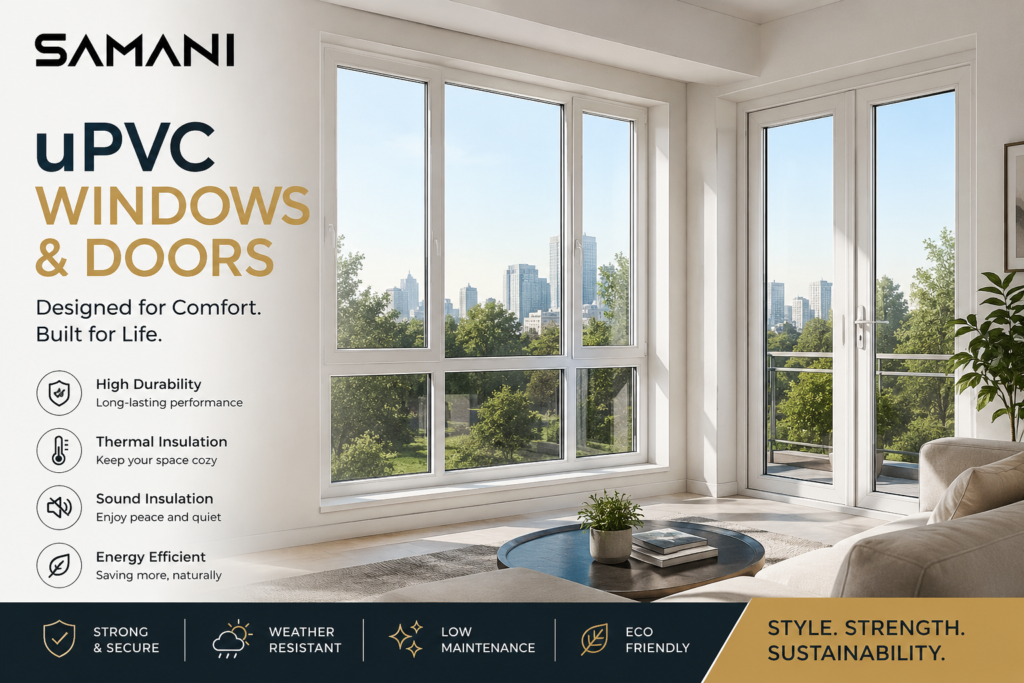

Choosing the right doors and windows can make a noticeable difference to your home’s comfort, appearance, ventilation, security, and everyday functionality. Among modern building solutions, uPVC doors and windows are widely considered for homes because they can combine weather resistance, low maintenance, insulation, and flexible design options in one system.
However, choosing uPVC is only the first step. The actual performance depends on the profile system, opening style, glass, reinforcement, hardware, sealing, drainage, installation quality, and the requirements of each room.
Whether you are building a new home, renovating an apartment, or replacing old windows and doors, this guide explains how to choose the right uPVC doors and windows for your home.
What Are uPVC Doors and Windows?
uPVC stands for unplasticized polyvinyl chloride, a rigid material commonly used to manufacture door and window profiles. Unlike conventional PVC, uPVC does not use plasticizers that make the material flexible.
uPVC profiles are manufactured into different chambers and sections to create door and window frames. These systems can accommodate different types of glass, hardware, gaskets, reinforcement, and opening configurations.
For homeowners, the important point is that a uPVC door or window is not simply a plastic frame. It is a complete system in which the profile, glass, hardware, seals, reinforcement, fabrication, and installation work together.
Why Choose uPVC Doors and Windows for a Home?
The right uPVC system can offer several practical advantages for residential applications.
1. Low Maintenance
uPVC generally does not require painting or polishing like many traditional wooden frames. Routine cleaning with a soft cloth and suitable household cleaner can help keep the frames looking good.
2. Resistance to Moisture
uPVC is naturally resistant to moisture and does not rust like metal. This makes it useful in areas exposed to humidity, rain, and everyday moisture, provided the complete system is correctly designed and installed.
3. Thermal Comfort
The frame design and glazing configuration can contribute to better thermal insulation than poorly insulated conventional openings. Actual performance depends on the profile, glass specification, installation, and surrounding building construction.
4. Noise Reduction
uPVC windows and doors can help reduce outside noise when combined with suitable glazing, good seals, and proper installation. For homes near busy roads or urban areas, the glass specification is particularly important.
5. Modern Appearance
uPVC doors and windows are available in multiple configurations and finishes. This allows homeowners to select systems that complement contemporary, minimalist, traditional, or functional interior designs.
6. Weather Sealing
A properly designed uPVC system can incorporate gaskets, drainage channels, and multi-point hardware to improve resistance against wind-driven rain and air leakage.
How Are uPVC Doors Different from uPVC Windows?
Although both use uPVC profiles, doors and windows have different functional requirements.
uPVC windows are primarily designed to provide natural light, ventilation, views, and weather protection. uPVC doors need to accommodate frequent access, stronger hardware, larger or heavier panels in some configurations, and greater structural demands.
| Feature | uPVC Windows | uPVC Doors |
| Primary purpose | Light, ventilation and views | Access and separation |
| Common styles | Sliding, casement, fixed, tilt-turn | Sliding, hinged, French, folding |
| Hardware | Window-specific hardware | Door-specific, generally heavier-duty hardware |
| Opening frequency | Usually moderate | Often higher |
| Structural requirement | Depends on size and configuration | Generally higher for larger/heavier panels |
| Glass options | Single, double or specialized glazing | Single, double or specialized glazing |
| Common locations | Bedrooms, kitchens, living rooms | Entrances, balconies, patios, bathrooms |
The two should therefore be selected as related but separate systems, rather than assuming that one configuration is suitable for every opening.
What Should You Check Before Buying uPVC Doors and Windows?
Choosing a product based only on appearance or quoted price can lead to problems later. Consider these factors before finalizing your system.
1. Profile Quality
Ask about the profile specification, construction, number of chambers where relevant, wall thickness, and overall system design.
A good-looking frame does not automatically indicate a suitable or high-performing system.
2. Reinforcement
Larger or structurally demanding doors and windows may require reinforcement within the profiles.
Ask the manufacturer or fabricator where reinforcement is used and what material and specification are provided.
3. Glass
Glass can significantly affect the comfort and performance of a door or window.
Depending on the application, options can include:
- Clear glass
- Toughened safety glass
- Laminated glass
- Double glazing
- Tinted glass
- Low-E glass
- Frosted or privacy glass
The right choice depends on factors such as safety, heat gain, noise, privacy, and location.
4. Hardware
Handles, locks, rollers, hinges, friction stays, and other hardware directly influence everyday usability.
For frequently used doors, hardware should be selected according to panel weight, opening frequency, security requirements, and system compatibility.
5. Seals and Gaskets
Good sealing is important for reducing air and water leakage. Ask what type of gaskets or seals are used and how the system manages drainage.
6. Drainage Design
Rainwater should have a controlled path away from the frame. Proper drainage becomes particularly important during heavy monsoon conditions.
7. Installation Quality
Even a high-quality uPVC system can perform poorly if it is incorrectly measured, aligned, sealed, or anchored.
Installation should therefore be treated as part of the product rather than an afterthought.
uPVC Doors and Windows: What About Security?
Security depends on the complete system rather than the frame material alone.
Look for:
- Quality locking systems
- Suitable hinges and handles
- Multi-point locking where appropriate
- Reinforced profiles for relevant applications
- Strong and correctly specified glass
- Proper frame anchoring
- Correct installation
For ground-floor openings and main entrances, security requirements may be higher than for upper-floor fixed windows.
How Much Do uPVC Doors and Windows Cost?
There is no single price for uPVC doors and windows because the final cost depends on several variables.
Important cost factors include:
- Opening dimensions
- Profile system
- Number of chambers and profile specifications
- Window or door configuration
- Glass type
- Glass thickness
- Hardware
- Reinforcement
- Finish
- Customization
- Installation
- Project quantity
- Site conditions
For this reason, two products that look similar can have significantly different quotations.
When comparing uPVC door price or uPVC window price, ask for a detailed quotation that separates the profile, glass, hardware, accessories, installation, and applicable taxes or additional charges.
This makes it easier to understand what you are actually paying for.
Why Is Professional Manufacturing and Installation Important?
uPVC doors and windows involve more than assembling a frame.
The profile must be accurately cut and fabricated, hardware needs to be correctly installed, glass must be properly fitted, drainage must be maintained, and the finished unit needs to be installed square and level.
Poor measurements or installation can affect:
- Smooth operation
- Air leakage
- Water resistance
- Hardware life
- Alignment
- Overall appearance
For this reason, it is useful to evaluate the manufacturer, fabrication quality, installation process, product specification, and after-sales support together.
Why Consider Samani ECC for uPVC Doors and Windows?
Samani ECC provides aluminium and uPVC architectural solutions for residential and commercial applications. Its uPVC range can be explored in different configurations according to requirements such as ventilation, natural light, privacy, weather protection, aesthetics, and everyday functionality.
For homeowners planning new construction or renovation, the focus should be on selecting the right combination of profile, opening style, glass, hardware, dimensions, and installation rather than choosing a door or window based only on appearance.
Frequently Asked Questions
1. Are uPVC doors and windows good for homes?
uPVC doors and windows can be suitable for many homes because they offer low maintenance, moisture resistance, design flexibility, and insulation characteristics. The final performance depends on system quality, glazing, hardware, and installation.
2. Which is better, uPVC sliding or casement windows?
Neither is universally better. Sliding windows are useful when space efficiency is important, while casement windows can provide a larger opening for ventilation. The choice depends on room layout and requirements.
3. Are uPVC doors waterproof?
A properly designed and installed uPVC door can provide good resistance to rain and water infiltration. However, performance depends on seals, drainage, thresholds, fabrication, installation, and exposure conditions.
4. How long do uPVC doors and windows last?
Their service life depends on profile quality, hardware, exposure, installation, maintenance, and usage. A properly specified and maintained system can provide long-term residential service.
5. Do uPVC windows require maintenance?
uPVC windows generally require relatively little maintenance. Regular cleaning, checking drainage paths, inspecting seals, and maintaining moving hardware can help preserve performance.
Conclusion
Choosing the right uPVC doors and windows is not simply about selecting a frame material. The best-suited solution depends on how each opening will be used, the size of the opening, ventilation and lighting requirements, weather exposure, glass specification, hardware, security, aesthetics, and installation quality.
For Indian homes, especially in regions with heavy rain and humidity, attention to sealing, drainage, glazing, hardware, and installation can make a meaningful difference to long-term performance.
Whether you are replacing old windows, planning a new home, or designing a modern apartment, take time to compare the complete system rather than comparing prices alone. A properly selected uPVC door or window can bring together practical functionality, contemporary design, and comfortable everyday living.