

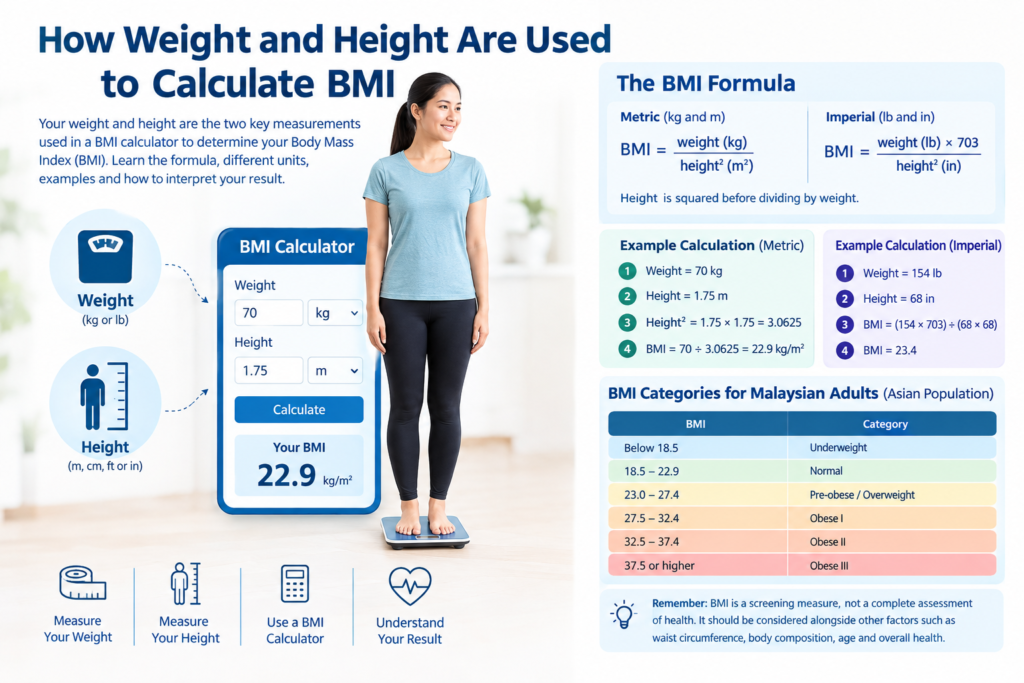

How Weight and Height Are Used to Calculate BMI with a BMI Calculator
Your weight and height are the two key measurements needed to calculate your Body Mass Index (BMI). A BMI Calculator uses these measurements to determine your BMI, a number that can be used to classify weight status in adults. The calculation is simple, but understanding the units, formula, and meaning of the result is just as important as getting the number.
For most adults, BMI is calculated by dividing weight in kilograms by height in metres squared. If you use pounds and inches instead, a different version of the formula is used. A BMI Calculator Online can handle these conversions automatically, making it easier to calculate BMI without doing the mathematics manually.
For people in Malaysia, it is also important to understand that BMI categories used for Asian populations can differ from commonly seen international charts. Malaysia’s Ministry of Health uses lower BMI thresholds for identifying overweight and obesity in Asian adults because health risks can increase at lower BMI levels in Asian populations.
How Does a BMI Calculator Use Weight and Height?
A BMI Calculator takes your body weight and height and applies the standard BMI formula:
BMI = weight (kg) ÷ height² (m²)
The calculation requires two measurements:
- Weight, usually entered in kilograms
- Height, usually entered in metres or converted from centimetres
For example, if someone weighs 70 kg and is 1.75 m tall:
BMI = 70 ÷ (1.75 × 1.75)
BMI = 70 ÷ 3.0625
BMI = 22.9 kg/m²
The BMI value can then be compared with an appropriate BMI classification to understand the person’s weight category.
A BMI Calculator Online performs these steps automatically. You enter your measurements, and the calculator provides the result without requiring you to work through the formula yourself.
What Is the BMI Formula?
The basic bmi formula is:
BMI = Weight ÷ Height²
When using metric measurements:
BMI = weight in kilograms ÷ height in metres²
The unit for BMI is kg/m².
The important point is that height is squared before the weight is divided by it. You should not simply divide your weight by your height.
For example:
- Weight = 80 kg
- Height = 1.80 m
- Height squared = 1.80 × 1.80 = 3.24
- BMI = 80 ÷ 3.24
- BMI = 24.7 kg/m²
This is the standard adult BMI calculation.
How to Get BMI From Height and Weight
If you want to calculate BMI manually, start by making sure your measurements are in compatible units.
For the metric method:
- Measure your weight in kilograms.
- Measure your height in metres.
- Multiply your height by itself.
- Divide your weight by the squared height.
- Round the result if necessary.
This gives you your BMI.
If your height is recorded in centimetres, convert it to metres first. For example, 175 cm is 1.75 m.
How to Calculate BMI in kg and cm
A common question is how to calculate BMI when weight is given in kilograms and height in centimetres.
The easiest method is to convert centimetres to metres:
Metres = centimetres ÷ 100
For example:
Height = 170 cm
170 ÷ 100 = 1.70 m
If the person’s weight is 65 kg:
BMI = 65 ÷ (1.70 × 1.70)
BMI = 65 ÷ 2.89
BMI ≈ 22.5 kg/m²
This is why a BMI Calculator kg and cm option is convenient. The calculator can perform the unit conversion before applying the formula.
You may also see searches such as BMI calculator cm kg, BMI calculator kg and cm, BMI calculator in cm and kg, and calculate BMI in kg and cm. These all refer to the same basic calculation using kilograms for weight and centimetres for height.
How to Calculate BMI in kg and Feet
Height is often given in feet and inches rather than metres. You cannot put feet directly into the metric BMI formula. The height must first be converted into metres.
For example, suppose someone is 5 feet 8 inches tall.
First convert the height into inches:
5 × 12 + 8 = 68 inches
Then convert inches to centimetres:
68 × 2.54 = 172.72 cm
Then convert centimetres to metres:
172.72 ÷ 100 = 1.7272 m
If the person’s weight is 70 kg:
BMI = 70 ÷ (1.7272 × 1.7272)
BMI ≈ 23.5 kg/m²
A BMI calculator in kg and feet can perform these conversions automatically.
This is useful for people who know their weight in kilograms but record their height in feet and inches. Searches such as BMI kg feet, BMI in feet and kg, BMI calculator feet and kg, and calculate BMI in kg and feet all describe this type of calculation.
BMI Calculator Using Inches and Pounds
The imperial BMI formula is useful when your measurements are given in pounds and inches.
The formula is:
BMI = (weight in pounds × 703) ÷ height in inches²
For example, consider a person weighing 154 pounds with a height of 68 inches:
BMI = (154 × 703) ÷ (68 × 68)
BMI = 108,262 ÷ 4,624
BMI ≈ 23.4
The same person’s BMI would be approximately the same whether calculated using metric or imperial measurements, provided the conversions are done correctly.
A BMI calculator inches and pounds or BMI calculator using inches and pounds handles this version of the equation automatically.
You may also see terms such as BMI formula inches and pounds, BMI in pounds and inches, BMI formula in lbs, BMI calculator lbs and inches, and imperial BMI calculator. These refer to the imperial measurement method.
Imperial BMI Formula
The imperial formula can be written as:
BMI = 703 × weight (lb) ÷ height² (in)
The number 703 is the conversion factor used when pounds and inches are used instead of kilograms and metres.
You do not need to memorize the imperial equation if you use an online calculator. However, understanding the formula can help you verify how the result is produced.
BMI Formula Example Step by Step
Let’s work through a complete metric example.
Suppose a person weighs 75 kg and is 1.70 m tall.
Step 1: Record weight
Weight = 75 kg
Step 2: Record height
Height = 1.70 m
Step 3: Square the height
1.70 × 1.70 = 2.89
Step 4: Divide weight by squared height
75 ÷ 2.89 = 25.95
Step 5: Interpret the result
The BMI is approximately:
26.0 kg/m²
The next step is to compare that number with the appropriate BMI classification.
This example demonstrates the bmi formula example in kg and cm after converting 170 cm to 1.70 m. It also shows how to calculate BMI manually without a calculator.
Does the BMI Formula Change for Men and Women?
For adults, the basic BMI formula is the same for men and women.
There is no separate mathematical equation for a bmi formula for men and a bmi formula for women. Both use weight and height:
BMI = weight ÷ height²
However, BMI does not provide the complete picture of body composition. Men and women can have different amounts and distributions of body fat at the same BMI, so the number should be interpreted alongside other relevant health information.
For this reason, an adult BMI Calculator for men and BMI Calculator for women can use the same mathematical calculation.
Age is different. BMI interpretation for children and teenagers is not the same as adult BMI because growing bodies change in height, weight, and body composition. A child or teenager should be assessed using age- and sex-specific BMI references rather than simply applying an adult BMI category.
Does Age Affect BMI Calculation?
For a standard adult BMI calculation, age is not part of the formula.
The calculation is based on:
Weight + height = BMI
However, age can matter when interpreting BMI, particularly for children and teenagers. Malaysia’s Ministry of Health also provides BMI-related tools that request information such as age, sex, weight, and height, reflecting the fact that health assessment can involve more than the basic adult BMI equation.
Therefore, a BMI calculator with age may collect additional information even though age itself is not inserted into the standard adult BMI formula.
BMI Categories for Adults in Malaysia
The interpretation of BMI depends on the reference population and guideline being used.
Malaysia’s Ministry of Health’s 2023 Clinical Practice Guideline for Management of Obesity uses the following BMI-based classification for adults over 18 in the Asian population:
| BMI | Malaysian/Asian adult classification |
|---|---|
| Below 18.5 | Underweight |
| 18.5–22.9 | Normal |
| 23.0–27.4 | Pre-obese / Overweight |
| 27.5–32.4 | Obese I |
| 32.5–37.4 | Obese II |
| 37.5 or higher | Obese III |
The same guideline notes that Asian populations can experience certain obesity-related health risks at lower BMI levels, which is why lower thresholds are used in the Malaysian clinical context.
This is an important distinction when using a BMI Calculator Malaysia. A generic calculator may display a different set of categories based on another population reference.
Why Height and Weight Alone Do Not Tell the Whole Story
BMI is useful because it is simple, inexpensive, and easy to calculate. However, it is a screening measure rather than a complete measurement of health.
BMI does not distinguish between muscle and fat. A person with substantial muscle mass may have a relatively high BMI without having the same body-fat level as another person with the same BMI. Malaysia’s Ministry of Health also notes that BMI does not distinguish body-fat distribution and that waist circumference can provide additional information about abdominal fat.
Cleveland Clinic similarly describes BMI as a screening tool rather than a complete assessment of an individual’s health.
This means your BMI result should be viewed in context rather than treated as a diagnosis.
BMI and Waist Circumference
Weight and height provide the information required for BMI, but waist circumference can add another useful measurement.
BMI tells you about the relationship between total body weight and height. Waist circumference provides information about fat carried around the abdomen.
Malaysia’s clinical guidance highlights waist circumference as a practical measure of abdominal fat and notes its relationship with metabolic and cardiovascular risk.
For that reason, someone checking their weight status may benefit from considering both BMI and waist circumference rather than relying on BMI alone.
Can You Calculate BMI Without a Calculator?
Yes. You can calculate BMI manually with a calculator, paper and pen, or a spreadsheet.
For metric measurements:
BMI = weight in kg ÷ height in m²
For imperial measurements:
BMI = weight in lb × 703 ÷ height in inches²
However, an online BMI Calculator reduces the chance of making mistakes with unit conversion or squaring the height. This is particularly helpful when switching between centimetres, metres, feet, inches, kilograms, and pounds.
Common BMI Calculation Mistakes
Several simple errors can produce an incorrect BMI.
Using centimetres without conversion
If your height is 175 cm, do not square 175 in the metric formula. Convert it first:
175 cm = 1.75 m
Forgetting to square height
BMI uses height squared.
It is:
Weight ÷ (height × height)
not:
Weight ÷ height
Mixing measurement systems
Do not combine kilograms with the imperial formula or pounds with the metric formula unless you first convert the measurements appropriately.
Entering feet as a decimal incorrectly
A height of 5 feet 6 inches is not the same as 5.6 feet. Feet and inches use different units, so a calculator designed for feet and inches is useful.
Using adult BMI categories for children
Children and teenagers require age- and sex-specific interpretation. An adult BMI chart should not simply be applied to them.
How Accurate Is a BMI Calculator?
A BMI Calculator can accurately perform the mathematical calculation when the height and weight entered are accurate. However, the BMI number itself is only an estimate used for screening.
For example, two people with the same BMI can have different amounts of body fat, muscle mass, and fat distribution.
Cleveland Clinic notes that BMI has limitations because it does not account for every aspect of health.
Malaysia’s Ministry of Health likewise identifies limitations involving muscle mass, ageing, and body-fat distribution.
Therefore, a BMI result is best understood as one piece of information rather than a complete diagnosis.
What Measurements Do You Need for a BMI Calculator?
For a standard adult calculation, you need:
- Weight
- Height
You may enter these measurements using either metric or imperial units, depending on the calculator.
For metric calculation:
Weight: kilograms
Height: metres or centimetres
For imperial calculation:
Weight: pounds
Height: feet and inches, converted to inches for the formula
Some calculators may also ask for age and sex. These details can be useful for broader interpretation, but they are not part of the basic adult BMI equation.
Frequently Asked Questions About BMI Calculation
What is the formula for BMI?
The standard metric formula is:
BMI = weight in kilograms ÷ height in metres squared
For imperial measurements:
BMI = weight in pounds × 703 ÷ height in inches squared
How do I calculate my BMI?
Measure your weight and height, make sure they are in compatible units, and apply the appropriate BMI formula. An online BMI Calculator can perform the calculation automatically.
How do I calculate BMI in kg and cm?
Convert your height from centimetres to metres, then divide your weight in kilograms by your height in metres squared.
For example, 170 cm becomes 1.70 m before calculation.
Can I calculate BMI in pounds?
Yes. Use the imperial BMI formula:
BMI = (weight in pounds × 703) ÷ height in inches²
Is the BMI formula the same for men and women?
Yes. The standard adult BMI formula is the same for men and women. What can differ is the interpretation of BMI in relation to overall health and body composition.
Does BMI use age?
Age is not part of the standard adult BMI formula. However, age is important when interpreting BMI for children and teenagers because their BMI is assessed differently.
What is the unit of BMI?
BMI is expressed in kilograms per square metre (kg/m²) when calculated using metric measurements.
Is BMI a measurement of body fat?
No. BMI is an indirect screening measure based on height and weight. It does not directly measure body fat or show where fat is stored.
Why can Malaysian BMI categories differ from international charts?
Malaysia’s Ministry of Health uses lower BMI thresholds for overweight and obesity in its Asian-population classification because health risks can occur at lower BMI levels among Asian populations.
Final Thoughts
Weight and height are the foundation of a standard adult BMI calculation. Once the measurements are recorded in compatible units, the formula is straightforward: divide weight in kilograms by height in metres squared.