
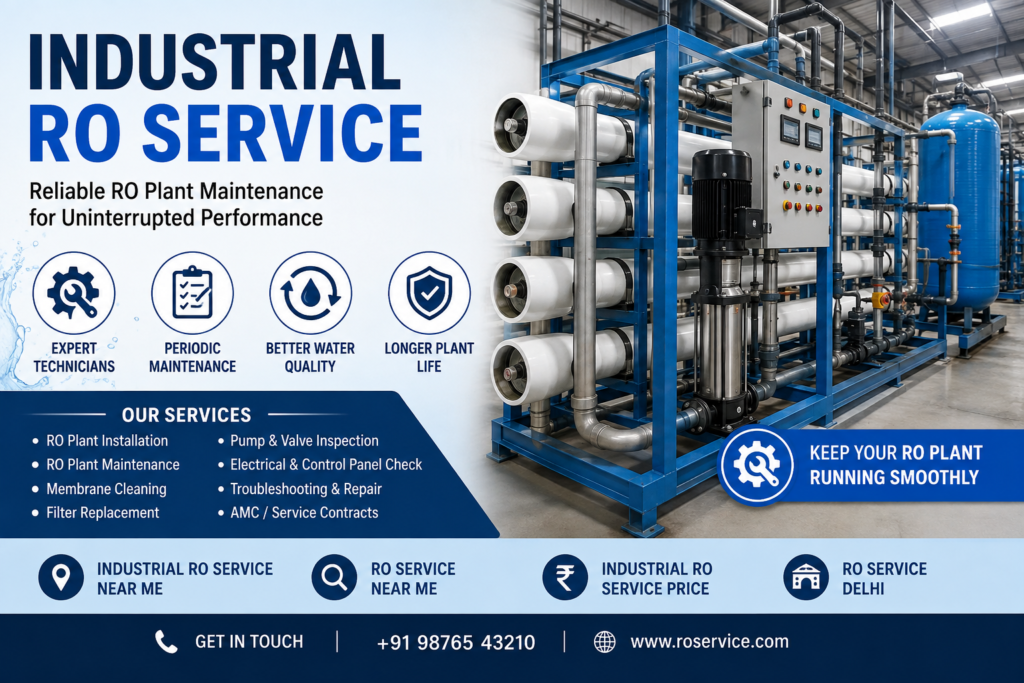

Industrial RO plants play an important role in supplying purified water for manufacturing units, commercial facilities, hospitals, hotels, food-processing industries, and many other applications. Since these systems operate continuously under demanding conditions, regular maintenance is essential for maintaining water quality, production capacity, and overall plant efficiency.
A professional industrial RO service program helps identify performance issues before they become major failures. From membrane inspection and filter replacement to pump maintenance and pressure monitoring, every component needs proper attention. Regular servicing can also help reduce unexpected downtime and extend the operating life of expensive RO equipment.
Why Industrial RO Service Is Important
An industrial RO plant consists of several interconnected components, including pretreatment systems, cartridge filters, high-pressure pumps, membranes, electrical controls, pressure gauges, flow meters, and storage systems. A problem in one component can affect the performance of the complete system.
Regular industrial RO service helps maintain:
- Consistent purified water production
- Better membrane performance
- Stable operating pressure
- Improved water recovery
- Reduced equipment downtime
- Longer membrane and component life
- Better overall plant efficiency
Instead of waiting for the plant to develop a serious fault, preventive maintenance allows operators to detect small problems at an early stage.
Common Problems in Industrial RO Plants
Industrial RO systems can experience different problems depending on feed-water quality, operating conditions, plant usage, and maintenance practices.
Some common issues include:
- Low permeate production
- Increasing feed or operating pressure
- Poor rejection of dissolved solids
- Frequent cartridge filter blockage
- Membrane fouling or scaling
- High-pressure pump problems
- Leakage from pipes and fittings
- Electrical control faults
- Unusual noise or vibration
- Changes in product-water quality
Ignoring these warning signs can increase repair expenses and may eventually result in prolonged plant shutdown.
Role of Pretreatment Maintenance
Pretreatment is one of the most important parts of an RO system. Its purpose is to protect RO membranes from suspended solids, hardness, chlorine, iron, organic matter, and other contaminants.
Depending on the feed-water characteristics, pretreatment may include:
- Multimedia filtration
- Activated carbon filtration
- Water softening
- Iron removal
- Micron or cartridge filtration
- Chemical dosing
- Antiscalant dosing
When pretreatment is not maintained properly, contaminants can reach the RO membranes and reduce their performance.
During professional RO service near me, technicians should inspect pretreatment equipment and verify whether filters, resin, chemicals, valves, and pressure conditions are functioning correctly.
RO Membrane Maintenance
RO membranes are among the most important and expensive components of an industrial RO plant. Membrane performance gradually changes due to fouling, scaling, biofouling, and unsuitable operating conditions.
Regular inspection should focus on:
- Feed pressure
- Concentrate pressure
- Permeate flow
- Feed flow
- Recovery percentage
- TDS rejection
- Differential pressure
If membrane performance declines, the system may require cleaning rather than immediate replacement. Proper membrane cleaning depends on the type of foulant and the manufacturer’s recommendations.
A well-maintained membrane can provide reliable performance for a longer period and help control operating costs.
High-Pressure Pump Inspection
The high-pressure pump supplies the pressure required for the RO membrane process. Pump performance directly affects the plant’s production capacity.
During industrial RO maintenance, technicians should check:
- Pump pressure
- Motor condition
- Leakage
- Unusual vibration
- Bearing condition
- Coupling alignment
- Electrical connections
- Noise levels
A pump operating outside its normal conditions can increase energy consumption and negatively affect membrane performance.
Cartridge Filter Replacement
Cartridge filters protect the RO membranes from fine particles that may pass through the earlier stages of pretreatment. Over time, these filters become clogged.
A blocked cartridge filter can cause:
- Higher pressure drop
- Reduced feed flow
- Increased pump load
- Lower RO production
- Greater stress on the system
Therefore, cartridge filters should be inspected and replaced according to operating conditions rather than following an arbitrary schedule.
Monitoring Pressure and Flow
Pressure and flow readings provide valuable information about the condition of an RO plant.
Operators should regularly record:
- Feed pressure
- Pump pressure
- Concentrate pressure
- Permeate flow
- Feed flow
- Reject flow
- Differential pressure
Comparing current readings with historical operating data makes it easier to identify gradual performance deterioration.
For example, a continuous reduction in permeate flow combined with an increase in operating pressure may indicate membrane fouling or scaling.
When to Search for Industrial RO Service Near Me
Searching for industrial RO service near me becomes particularly important when the plant experiences repeated operational problems or when in-house maintenance resources are limited.
Professional service support can be useful for:
- Preventive maintenance
- Membrane cleaning
- Pump troubleshooting
- Filter replacement
- Leakage inspection
- Electrical troubleshooting
- TDS-related issues
- Flow and pressure problems
- Plant performance evaluation
- Emergency breakdown support
A nearby service provider can also reduce response time when an unexpected plant shutdown occurs.
How to Select an Industrial RO Service Provider
Choosing the right service provider is important because industrial RO plants vary significantly in size, design, capacity, and application.
Before selecting a company, consider:
Technical Experience
The service team should understand industrial RO systems, membranes, pumps, pretreatment equipment, electrical controls, and water-quality parameters.
Maintenance Approach
A reliable provider should focus on identifying the root cause instead of repeatedly replacing components without understanding the underlying problem.
Spare Parts Availability
Timely availability of compatible spare parts can reduce downtime during maintenance or repairs.
Service Response
For industries dependent on continuous purified-water production, quick technical support can be extremely valuable.
Documentation
A professional service team should ideally provide maintenance observations, replaced-component details, operating readings, and recommendations.
Understanding Industrial RO Service Price
The industrial RO service price can vary depending on several factors. There is no single fixed cost for every plant.
Important factors include:
- RO plant capacity
- Number of membranes
- Plant design
- Type of fault
- Required spare parts
- Membrane cleaning requirements
- Pump condition
- Pretreatment requirements
- Service frequency
- Site location
- Emergency vs scheduled service
Routine preventive maintenance is generally easier to plan than emergency repairs because technicians can identify potential problems before they cause major failures.
Preventive Maintenance vs Emergency Repair
Preventive maintenance focuses on avoiding failures, while emergency repair is performed after a significant problem has already occurred.
A preventive maintenance program may include:
- Daily operating checks
- Weekly equipment inspection
- Monthly performance review
- Filter inspection and replacement
- Membrane performance analysis
- Pump inspection
- Electrical system checks
- Water-quality testing
- Cleaning when required
- Detailed maintenance reporting
This approach can reduce the chances of sudden breakdowns and help industries plan maintenance expenses more effectively.
Importance of Water Quality Monitoring
RO plant performance should not be judged only by the amount of water produced. Product-water quality is equally important.
Operators should monitor parameters such as:
- TDS
- Conductivity
- pH
- Recovery
- Flow rate
- Rejection percentage
A sudden change in product-water quality can indicate membrane performance problems, pretreatment failure, chemical imbalance, or another system issue.
Regular testing allows technicians to take corrective action before the problem becomes severe.
RO Service Near Me for Faster Technical Support
When an industrial plant operates continuously, delays in maintenance can result in production losses. Businesses often search for RO service near me when they need quick technical assistance.
However, proximity should not be the only selection factor. Technical expertise, service quality, spare-parts availability, maintenance practices, and previous industrial experience should also be considered.
The ideal service provider should be capable of handling both routine maintenance and complex troubleshooting.
RO Service Delhi for Industrial Applications
Industries located in and around Delhi may look for RO Service Delhi providers for regular maintenance, breakdown support, membrane cleaning, pump inspection, and other RO-related requirements.
A local service team can be particularly useful for scheduled inspections and urgent breakdown situations. Before hiring a provider, businesses should evaluate the service scope, technical experience, response time, and expected maintenance requirements.
Creating an Effective Maintenance Schedule
A practical maintenance schedule can make industrial RO management easier.
Daily
Check:
- Feed pressure
- Product flow
- Reject flow
- TDS or conductivity
- Leakage
- Unusual noise
Weekly
Inspect:
- Filters
- Pumps
- Valves
- Pipes and fittings
- Electrical panels
- Pressure readings
Monthly
Review:
- Membrane performance
- Recovery rate
- Rejection percentage
- Pump performance
- Cartridge condition
- Pretreatment efficiency
Periodically
Perform:
- Membrane cleaning when required
- Detailed equipment inspection
- Electrical maintenance
- Instrument calibration
- Preventive replacement of worn components
The exact schedule should be adjusted according to the plant design and operating environment.
Benefits of Professional Industrial RO Service
Professional servicing offers several long-term benefits to industrial users.
1. Better Plant Efficiency
Properly maintained equipment can operate closer to its intended performance.
2. Reduced Downtime
Early identification of faults helps prevent unexpected shutdowns.
3. Longer Equipment Life
Regular inspection can reduce unnecessary stress on pumps, membranes, valves, and other components.
4. Consistent Water Quality
Continuous monitoring helps maintain the required product-water quality.
5. Controlled Maintenance Costs
Preventive maintenance can reduce the possibility of expensive emergency repairs.
6. Improved Operational Planning
Maintenance records help businesses plan future servicing, replacement, and operational requirements.
Keep Detailed Maintenance Records
Maintenance records are often overlooked, but they are extremely useful for industrial RO management.
A good record should include:
- Date of service
- Feed-water readings
- Product-water readings
- Pressure values
- Flow values
- Membrane condition
- Filters replaced
- Chemicals used
- Repairs completed
- Parts replaced
- Technician observations
- Recommended next service
Historical records make it easier to identify trends and determine when a component is gradually losing performance.
Long-Term Industrial RO Maintenance Strategy
An effective RO maintenance strategy should not depend only on emergency repairs. Businesses should combine daily monitoring, preventive maintenance, professional servicing, and accurate documentation.
The strategy should focus on three major objectives:
Protect the equipment: Maintain pretreatment, membranes, pumps, filters, and electrical components properly.
Maintain water quality: Monitor TDS, conductivity, flow, recovery, and rejection performance.
Reduce downtime: Identify abnormal readings early and schedule maintenance before a major breakdown occurs.
This approach can help businesses maintain reliable water treatment operations throughout the year.
Conclusion
Regular industrial RO service is essential for maintaining the efficiency, reliability, and water-quality performance of an industrial RO plant. Proper maintenance of pretreatment systems, membranes, pumps, cartridge filters, electrical controls, and monitoring instruments can significantly improve overall plant operation.
Whether a business needs industrial RO service near me, is comparing industrial RO service price, or is searching for RO service near me and RO Service Delhi, the focus should always be on technical expertise, preventive maintenance, quick support, and long-term system performance.
A well-maintained RO plant does more than produce purified water—it helps industries reduce operational disruptions, protect valuable equipment, and maintain a dependable water-treatment process.