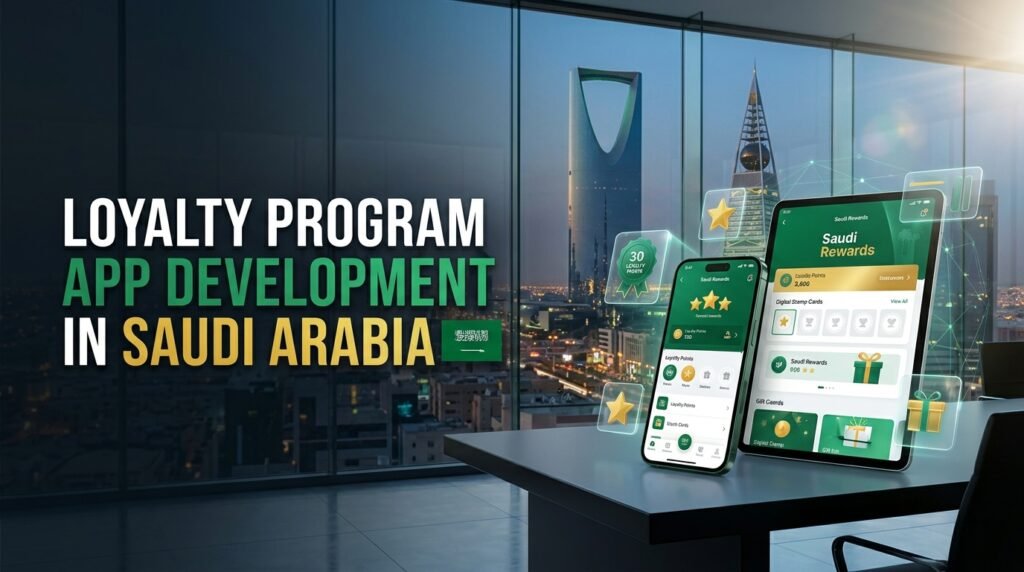

Customers appreciate businesses that recognize their continued support. Whether someone regularly visits a restaurant, shops at a retail store, or orders products online, receiving useful rewards can give them another reason to return. Loyalty Program App Development In Saudi Arabia helps businesses create a direct connection with their customers through mobile applications that manage points, rewards, membership accounts, and special offers. Instead of relying on physical cards or manual reward tracking, companies can give customers a convenient way to access their benefits through their smartphones.
For Saudi businesses, a loyalty app can support customer relationships across physical stores, websites, and mobile shopping channels. However, a successful application needs more than a points counter. It should be easy to use, secure, and flexible enough to support the company’s reward strategy as its customer base grows.
Let’s look at the key features businesses should consider when developing a loyalty program application.
1. Easy Registration and Customer Profiles
The registration process is the customer’s first interaction with a loyalty application. If joining the program requires too many steps, some people may leave before completing the process.
A good loyalty app should make registration quick and straightforward. Customers should be able to create an account using commonly supported methods, such as a mobile number, email address, or social login.
After registration, each member should have a personal profile containing relevant information, including:
- Name and contact details
- Membership ID
- Current points balance
- Available rewards
- Membership level
- Purchase and reward history
For businesses in Saudi Arabia, Arabic and English language support can make the application accessible to a wider customer base. The interface should also be simple enough for customers who are not familiar with digital loyalty programs.
Businesses should collect only the information they need and explain how customer data will be used.
2. Points Tracking and Automatic Updates
Points tracking is one of the most important Loyalty App Features. Customers want to know how many points they have earned, how many they can spend, and what they need to do to receive their next reward.
The application should automatically calculate points after eligible transactions. For example, a retail business might offer one point for every SAR 10 spent. When a customer completes a purchase, the system calculates the eligible points and updates their account.
A useful points management feature should support:
- Points earned from purchases
- Bonus points for selected products
- Points earned through special campaigns
- Points redemption
- Expiry dates
- Transaction history
Customers should be able to see these details without contacting customer support.
The business should also have control over the points rules. Administrators may need to change earning rates, set minimum purchase requirements, or introduce temporary bonus campaigns. These settings should be manageable through an administrative dashboard.
3. Multiple Reward and Redemption Options
Different customers value different benefits. Some prefer discounts, while others may choose free products, vouchers, or exclusive services.
A loyalty application should support several reward types so businesses can offer benefits that match their products and customer preferences.
Common options include:
- Percentage-based discounts
- Fixed-value vouchers
- Free products or services
- Buy-one-get-one offers
- Birthday rewards
- Exclusive member promotions
- Special seasonal offers
For example, a restaurant could allow customers to exchange points for a free meal, while a clothing retailer might offer a discount voucher after a customer reaches a specific points balance.
The redemption process should be simple. Customers might apply a reward during online checkout, scan a QR code at a physical branch, or show a digital voucher to an employee.
Businesses should also be able to define reward conditions, such as expiry dates, minimum spending amounts, eligible products, and participating branches.
4. Personalized Offers and Customer Segmentation
Giving every customer the same promotion may not always produce good results. People have different interests, purchase habits, and spending patterns.
A loyalty app can help businesses create more relevant offers by using suitable customer information and purchase history.
For example, a supermarket may identify customers who regularly purchase certain product categories and offer them relevant discounts. A restaurant could provide a special offer to customers who visit frequently, while a beauty retailer might share promotions based on previous purchases.
Customer segmentation can use factors such as:
- Purchase frequency
- Average spending
- Product preferences
- Previous transactions
- Membership level
- Reward redemption activity
This allows businesses to create different campaigns for different customer groups.
However, personalization should be handled carefully. Customers should receive offers that are useful rather than constant promotional messages. Businesses must also respect privacy requirements when using personal information for marketing.
5. Digital Membership Cards and QR Code Scanning
Physical membership cards can be lost, damaged, or forgotten at home. A digital membership card solves much of this inconvenience by allowing customers to access their loyalty details through an application.
Each customer can receive a unique membership ID, QR code, or barcode. At checkout, employees can scan the code to identify the member and apply eligible rewards.
This feature is particularly useful for businesses with multiple branches, such as supermarkets, restaurants, retail chains, and service providers.
Digital membership cards can help businesses:
- Identify customers quickly
- Record eligible purchases
- Apply rewards at checkout
- Reduce dependence on physical cards
- Maintain consistent membership records
The app should also make it easy to access the digital card, preferably from the home screen or a clearly visible section.
6. Push Notifications and Reward Reminders
Customers may forget about their points or miss special offers if they do not receive timely updates. Push notifications can help businesses keep members informed about important account activity.
A loyalty application can send notifications for:
- Points earned after a purchase
- New rewards becoming available
- Expiring points or vouchers
- Membership level upgrades
- Birthday offers
- Special promotional campaigns
For example, when a customer earns enough points to redeem a reward, the app can send a notification explaining what benefit is now available.
Businesses should give users suitable control over promotional notifications. Too many messages can become annoying and may encourage customers to disable notifications altogether.
The best approach is to send updates when they provide genuine value, such as confirming a transaction or reminding customers about a reward they can actually use.
7. Integration With POS, E-Commerce, and CRM Systems
A loyalty application should not operate as an isolated system. Businesses often use separate platforms for sales, inventory, customer records, and online orders.
Integrating the loyalty app with these systems helps keep customer information and reward activity consistent.
Important integrations may include:
- Point-of-sale (POS) systems
- E-commerce websites
- Payment gateways
- Customer relationship management (CRM) software
- Inventory management systems
- Marketing platforms
Consider a customer who makes a purchase through a company’s website. The loyalty platform should receive the eligible transaction information, calculate the points, and update the customer’s account.
The same member should be able to earn or redeem rewards at a physical branch if the business supports connected in-store and online services.
For companies operating several locations, these integrations can reduce manual work and help maintain accurate records across different sales channels.
8. Customer Analytics and Reporting Dashboard
A loyalty application can provide more than a convenient way to distribute rewards. It can also help businesses learn how customers interact with their products and services.
A reporting dashboard should present useful information about the loyalty program, including:
- Total registered members
- Active and inactive customers
- Points earned and redeemed
- Most popular rewards
- Repeat purchase activity
- Average customer spending
- Campaign performance
- Customer retention patterns
For example, if a business notices that many customers collect points but rarely redeem them, it may need to review the available rewards or simplify the redemption process.
Similarly, if a large number of customers register but do not make another purchase, the company can review its welcome offers and follow-up communication.
These reports help managers make practical decisions based on customer activity rather than assumptions.
9. Multi-Branch and Multi-Brand Management
Businesses with several branches need a loyalty application that works consistently across their locations.
Imagine a retail chain operating in Riyadh, Jeddah, and Dammam. A customer should be able to earn points at one branch and use them at another, provided the company’s reward rules allow it.
A multi-branch management feature should support:
- Centralized customer accounts
- Shared points balances
- Branch-level transaction records
- Location-specific offers
- Branch performance reports
- Employee access controls
Companies operating multiple brands may also need separate loyalty programs or a shared membership structure.
The right setup depends on how the business operates. A centralized system can make management easier, while flexible rules allow each brand or branch to maintain its own promotions.
10. Secure Customer Accounts and Data Privacy
A loyalty application may store personal information, contact details, purchase history, and reward activity. Protecting this information should be part of the development process from the beginning.
In Saudi Arabia, the Personal Data Protection Law (PDPL) establishes requirements for collecting and processing personal information. Businesses should consider these requirements when designing registration, marketing, analytics, and data-sharing features.
Important security and privacy capabilities include:
- Secure login and authentication
- Role-based access for employees
- Encryption of sensitive information
- Consent management
- Secure data storage
- Appropriate backup procedures
- Customer options for managing marketing preferences
For example, a customer should be able to understand why their information is collected and how it will be used. If the business sends promotional messages, it should follow applicable consent and opt-out requirements.
Security should not be treated as an optional feature added after development. It is an essential part of a reliable loyalty application.
11. Arabic and English Language Support
A loyalty application should communicate clearly with its intended customers. For businesses operating in Saudi Arabia, offering both Arabic and English can make the application more accessible.
Language support should cover more than translating a few buttons. The entire experience should be considered, including:
- Registration screens
- Account settings
- Reward descriptions
- Notifications
- Terms and conditions
- Customer support information
Arabic interfaces should also support right-to-left layouts correctly. This includes menus, text alignment, navigation, and form fields.
When language settings are handled properly, customers can use the application more comfortably and understand the reward conditions without confusion.
Planning a Loyalty App That Supports Business Growth
Before starting Loyalty Program App Development, businesses should define what they want the application to achieve. A small restaurant may need registration, points tracking, digital vouchers, and notifications. A large retail chain may require advanced analytics, multi-branch management, system integrations, and automated campaigns.
It is useful to consider the following questions:
- Who will use the application, and what rewards will they value?
- Will customers earn and redeem points online, in stores, or through both channels?
- Which existing business systems need to be connected?
- Does the app need Arabic and English support?
- How will customer information be protected?
- Can the platform support more users and branches as the business expands?
Businesses should also plan for testing, employee training, maintenance, and future updates. A well-designed application needs ongoing attention to keep its features reliable and its customer experience simple.
Building Better Customer Relationships Through Loyalty Apps
A loyalty application gives businesses a practical way to reward customers, manage membership accounts, and encourage repeat purchases. Features such as points tracking, personalized offers, digital membership cards, push notifications, analytics, and system integrations can make the program easier to use and manage.
For Saudi businesses, Loyalty Program App Development In Saudi Arabia should focus on local customer needs, Arabic and English accessibility, secure data handling, and convenient digital experiences. The best application is not necessarily the one with the largest number of features. It is the one that makes rewards easy to earn, simple to redeem, and valuable enough to give customers a reason to return.