


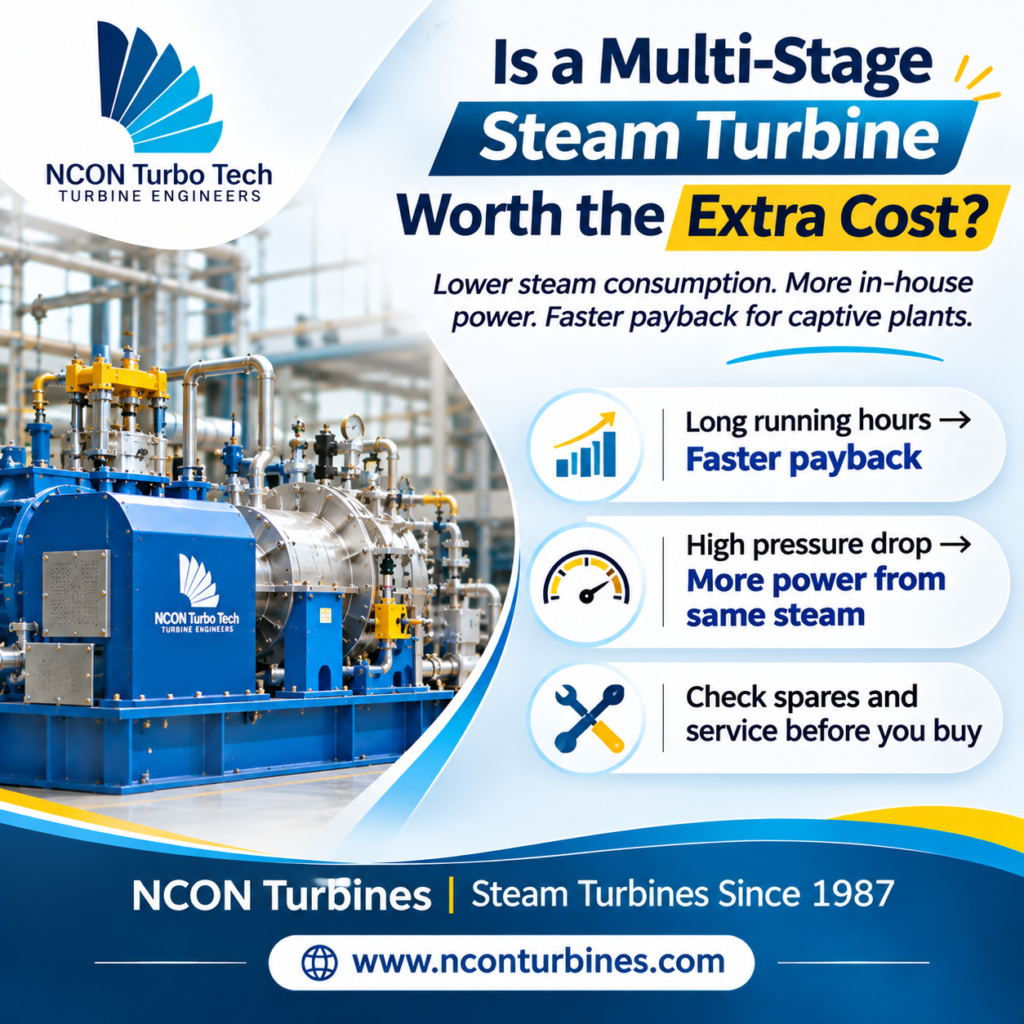

Ask any plant owner who runs a captive power unit what worries them most, and the answer is usually the same: electricity cost. Grid tariffs keep moving, industrial demand keeps growing, and every unit generated in-house is a unit you do not have to buy at a higher rate.
That is why the steam turbine becomes the heart of the decision. And when the quotation for a multi-stage machine lands on the table, one question comes up in almost every meeting: “It costs more than a single-stage unit. Is it really worth it?”
This article looks at that question honestly. If you are evaluating multi-stage steam turbines India for a captive power plant, the points below will help you judge the investment with real numbers in mind, not just brochure claims.
Understanding Why Multi-Stage Turbines Cost More
More components, more precision
A multi-stage turbine has several rows of nozzles, blades and diaphragms inside the casing. Each stage needs careful machining, balancing and alignment. The rotor is longer, the casing is bigger, and the assembly work takes more time.
All of this adds to the manufacturing cost. It is a fair reason for the higher price, but it is also the reason the machine can convert steam into power more effectively.
What you are really paying for
You are not paying extra for complexity. You are paying for the ability to extract more shaft power from every kilogram of steam. Whether that is worth it depends entirely on how much steam you have and how many hours you run.
How the Savings Actually Show Up
Lower steam consumption per kilowatt
The most direct benefit is steam rate. A more efficient turbine needs less steam to produce one kilowatt-hour. If your boiler capacity is fixed, this means more electricity from the same fuel. If you want to hold power constant, it means lower fuel consumption.
Fuel cost reduction
For plants burning coal, biomass, bagasse or gas, steam is made from money. Every kilogram saved is fuel saved. Over a full year, even a small improvement in steam rate becomes a large rupee figure.
Reduced dependence on grid power
Higher in-house generation means you draw less from the grid. For plants facing high industrial tariffs or peak demand charges, this alone can change the economics of the whole project.
A Simple Way to Estimate Payback
You do not need complicated software for a first estimate. Here is a practical method.
Step 1: Note your steam data
Collect your inlet pressure, inlet temperature, exhaust pressure and steam flow. These are the basics that any turbine manufacturer will ask for.
Step 2: Compare two options
Ask for the expected power output from both a single-stage and a multi-stage option for the same steam. The difference in kilowatts is the extra power you gain.
Step 3: Convert extra power into money
Multiply the extra kilowatts by your running hours per year and by your grid tariff or your cost of purchased power. That gives you the yearly value of the additional generation.
Step 4: Compare with the extra cost
Divide the price difference between the two machines by the yearly value you calculated. The result is a rough payback period in years. If it is within a few years, the higher investment usually makes sense.
When the Investment Clearly Pays Off
Continuous process industries
Plants such as paper mills, sugar factories, chemical units and textile processors often run for most of the year. Long operating hours mean the efficiency advantage is used every day, and payback comes faster.
High pressure and low exhaust conditions
When there is a large pressure difference between inlet and exhaust, a lot of energy is available. A multi-stage turbine can capture much more of it than a single-stage machine can.
Plants with high grid power costs
If the electricity you purchase is expensive, every extra unit generated in-house saves more. The same turbine that looks costly in a low-tariff setting can look like a bargain when tariffs are high.
When It May Not Be Worth It
Being honest here will save you money.
Small steam quantity
If the steam available is small, the extra power from additional stages may be too little to justify the price. A single-stage turbine could be the more sensible choice.
Few running hours
A turbine that runs only a few hours a day will not recover the higher cost quickly. Standby or seasonal applications often fall in this category.
Low pressure drop
When inlet and exhaust pressures are close, additional stages add very little. In that situation, you are paying for efficiency you cannot use.
Wet steam conditions
Plants working with moist steam need extra care, because moisture can damage blades in later stages. It is wise to discuss steam quality with experienced saturated steam turbine manufacturers before finalising the design. Sometimes a simpler configuration is the safer and more economical option.
Costs Beyond the Purchase Price
The turbine price is only one part of the total spend. A sound investment decision looks at the whole picture.
Installation and auxiliary systems
Foundation work, steam piping, lube oil systems, governing systems, cooling arrangements and electrical connections all add to the project cost. A larger machine may need more civil work, so plan for it early.
Operating and maintenance cost
Multi-stage machines have more internal parts, so inspections are more detailed. That does not mean they are unreliable. It means maintenance should be planned, not left to chance.
Spares and service availability
This is where many plants get caught out. A turbine is a long-term asset, and parts will be needed at some point. If spares take weeks to arrive, production suffers. Choosing a supplier who also provides dependable turbine spares & services India can protect your investment far better than a small discount on the purchase price.
Risks Plants Should Think About
Overestimating steam availability
Some plants size the turbine on boiler capacity written on paper. If actual steam flow is lower, the turbine runs below its best range and the expected savings do not appear. Always base the decision on measured data.
Ignoring load variation
Captive plants rarely run at a constant load. Ask how the turbine performs at 60, 70 and 80 percent load, because that is where it may spend much of its life.
Not planning for expansion
If production is likely to grow, discuss it with your manufacturer now. A slightly larger design margin can save you from a costly replacement later.
Questions to Ask Before You Commit
Here are a few practical questions for your next supplier meeting:
- What is the expected steam rate at full load and at partial load?
- How many years of working experience does the company have with similar installations?
- What spares should we keep in stock, and how fast can you deliver the rest?
- Is on-site service support available, and what is the response time?
- What are the expected overhaul intervals for our duty cycle?
A supplier who answers these clearly, without hurrying you, is usually one worth trusting.
How NCON Turbines Approaches This Decision
NCON Turbines has been manufacturing steam turbines in India since 1987, serving small and large industrial applications. The range includes low-cost, single-stage and multi-stage turbines, along with parts and service support.
When a plant approaches us, we start with the steam data, not the product. If a single-stage turbine gives you a better return, we say so. If the numbers favour multi-stage, we show you why and what to expect. The aim is a turbine that fits your plant for years, not one that merely looks good on paper.
You can learn more about the range on the NCON Turbines multi-stage steam turbines page and request a free consultation for your plant.
Quick Summary for Decision Makers
- Higher cost buys higher efficiency: more power from the same steam.
- Long running hours speed up payback: continuous plants benefit the most.
- Large pressure drops favour multi-stage: small drops usually do not.
- Look at total cost: installation, maintenance and spares matter as much as price.
- Pick a supplier with service support: it protects your investment over decades.
Final Thoughts
So, is the higher investment in a multi-stage turbine worth it for a captive power plant? For many Indian plants with steady steam supply, long running hours and a decent pressure drop, the answer is yes. The extra cost is recovered through lower steam consumption and higher in-house power generation.
For others, a simpler machine is the smarter choice. What matters is making the decision with your own plant data and a clear payback estimate.
If you would like help working out the numbers for your plant, share your steam details with NCON Turbines. A short conversation now can save years of regret later.
Contact us
Address: F-62 & F-63, Industrial Estate, Rajajinagar, Bangalore, Karnataka, India – 560044
Call Us: +91 80231 5148
Email ID: enquiry@nconturbines.com
Website: https://www.nconturbines.com/
Services Quick Links:
Low-Cost Steam Turbines | Single-Stage Steam Turbines | Multi-Stage Steam Turbines | Parts and Services


