
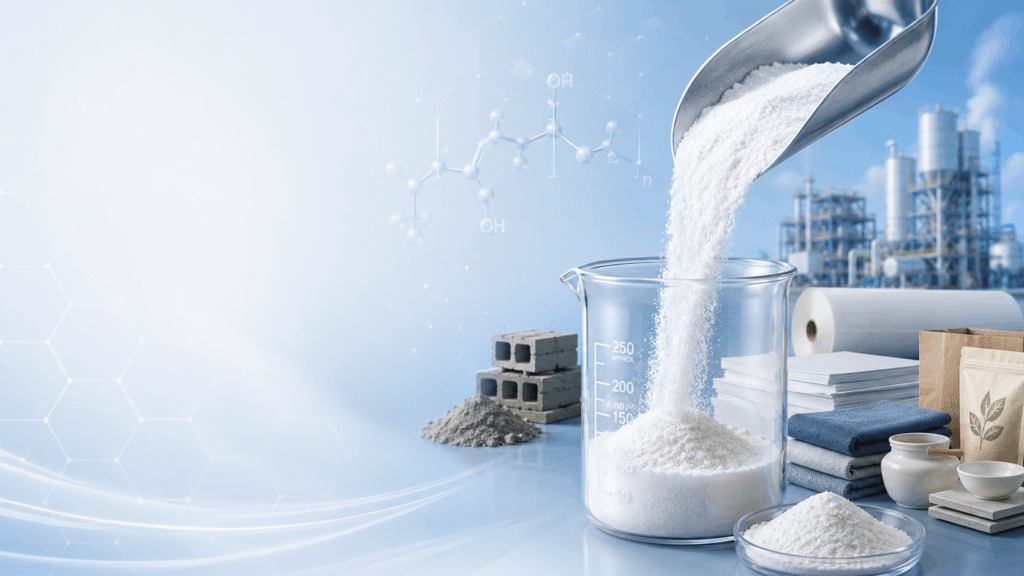

In today’s industrial landscape, manufacturers are constantly searching for materials that offer excellent performance, cost efficiency, and environmental sustainability. Polyvinyl Alcohol (PVA) Powder has emerged as one of the most versatile synthetic polymers, serving a wide range of industries including construction, adhesives, textiles, paper, ceramics, pharmaceuticals, and packaging.
Thanks to its exceptional water solubility, strong bonding capability, film-forming properties, and eco-friendly characteristics, PVA powder continues to gain popularity worldwide. Whether you’re a manufacturer, supplier, or product developer, understanding the properties and applications of PVA powder can help you make better material choices.
What Is Polyvinyl Alcohol (PVA) Powder?
Polyvinyl Alcohol (PVA) Powder is a synthetic, water-soluble polymer produced by the hydrolysis of polyvinyl acetate (PVAc). Unlike many conventional polymers, PVA contains hydroxyl groups that give it excellent water solubility and superior adhesive properties.
Available in various grades based on viscosity, molecular weight, and degree of hydrolysis, PVA powder can be tailored to meet the performance requirements of different industries.
Key Characteristics of PVA Powder
High Water Solubility
PVA powder dissolves efficiently in water, making it suitable for water-based formulations and industrial processing. Different grades are available for cold-water or hot-water dissolution depending on application requirements.
Excellent Adhesion
One of the biggest advantages of PVA powder is its ability to bond a wide variety of materials, including cement, paper, wood, ceramics, and textiles.
Superior Film Formation
When dissolved and dried, PVA forms clear, flexible, and durable films with excellent mechanical strength, making it ideal for coatings and protective applications.
Chemical Stability
PVA demonstrates good resistance to oils, greases, and many chemicals while maintaining excellent dimensional stability under normal operating conditions.
Eco-Friendly Material
As industries move toward sustainable manufacturing, PVA powder offers a more environmentally responsible solution due to its low toxicity and biodegradable characteristics under appropriate conditions.
Benefits of Using Polyvinyl Alcohol (PVA) Powder
Businesses across industries choose PVA powder because it offers numerous advantages:
- Improves product strength and durability
- Enhances bonding performance
- Increases flexibility of finished products
- Provides excellent water retention
- Reduces cracking in construction materials
- Produces smooth, uniform films
- Compatible with many water-based formulations
- Supports environmentally conscious manufacturing
These benefits contribute to improved product quality while helping manufacturers optimize production efficiency.
Industrial Applications of Polyvinyl Alcohol Powder
Construction Materials
The construction industry is one of the largest consumers of PVA powder.
Common applications include:
- Tile adhesives
- Cement-based mortars
- Wall putty
- Self-leveling compounds
- Repair mortars
- Dry-mix construction products
PVA powder improves workability, adhesion, flexibility, and crack resistance, resulting in stronger and more durable construction materials.
Adhesive Manufacturing
PVA powder serves as an important ingredient in many industrial and consumer adhesives.
Typical applications include:
- Wood glue
- Paper adhesives
- Packaging adhesives
- Bookbinding glue
- Label adhesives
Its strong bonding capability and ease of formulation make it an industry favorite.
Textile Processing
In textile manufacturing, PVA powder is widely used for:
- Warp sizing
- Fabric finishing
- Printing auxiliaries
- Yarn protection
It improves weaving efficiency by minimizing yarn breakage and enhancing fabric strength during processing.
Paper Industry
Paper manufacturers rely on PVA powder to improve paper quality.
Its functions include:
- Surface sizing
- Pigment coating binder
- Paper reinforcement
The result is stronger paper with better printability, smoother surfaces, and improved resistance to tearing.
Ceramic Manufacturing
Ceramic producers use PVA powder as a temporary binder during the shaping process.
It provides:
- Improved green strength
- Better mold release
- Reduced breakage before firing
- Enhanced handling performance
Packaging Solutions
PVA powder has become increasingly important in sustainable packaging technologies.
Applications include:
- Water-soluble films
- Laundry detergent pods
- Agricultural chemical packaging
- Medical packaging
- Biodegradable packaging materials
Its environmental advantages make it a valuable material for reducing plastic waste.
Factors to Consider When Choosing PVA Powder
Selecting the right PVA powder depends on your manufacturing process and end-use requirements.
Important factors include:
Degree of Hydrolysis
The degree of hydrolysis affects water solubility, film strength, and moisture resistance.
Viscosity
Viscosity determines processing behavior and influences adhesive strength and coating performance.
Particle Size
Fine powders dissolve faster and provide more consistent mixing during production.
Moisture Content
Low moisture levels contribute to longer shelf life and improved product stability.
Product Consistency
Choosing a supplier with strict quality control ensures reliable batch-to-batch performance.
Storage and Handling Tips
To maintain product quality, PVA powder should be stored properly.
Best practices include:
- Store in a cool and dry environment.
- Keep containers tightly sealed.
- Protect from excessive humidity.
- Avoid direct sunlight.
- Use clean equipment during handling to prevent contamination.
Proper storage extends shelf life and maintains consistent processing performance.
Why Industries Continue to Choose PVA Powder
The growing demand for high-performance and environmentally friendly materials continues to drive the adoption of Polyvinyl Alcohol powder.
Its combination of excellent adhesion, water solubility, film-forming capability, mechanical strength, and processing flexibility makes it suitable for both traditional manufacturing and emerging applications.
As industries continue investing in sustainable technologies, PVA powder is expected to remain an essential material across numerous sectors.
Conclusion
Polyvinyl Alcohol (PVA) Powder has established itself as a versatile and reliable material for modern manufacturing. From construction and adhesives to paper, textiles, ceramics, and sustainable packaging, its broad range of applications highlights its importance in today’s industrial world.
By selecting the appropriate PVA grade and working with a trusted supplier, manufacturers can improve product quality, increase production efficiency, and meet evolving environmental standards. As innovation continues, PVA powder will remain a key material driving industrial growth and sustainable development across global markets.