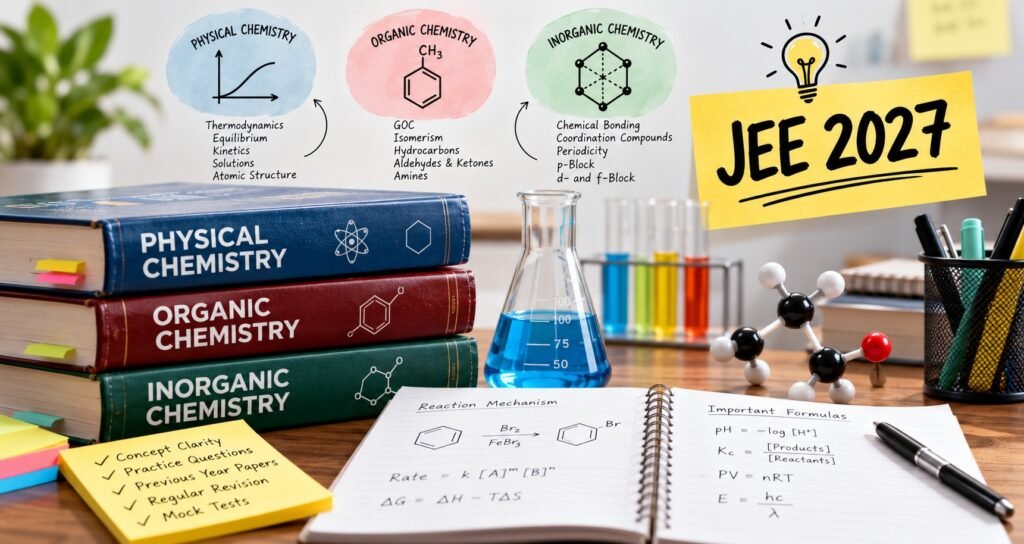

Preparing for JEE 2027? Chemistry can be one of the most scoring subjects in the exam, but only if you prepare it with a clear plan. With so many chapters in Physical, Organic, and Inorganic Chemistry, deciding where to start can feel confusing.
Should you spend more time on Chemical Bonding or Coordination Compounds? Is Organic Chemistry worth prioritising early? And which Physical Chemistry chapters should you practise regularly?
The answer depends on your current preparation, the official syllabus, and how well you understand the basics.
Instead of trying to complete every chapter at the same time, start with the topics that build your foundation and connect to other chapters. This approach can help you use your study hours better and revise more effectively.
In this guide, you will find the important Chemistry chapters to prioritise for JEE 2027, subject-wise preparation tips, and a practical study plan.
Why Is Chemistry Important for JEE 2027?
Chemistry carries a significant share of the JEE Main and JEE Advanced examinations. Both exams test your understanding of concepts, but the question style and difficulty can differ.
Chemistry includes three main sections:
- Physical Chemistry, which focuses on calculations, formulas, graphs, and numerical problems.
- Organic Chemistry, which tests reaction mechanisms, chemical behaviour, and the relationships between compounds.
- Inorganic Chemistry, which requires conceptual understanding, periodic trends, chemical bonding, and careful revision of factual information.
Many students make the mistake of treating Chemistry as a subject they can finish just before the exam. That approach often creates problems, especially in Organic Chemistry and topics that need repeated revision.
A better plan is to study all three sections throughout your preparation.
Important Chemistry Chapters for JEE Main 2027
The following chapters are useful priorities because they develop core concepts or connect with other topics. This is a preparation guide, not an official prediction of chapter-wise weightage. The exact syllabus and question distribution may change.
1. Physical Chemistry Chapters to Prioritise
Physical Chemistry becomes easier when you understand the concepts and practise numerical questions regularly.
Chemical Equilibrium and Ionic Equilibrium
Chemical Equilibrium helps you understand reversible reactions and equilibrium constants. Ionic Equilibrium extends these ideas to acids, bases, buffers, and solubility.
Focus on:
- Equilibrium constants and their applications
- Le Chatelier’s principle
- pH and pOH calculations
- Buffer solutions
- Solubility product and common-ion effect, where included in the syllabus
These chapters need regular numerical practice. Start with direct formula-based questions and then move to multi-step problems.
Thermodynamics
Thermodynamics is a core topic in Physical Chemistry. It explains energy changes during chemical reactions and physical processes.
Prioritise:
- Enthalpy and internal energy
- First law of thermodynamics
- Hess’s law
- Entropy and Gibbs energy
- Spontaneity of reactions
Pay attention to sign conventions and the relationships between thermodynamic quantities. A small mistake in these areas can change the final answer.
Chemical Kinetics
Chemical Kinetics deals with the speed of chemical reactions and the factors that affect reaction rates.
Important topics include:
- Rate of reaction
- Rate law and rate constant
- Order and molecularity
- Integrated rate equations
- Half-life
- Arrhenius equation, where prescribed
Make a short formula sheet and solve questions from each major concept. Practising different question types will help you recognise which formula or relationship applies.
Solutions
Solutions is another useful chapter for numerical practice.
Study concentration terms, Raoult’s law, colligative properties, and related calculations included in the official syllabus.
Learn the formulas with their units. Then practise questions involving molarity, molality, relative lowering of vapour pressure, and elevation or depression of characteristic temperatures, as applicable.
Atomic Structure
Atomic Structure builds the foundation for understanding electronic configuration, quantum numbers, and periodic trends.
Give attention to:
- Bohr’s model and related calculations
- Quantum numbers
- Electronic configuration
- de Broglie wavelength
- Heisenberg’s uncertainty principle
This chapter also supports your understanding of Chemical Bonding and the periodic behaviour of elements.
2. Organic Chemistry Chapters You Should Not Ignore
Organic Chemistry often feels difficult when students memorise reactions without understanding why they happen.
Start with the basics, then move towards more complex reactions.
General Organic Chemistry
General Organic Chemistry, commonly called GOC, deserves early attention because it supports many other Organic Chemistry chapters.
Focus on:
- Inductive effect
- Resonance
- Hyperconjugation
- Acidity and basicity
- Stability of reaction intermediates
- Electrophiles and nucleophiles
- Basic reaction mechanisms
Do not rush through GOC. If you understand electron movement and the stability of intermediates, later reaction-based questions become easier to approach.
Isomerism
Isomerism helps you understand why compounds can have the same molecular formula but different structures or spatial arrangements.
Prioritise structural isomerism, geometrical isomerism, and optical isomerism according to the JEE 2027 syllabus.
Practise drawing structures rather than relying only on notes. Visual practice helps you identify differences between compounds and avoid common mistakes.
Hydrocarbons
Hydrocarbons introduce important reactions of alkanes, alkenes, alkynes, and aromatic compounds.
Study the reaction conditions, major products, and the reasoning behind common transformations. Connect each reaction to the relevant concepts from GOC.
Make a reaction chart as you progress. Include the starting compound, reagent, conditions, and major product.
Aldehydes, Ketones and Carboxylic Acids
These compounds involve several important reaction patterns and functional-group transformations.
Revise nucleophilic addition, oxidation and reduction, acidity, and the reactions included in the official syllabus.
Instead of memorising every reaction as a separate fact, group reactions by mechanism or functional group. This makes revision more manageable.
Amines
Amines are worth studying alongside other functional-group chapters.
Focus on basicity, preparation methods, important reactions, and the chemical behaviour of aromatic and aliphatic amines.
Practise comparison questions, especially those involving the relative basicity of different compounds. The answer often depends on electronic effects and the surrounding chemical environment.
3. Inorganic Chemistry Chapters to Focus On
Inorganic Chemistry needs a mix of conceptual study and regular revision. Reading a chapter once is rarely enough to retain every trend, exception, and chemical property.
Chemical Bonding and Molecular Structure
Chemical Bonding is a foundational chapter that supports several other areas of Chemistry.
Prioritise:
- Lewis structures
- VSEPR theory
- Hybridisation
- Molecular orbital theory
- Bond order and magnetic behaviour
- Dipole moment and molecular shape
Practise drawing structures and predicting molecular geometry. Understanding why a molecule has a particular shape is more useful than memorising a list of examples.
Coordination Compounds
Coordination Compounds are an important topic for understanding complex ions and their properties.
Study nomenclature, coordination number, oxidation state, isomerism, bonding theories, and magnetic properties as covered in the syllabus.
Create a separate revision sheet for common rules and examples. Solve questions that ask you to identify the geometry, oxidation state, or magnetic behaviour of a complex.
Periodic Table and Periodicity
Periodic trends explain how atomic and chemical properties change across periods and down groups.
Focus on atomic radius, ionisation enthalpy, electron gain enthalpy, electronegativity, and the reasons behind important exceptions.
Try to understand the cause of each trend rather than memorising every comparison. This will help you solve unfamiliar questions more confidently.
p-Block and d- and f-Block Elements
These chapters require attention to the exact syllabus for your exam year.
Revise the properties, trends, oxidation states, and important compounds included in the prescribed material. Use concise notes and practise previous-year questions to check your understanding.
Do not assume that every topic from an older textbook remains part of the JEE 2027 syllabus. Confirm the current official syllabus before deciding how much time to spend on individual subtopics.
How Should You Prioritise Chemistry Chapters for JEE 2027?
Use the following order as a starting point. Adjust it according to your current strengths, completed chapters, and mock-test results.
| Priority | Chapters | Preparation goal |
| First | Chemical Bonding, Atomic Structure, GOC | Build the foundation |
| Second | Thermodynamics, Equilibrium, Isomerism | Strengthen core concepts |
| Third | Chemical Kinetics, Solutions, Coordination Compounds | Improve numerical and conceptual accuracy |
| Fourth | Hydrocarbons, Aldehydes and Ketones, Amines | Connect reaction patterns |
| Fifth | Periodicity, p-Block, d- and f-Block | Revise trends and prescribed facts |
This order is not a guarantee of exam weightage. Check the official syllabus and analyse recent previous-year questions before finalising your study schedule.
A Practical 30-Day Chemistry Study Plan
If you have already started your preparation, you can use this sample plan to organise your revision. It is not a complete replacement for a longer JEE study schedule.
Days 1–7: Strengthen the Basics
- Revise Atomic Structure and Chemical Bonding.
- Study GOC and the main concepts of Isomerism.
- Solve basic questions after each topic.
- Keep a record of formulas and recurring mistakes.
Days 8–14: Work on Physical Chemistry
- Revise Thermodynamics and Equilibrium.
- Practise Chemical Kinetics and Solutions.
- Solve numerical questions with a time limit.
- Revisit questions you answered incorrectly.
Days 15–21: Build Organic Chemistry
- Revise Hydrocarbons and the functional-group chapters in your syllabus.
- Practise reaction sequences.
- Review reagents, reaction conditions, and mechanisms.
- Test your recall without looking at your notes.
Days 22–26: Revise Inorganic Chemistry
- Review Periodicity and Coordination Compounds.
- Revise the prescribed p-Block and d- and f-Block topics.
- Solve previous-year questions.
- Create short notes for difficult trends and exceptions.
Days 27–30: Test and Review
- Attempt timed Chemistry practice tests.
- Analyse incorrect and unanswered questions.
- Identify weak chapters and revise them.
- Practise questions from all three Chemistry sections.
If you are starting from scratch, extend this schedule rather than trying to complete everything in a month.
How Can IIT JEE Classes in Nagpur Help with Chemistry Preparation?
Choosing suitable coaching can help you follow a regular study schedule and identify gaps in your understanding.
When comparing IIT JEE Classes in Nagpur, look beyond the number of lectures or claims about results. Check whether the teaching approach matches your needs.
Consider these points:
- Concept-based teaching: Does the faculty explain the reasoning behind formulas and reactions?
- Regular practice: Are chapter-wise tests and previous-year questions part of the schedule?
- Doubt-solving support: Can you get help when a concept remains unclear?
- Progress tracking: Do teachers review your test performance and suggest improvements?
- Revision planning: Does the course include repeated revision and mock tests?
- JEE Main and Advanced preparation: Does the programme match your target examination?
Ask about faculty qualifications, batch size, available study material, and the schedule before enrolling. If possible, attend a demo class to understand the teaching style.
The right coaching programme should support your independent practice, not replace it. Your progress will still depend on how consistently you revise, solve questions, and learn from mistakes.
Common Chemistry Preparation Mistakes to Avoid
A few habits can make Chemistry preparation harder than it needs to be.
- Memorising Organic Chemistry reactions without learning the underlying concepts.
- Ignoring numerical practice in Physical Chemistry.
- Studying Inorganic Chemistry once and expecting to remember everything.
- Solving questions without reviewing mistakes.
- Depending entirely on predicted chapter weightage.
- Using outdated syllabus lists without checking the current official requirements.
- Spending too much time on one difficult question while neglecting other chapters.
Keep your preparation balanced. Even if one section is your strength, continue revising the other two.
Frequently Asked Questions
- Which Chemistry chapters should I study first for JEE 2027?
Start with Chemical Bonding, Atomic Structure, and General Organic Chemistry. These topics develop concepts that support other chapters. Then move to Equilibrium, Thermodynamics, Isomerism, and other syllabus-based topics.
- Which Chemistry section is easiest to score in?
It depends on your strengths. Some students prefer Physical Chemistry because they enjoy numerical problems. Others find Inorganic Chemistry more comfortable after regular revision. Organic Chemistry becomes easier when you understand mechanisms and practise reactions.
- Can I prepare Chemistry for JEE 2027 without coaching?
Yes. You can prepare independently with the official syllabus, suitable textbooks, reliable study material, previous-year questions, and regular mock tests. Coaching may provide structure and doubt-solving support, but it is not the only way to prepare.
- How many hours should I study Chemistry daily?
There is no fixed number for every student. Set aside enough time to learn concepts, practise questions, and revise older topics. Your daily Chemistry schedule should also fit your Physics and Mathematics preparation.
- Are previous-year questions enough for JEE Chemistry?
Previous-year questions are useful for understanding question styles and testing your preparation. But they should be combined with concept study, topic-wise practice, and mock tests. Do not rely on repeated questions alone.
Final Preparation Advice
A strong Chemistry score comes from understanding concepts, practising questions, and revising at regular intervals.
Start with foundational chapters, keep your preparation balanced across Physical, Organic, and Inorganic Chemistry, and use mock tests to find your weak areas.
If you are comparing IIT JEE Classes in Nagpur, choose a programme that offers clear teaching, regular practice, doubt-solving support, and a realistic revision plan.
Most importantly, check the official JEE 2027 syllabus and build your study plan around it. A focused and consistent approach will help you prepare with greater confidence.