


A filtration system can only perform as intended when the filter media, housing, seals, flow rate, and operating conditions are properly matched.
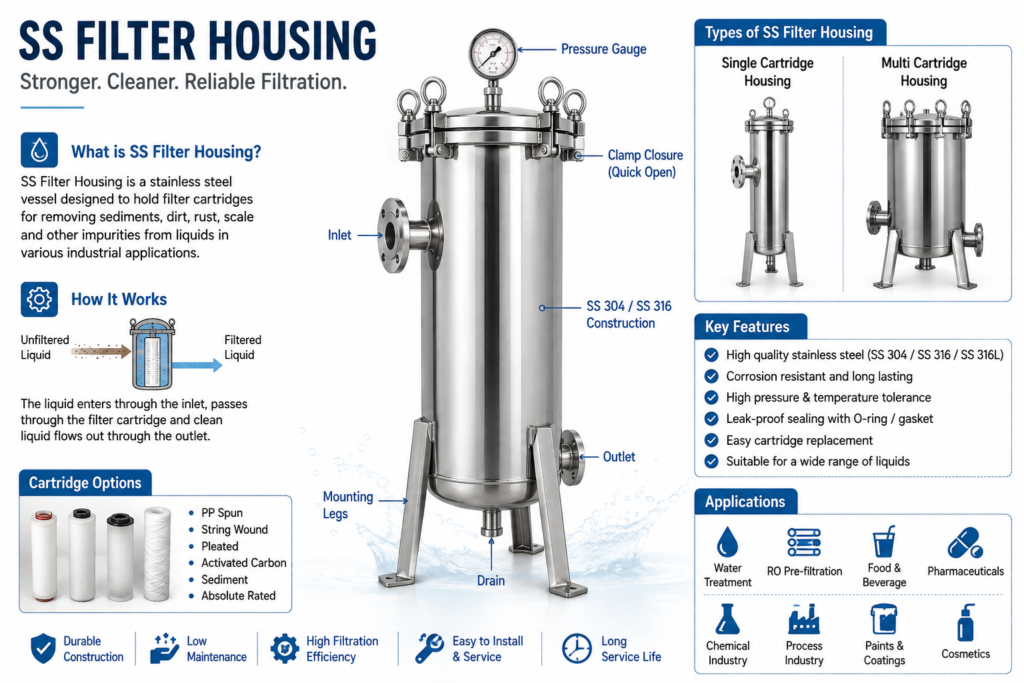
An SS Filter Housing is a reusable stainless-steel vessel designed to hold cartridge filters in liquid filtration systems. Although the filter cartridge performs the actual filtration, the housing provides the controlled environment needed for the cartridge to function correctly.
In industrial applications, filtration is often positioned between different treatment stages or before sensitive equipment. A properly selected housing can help maintain the desired flow path, support the filter cartridge, prevent unwanted bypass, and make routine cartridge replacement easier.
This makes stainless-steel filter housings relevant to a wide range of industries, including water treatment, industrial RO, food and beverage, pharmaceuticals, chemicals, manufacturing, cosmetics, and process industries.
What Is an SS Filter Housing?
An SS Filter Housing is a stainless-steel enclosure designed to accommodate one or more cartridge filter elements.
The basic filtration process starts when the liquid enters the housing through an inlet. The internal design directs the liquid toward the filter cartridge. As the liquid passes through the filtration media, targeted particles are retained. The filtered liquid then exits through the outlet.
The housing typically consists of components such as:
- Stainless-steel vessel
- Housing cover
- Cartridge support
- Inlet and outlet connections
- O-ring or gasket
- Vent arrangement
- Drain arrangement
- Mounting support
The exact construction depends on the filtration application.
A small commercial system may require a single-cartridge housing, while an industrial plant with higher flow requirements may use a multi-cartridge configuration.
Why the Housing Matters in Cartridge Filtration
It is easy to assume that the filter cartridge is the only important part of a filtration system.
In reality, the housing plays a major supporting role.
The cartridge needs to remain correctly positioned inside the vessel. The fluid must be directed through the intended filtration media, and the sealing arrangement must prevent untreated liquid from bypassing the cartridge.
If any of these conditions are compromised, the performance of the filtration stage can be affected.
A properly engineered Cartridge Filter Housing therefore provides more than physical protection. It helps establish the flow and sealing conditions required for effective cartridge filtration.
Advantages of Stainless-Steel Construction
Stainless steel is frequently selected for industrial filter housings because it can combine mechanical strength with resistance to many operating environments.
Depending on the grade and application, stainless steel can provide:
- Durable construction
- Resistance to corrosion
- Long service potential
- Easy inspection
- Good cleanability
- Suitability for repeated cartridge replacement
Industrial systems can expose equipment to moisture, chemicals, pressure, and cleaning processes.
The correct stainless-steel grade should therefore be selected according to the process.
SS 304 is widely used for general applications, while SS 316 and SS 316L may be preferred for certain demanding environments.
The best material is always dependent on actual operating conditions.
SS 304, SS 316, and SS 316L
Material selection can have a direct impact on equipment performance.
SS 304
SS 304 is commonly used for general-purpose filtration applications.
It may be suitable for many water treatment and industrial filtration systems where the process environment is not highly corrosive.
SS 316
SS 316 offers improved resistance to certain corrosive environments compared with SS 304.
It can be considered for applications involving more demanding chemical or hygienic conditions.
SS 316L
SS 316L is a low-carbon version of SS 316 and may be selected where specific fabrication, hygienic, or process requirements apply.
The choice should be based on fluid chemistry, temperature, cleaning methods, chloride exposure, pressure, and other operating factors.
SS Filter Housing in Water Treatment Plants
Water treatment systems often combine several technologies to achieve the required water quality.
Depending on the application, the treatment sequence may include:
- Sediment filtration
- Activated carbon
- Cartridge filtration
- Softening
- Ultrafiltration
- Reverse osmosis
- UV treatment
- Polishing filtration
An SS Filter Housing can be used as part of one or more filtration stages.
For example, a cartridge filter can be installed before an RO membrane to reduce suspended particles. Another filtration stage may be used after treatment for additional polishing.
Because the housing is reusable, the filtration media can be replaced without replacing the complete vessel.
Role in Industrial RO Systems
Industrial RO systems require appropriate pretreatment to protect the membrane from excessive particulate loading.
Cartridge filtration can serve as a protective stage before the RO membrane.
An SS Filter Housing contains the cartridge and creates the controlled flow path through which the water passes.
The actual filtration rating should be selected according to the water quality and membrane system requirements.
The housing itself does not replace other pretreatment processes. Instead, it works as one component within the complete treatment arrangement.
This makes proper system design essential.
How an SS Filter Housing Protects Downstream Equipment
Filtration is frequently installed to protect equipment rather than simply improve the appearance or quality of water.
Suspended particles can potentially affect:
- RO membranes
- Pumps
- Valves
- Nozzles
- Heat exchangers
- Spray systems
- Process equipment
By placing an appropriate filter before sensitive equipment, the system can reduce the amount of particulate material reaching downstream components.
This gives the Industrial Filter Housing an important supporting role in equipment protection.
The effectiveness of this protection depends on the cartridge selection, filtration rating, flow conditions, and maintenance practices.
Single-Cartridge vs Multi-Cartridge Housing
The required housing configuration depends largely on the system’s flow requirement.
Single-Cartridge Housing
A single-cartridge housing contains one filter element.
It can be appropriate for:
- Small RO plants
- Commercial filtration
- Small water treatment systems
- Laboratory systems
- Compact process applications
Its smaller footprint can make installation convenient where space is limited.
Multi-Cartridge Housing
A multi-cartridge housing contains several filter elements.
It can be suitable for:
- Industrial water treatment
- High-flow RO systems
- Manufacturing facilities
- Process filtration
- Large commercial systems
Multiple cartridges allow the filtration area to increase and can help distribute the incoming flow.
Why Flow Rate Should Be Considered Carefully
Flow rate is one of the most important factors when selecting filtration equipment.
Every cartridge has a practical flow capacity.
If the required system flow is greater than the available filtration capacity, pressure drop may increase and the cartridges may load more quickly.
For larger systems, several cartridges can be installed in parallel.
This increases the total filtration area and allows the system to accommodate higher flow.
The housing should therefore be selected based on the complete filtration requirement rather than its physical dimensions alone.
Understanding Differential Pressure
Differential pressure is an important operating parameter in cartridge filtration.
It represents the pressure difference between the inlet and outlet sides of the filter.
When a cartridge is relatively clean, pressure drop may be comparatively low.
As the filter collects contaminants, resistance to flow can increase.
A rising differential pressure can therefore indicate that the cartridge is becoming loaded.
Operators can use pressure readings, flow performance, and system-specific replacement criteria to determine when the filter should be changed.
This can help avoid replacing cartridges too early or allowing them to remain in service beyond the recommended operating range.
The Importance of Cartridge Sealing
Sealing is a critical part of the filtration process.
The incoming liquid and filtered liquid must remain separated.
The cartridge seal helps prevent untreated fluid from moving around the filter element.
Potential causes of bypass include:
- Incorrect cartridge installation
- Damaged O-rings
- Incorrect gasket selection
- Worn sealing surfaces
- Improper housing closure
- Incompatible cartridge design
Even a high-quality filter cartridge cannot perform properly if the sealing arrangement allows fluid to bypass the media.
Regular inspection of the housing and sealing components is therefore important.
Selecting the Correct Gasket or O-Ring
The seal should be compatible with the process environment.
Factors to consider include:
- Fluid type
- Chemical exposure
- Temperature
- Pressure
- Cleaning chemicals
- Operating duration
Different elastomer materials have different resistance characteristics.
A seal that performs well in a water treatment application may not necessarily be suitable for an aggressive chemical process.
Therefore, seal selection should be treated as part of the overall housing specification.
SS Filter Housing in Food and Beverage Industries
Food and beverage plants often require filtration systems that can support clean and controlled processing environments.
Stainless steel is commonly used in processing equipment because it provides durable construction and can be incorporated into cleanable systems.
An SS Filter Housing may be used for:
- Process water
- Beverage filtration
- Syrup filtration
- Ingredient filtration
- Liquid polishing
- Final filtration
The appropriate housing design depends on the product, cleaning process, surface-finish requirements, seals, and operating conditions.
For hygienic applications, the internal design can be as important as the external appearance of the equipment.
Pharmaceutical and High-Purity Applications
Pharmaceutical and high-purity processes may have more demanding equipment requirements.
A filtration housing may need to support:
- Controlled contamination levels
- Cleanability
- Appropriate surface finish
- Material compatibility
- Suitable seals
- Proper drainage
- Process integrity
Stainless-steel housings can be used in certain applications because they can be designed around these requirements.
However, pharmaceutical filtration should always be specified according to the individual process and applicable standards.
A general industrial housing should not automatically be assumed to meet high-purity requirements.
Chemical Filtration Applications
Chemical processing requires careful evaluation of materials.
The fact that a housing is made from stainless steel does not mean it is compatible with every chemical.
Factors such as chemical concentration, pH, temperature, chloride content, and exposure time can affect material performance.
The filter cartridge, housing, and sealing materials should all be evaluated together.
For demanding applications, confirming chemical compatibility before installation can help prevent premature equipment problems.
Importance of Surface Finish
The internal surface finish of a filter housing can influence cleanability and maintenance.
A smoother surface may make it easier to remove deposits and maintain the internal area.
This can be especially important in:
- Food processing
- Beverage production
- Pharmaceuticals
- Cosmetics
- High-purity water systems
General industrial applications may have different requirements.
The appropriate finish should therefore be selected according to the actual process rather than simply choosing a specification based on appearance.
Drain and Vent Arrangements
A well-designed housing should also be convenient to service.
Before opening the vessel, the filtration stage must be isolated and safely depressurized.
A drain connection can help remove residual liquid.
A vent can assist in releasing trapped air.
These features can make cartridge replacement and cleaning easier.
For plants with multiple filtration housings, maintenance-friendly design can reduce the time required for routine servicing.
Cartridge Replacement and Routine Maintenance
The housing is normally the reusable part of the filtration system, while the cartridge is the consumable element.
When the cartridge becomes loaded, it can be removed and replaced.
During maintenance, operators should inspect the housing for:
- Corrosion
- Deposits
- Damaged surfaces
- Worn seals
- Leakage
- Cartridge seating problems
- Connection issues
The new cartridge should be installed according to the manufacturer’s instructions.
Proper maintenance helps preserve the intended flow path and sealing arrangement.
SS Filter Housing for Water Reuse
Industrial water reuse is becoming an important part of modern water management.
Instead of using freshwater for every process, treated water can sometimes be recovered and reused after suitable treatment.
Filtration can be an important part of this process.
An SS Filter Housing may be incorporated into systems for:
- Recovered water filtration
- RO pretreatment
- Process water recycling
- Cooling water treatment
- Polishing filtration
The required treatment depends on the quality of the recovered water and the intended reuse application.
A reusable stainless-steel housing can provide a durable platform for repeated filtration cycles.
Common Problems in SS Filter Housing Systems
A filtration system can experience performance issues even when the housing is made from stainless steel.
Leakage
Leakage can result from worn seals, loose fittings, or improper assembly.
Filter Bypass
Incorrect cartridge positioning can allow untreated liquid to bypass the filtration media.
High Pressure Drop
A loaded cartridge or insufficient filtration capacity can increase resistance to flow.
Corrosion
An unsuitable material grade or aggressive process conditions can contribute to corrosion.
Uneven Flow
In multi-cartridge systems, poor distribution can cause different cartridges to load at different rates.
Difficult Maintenance
Poor access to the housing can increase cartridge replacement time.
These problems highlight why housing selection should consider the entire operating environment.
How to Choose an SS Filter Housing
Before selecting a housing, several specifications should be evaluated.
Flow Requirement
Determine the normal and maximum process flow.
Cartridge Configuration
Check cartridge length, diameter, end type, and required filtration rating.
Material Grade
Select SS 304, SS 316, or another suitable material according to the process.
Pressure
Confirm the housing is appropriate for operating and design pressure.
Temperature
Check normal and maximum process temperatures.
Fluid Compatibility
Evaluate the process liquid against the housing, cartridge, and seal materials.
Connection Type
Ensure inlet and outlet connections match the existing pipeline.
Maintenance Access
Consider how easily cartridges can be removed, inspected, and replaced.
Making these checks before installation can help prevent compatibility issues later.
Benefits of Using SS Filter Housing
An appropriately selected stainless-steel filter housing can provide several practical advantages.
1. Reusable Construction
The housing can remain in service while cartridges are replaced.
2. Durable Equipment
Stainless steel can provide long-term structural performance under suitable conditions.
3. Flexible Filtration
Different cartridge types can be used when compatible with the housing.
4. Maintenance Convenience
A removable cartridge allows routine filtration media replacement.
5. Equipment Protection
The filtration stage can help reduce particulate exposure to downstream components.
6. Industrial Versatility
The same basic housing concept can be adapted to many water and process applications.
Why Quality Matters More Than Appearance
A stainless-steel housing may look simple from the outside, but several details influence its actual performance.
The quality of fabrication, sealing surfaces, internal supports, connections, and material selection all matter.
A housing with poor sealing or incorrect cartridge support can create problems even if its exterior appears robust.
For industrial applications, the housing should therefore be evaluated based on technical suitability rather than appearance alone.
Important considerations include pressure capability, material grade, cartridge compatibility, flow requirements, maintenance access, and process compatibility.
SS Filter Housing and Long-Term Filtration Reliability
A filtration system is expected to operate through many maintenance cycles.
The housing remains installed while cartridges are replaced periodically.
This means the housing must continue to maintain its structural and sealing performance over repeated use.
Proper cleaning, inspection, and maintenance can help extend the useful service of the equipment.
At the same time, operators should monitor process conditions and address issues such as corrosion, leakage, or damaged seals promptly.
Long-term reliability is therefore a combination of equipment quality and proper operating practices.
Frequently Asked Questions
What is an SS Filter Housing?
An SS Filter Housing is a stainless-steel vessel used to hold cartridge filters and provide a controlled flow path for liquid filtration.
Where is SS Filter Housing used?
It is commonly used in water treatment, industrial RO plants, process filtration, food and beverage manufacturing, pharmaceutical systems, chemical applications, and other liquid filtration processes.
What does the cartridge do inside the housing?
The cartridge contains the filtration media that captures or retains targeted contaminants. The housing supports the cartridge and controls the fluid path.
Is stainless steel suitable for RO systems?
Yes. Stainless-steel filter housings can be used for cartridge filtration in RO pretreatment and other stages, provided the material and design are appropriate for the application.
What is better, SS 304 or SS 316?
Neither is universally better. The correct grade depends on the process fluid, temperature, chemical exposure, cleaning requirements, and other operating conditions.
How often should the cartridge be changed?
There is no single replacement interval. Cartridge replacement should be based on pressure drop, flow performance, contamination loading, and the system’s operating criteria.
Can an SS Filter Housing be reused?
Yes. The housing is generally designed as a reusable component, while the cartridge is replaced when required.
Conclusion
An SS Filter Housing is a fundamental part of many modern liquid filtration systems. Its job goes beyond simply holding a cartridge. It provides the structure, controlled flow path, sealing arrangement, and maintenance access required for cartridge filtration to function effectively.
Its use across water treatment, industrial RO, process filtration, food and beverage, pharmaceutical, chemical, and water reuse applications demonstrates its versatility.
Choosing the right housing requires attention to several factors, including flow rate, cartridge configuration, stainless-steel grade, pressure, temperature, seals, connections, and maintenance requirements.
When these factors are correctly matched, a Stainless Steel Filter Housing can provide a durable and reusable platform for filtration while supporting the protection of downstream equipment.
For industrial facilities, the right Cartridge Filter Housing is not simply a supporting accessory. It is an important part of the filtration infrastructure that can contribute to controlled operation, convenient maintenance, and dependable filtration performance over repeated service cycles.