
You’ve got a 2027 show on the calendar and a budget approved. Now someone asks the question that quietly stalls a lot of projects: “So… who do we call first?”
A designer? A manufacturer? A company that says it does both? Call the wrong one first and you can lose weeks, pay for work twice or end up with a design that nobody can build in time.
This guide is about sequence. Not which kind of company is better, but who to talk to, in what order, for your situation.
Why the order matters
A booth passes through a chain: goals, design, engineering, fabrication, graphics, shipping, install. Each step depends on the one before it. When the order is wrong, you tend to see the same symptoms:
- A design that looks great but is too heavy, too tall or too costly to build
- A build started before the design is settled, followed by changes that mean rework
- A quote that doesn’t match what you needed, because the brief was vague
- A late discovery that a venue rule affects the structure
- A compressed schedule that adds rush charges
None of these come from bad intentions. They come from starting the wrong conversation first.
First, what each one actually does
Quick definitions, in plain language.
A trade show booth designer works out what the booth should look like and how visitors move through it. That means concept, layout, renderings and often materials and finishes. A tradeshow booth designer might work independently, inside an agency or inside a build company.
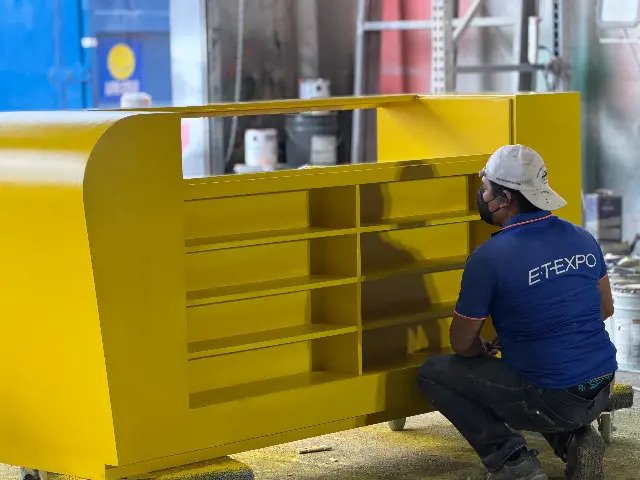
A trade show booth manufacturer makes the physical thing: cutting, welding, building, finishing, printing and assembling. Some manufacturers also design. Some build only from other people’s drawings.
A trade show manufacturer is a broader label. It may cover booths, displays, graphics, fixtures or related products, so it’s worth asking what they make and what they don’t.
These words overlap and aren’t regulated. So the label tells you little. What matters is which jobs the company actually does.
The golden rule: define the brief before you hire anyone
Whichever route you take, one thing comes first and costs nothing: a one-page brief. It saves time with every vendor you talk to.
Write down:
- The show and dates, and the booth size and type if known
- Your goal: leads, meetings, product launch, brand awareness
- Your audience: who you want to attract
- What goes in the booth: products, demos, screens, meeting space
- How many shows it needs to serve in 2027
- Your budget range, including costs outside the booth
- Your hard deadlines
With a brief, any designer or manufacturer can give you a useful answer. Without it, every conversation starts from zero.
Who to hire first: five common situations
Situation 1: You have no design yet and a flexible timeline
Start with: a designer, or a company that offers design and build together. You need ideas, layouts and renderings before anyone can build. Ask early whether the designer will review the concept with the people who’ll build it, so the plan stays practical.
Situation 2: You already have a design from an agency or in-house team
Start with: a manufacturer, and share the drawings right away. Ask them to review the design for structure, weight, shipping and venue rules before you approve it as final. Treat this review as a normal step, not an insult to the designer.
Situation 3: Your show is close
Start with: a company that can do both, or talk to a designer and a manufacturer at the same time. Time is the issue, so avoid a strictly one-then-the-other process. A rental or hybrid booth with custom graphics and one standout feature is often the realistic path. Ask early what’s possible in your window.
Situation 4: You’re new to exhibiting
Start with: a conversation, not a commitment. Talk to one or two companies about goals and options before choosing a route. A partner who explains trade-offs is more useful than one who simply quotes.
Situation 5: You have several 2027 shows
Start with: a designer who plans for reuse, then a manufacturer who builds for it. The structure should work across shows, with graphics and displays changing for each. Reuse is a design decision first and a build decision second, so it has to be discussed at the start.
The sequence we’d suggest for most exhibitors
If you’re unsure, this order works for a lot of projects:
| Step | What happens | Who’s involved |
| 1 | Write the one-page brief | You |
| 2 | Read the exhibitor manual for deadlines and rules | You |
| 3 | Talk to two or three companies | You |
| 4 | Concept and layout | Designer |
| 5 | Review for structure, shipping and venue rules | Designer and manufacturer together |
| 6 | Approve design, renderings and material samples | You |
| 7 | Fabrication, graphics and freight planning | Manufacturer |
| 8 | Install and on-site support | Manufacturer, with you |
Step 5 is the one most often skipped. It’s the moment a design meets reality, and it’s where problems are cheapest to fix.
Designer first, manufacturer first, or both together?
Here’s the honest trade-off.
Designer first
- Good when you need ideas, strategy and a distinctive look
- Risk: the design may not account for fabrication, weight or timeline unless the builder is involved early
Manufacturer first
- Good when you have a design or a clear spec
- Risk: if you don’t have a design, you may end up with whatever the shop can build easily, rather than what your goals need
Both together (one team or close collaboration)
- Good when time is tight or you want accountability in one place
- Risk: make sure design isn’t treated as an afterthought, and ask who does what
No option is right for everyone. What matters is that someone is looking at both the look and the build from day one.
Questions to ask whoever you call first
- What do you do in-house, and what do you hand off?
- If I bring a design, will you review it for structure, shipping and venue rules?
- If I don’t have one, can you design it, and will the builders be involved?
- Will I see renderings and material samples before production starts?
- What’s your realistic schedule for my show date, in writing?
- Who is my single point of contact?
- Is pricing itemized, and what sits outside your quote?
- What support do I get on site?
Specific answers help. Vague ones are worth noticing.
Common sequencing mistakes
- Ordering graphics before the design is final. Changes mean reprints.
- Booking freight before the booth is engineered. Weight and crate count can change.
- Approving the render without a build review. Looks and feasibility are different things.
- Waiting for the perfect design. Delay can cost more than a good-enough decision.
- Splitting design and build with no coordination. Someone needs to own the handoff.
- Forgetting show-services deadlines. Power, rigging and other orders have their own timelines.
A rough 2027 timeline
A guide from our own project schedules. Yours may differ, and the exhibitor manual sets the real deadlines.
| Time before show | What to be doing |
| 5 to 6 months | Brief, budget, shortlist companies, read the manual |
| 3 to 4 months | Design approved and reviewed for build |
| 8 to 12 weeks | Fabrication starts; graphics finalized |
| 4 to 6 weeks | Freight planned; staff trained |
| 1 to 2 weeks | Final checks and install plan |
If your first 2027 show is closer than this, don’t assume it’s too late. A focused rental or hybrid booth can still work well. The trick is to talk to a partner early and decide quickly.
Where we fit
We’re a Las Vegas company that does design and fabrication in the same place: our own 35,000 sq ft studio with carpentry, metalwork, machining and print. That means the people who design a booth can walk over and talk to the people who build it. We show photorealistic renderings and material samples before building, quote with itemized pricing and keep one point of contact. We’re based in Las Vegas, and we say so up front.
If you already have a design, we’re happy to review it. If you don’t, we can start from your brief. Either way, the first conversation is free of pressure.
The bottom line
The question “designer or manufacturer first?” has no universal answer, but it has a good general rule: don’t let design and build live in separate worlds. Whoever you call first, make sure the other is part of the conversation before the design is final. Start with a one-page brief, read the exhibitor manual, and ask the questions above.
Do that, and the order of your calls matters a lot less than the quality of the answers.