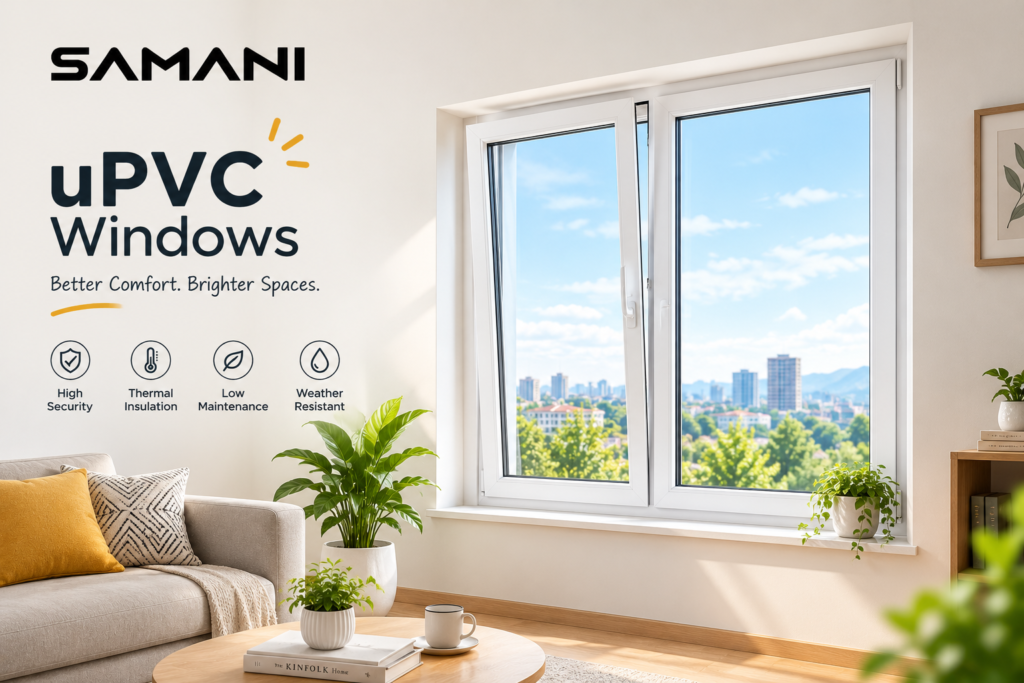

Choosing windows for your home involves more than selecting a frame colour or design. The material affects insulation, appearance, maintenance, ventilation and how the windows perform over time.
Two commonly considered options are uPVC and aluminium windows. Both are available in different styles, sizes and configurations, but their properties and applications are different.
So, uPVC windows vs aluminium windows—which should you choose for your Indian home?
The answer depends on your priorities, such as indoor comfort, larger glass openings, architectural design, budget and maintenance requirements. Let’s compare the two materials to understand where each one fits best.
1. What Is the Difference Between uPVC and Aluminium Windows?
The main difference is the frame material.
uPVC windows are made using unplasticised polyvinyl chloride, a rigid material commonly used for window frames. They are valued for their insulation potential, low-maintenance surface and suitability for different residential applications.
Aluminium windows use metal profiles to create window frames. Aluminium is known for its strength-to-weight characteristics and ability to accommodate slim-frame designs and larger glass panels when the system is appropriately engineered.
Both materials are available in sliding, casement and other opening configurations, depending on the manufacturer’s product range.
2. uPVC vs Aluminium Windows: Complete Comparison
| Comparison factor | uPVC windows | Aluminium windows |
| Frame material | Rigid uPVC | Aluminium profiles |
| Thermal insulation | Generally good due to the material’s lower thermal conductivity | Depends on the system; thermal-break options improve insulation |
| Frame appearance | Often features relatively wider frame sections | Can accommodate slim-profile designs |
| Large openings | Depends on the profile and reinforcement system | Often suitable for larger openings with appropriate engineering |
| Maintenance | Generally requires routine cleaning | Generally requires routine cleaning |
| Design options | Available in different colours and finishes | Available in different colours, finishes and profile designs |
| Weather performance | Depends on profiles, seals and installation | Depends on profiles, seals, drainage and installation |
| Cost | Depends on dimensions, specifications and hardware | Depends on profile system, finish, glass and hardware |
Neither material is automatically better in every category. The complete window specification matters more than the material name alone.
3. Which Windows Offer Better Heat and Noise Insulation?
Indoor comfort is an important consideration for Indian homes, especially in areas exposed to high temperatures, traffic noise or changing weather.
uPVC frames have relatively low thermal conductivity, which can help limit heat transfer through the frame.
Aluminium naturally conducts heat more readily. However, thermal-break aluminium systems use an insulating barrier within the frame to reduce heat transfer.
Noise reduction depends on more than the frame material. Glass type, glazing thickness, air gaps, weather seals and installation all influence the result.
Which should you consider?
- Choose uPVC if frame insulation is a major priority.
- Consider thermal-break aluminium if you want aluminium’s design flexibility with improved thermal performance.
- For better noise control, compare the complete glazing and sealing specifications of both options.
4. Which Is Better for Large Windows and Modern Designs?
Aluminium windows are often considered for contemporary architecture because their profiles can support slim-frame designs and larger glass sections when properly engineered.
They can be suitable for:
- Large living-room windows
- Floor-to-ceiling glazing
- Wide balcony openings
- Modern commercial facades
- Minimalist architectural designs
uPVC windows are also available in modern designs, including sliding and casement configurations. Their suitability for larger openings depends on the profile system, reinforcement, dimensions and manufacturer specifications.
If your priority is a minimal appearance with expansive glass, compare the available aluminium systems. If you want residential window solutions with a focus on insulation, uPVC is also worth considering.
5. Which Windows Require Less Maintenance?
Both uPVC and Aluminium windows are generally considered low-maintenance options compared with conventional timber windows.
uPVC windows:
- Do not require routine painting.
- Can be cleaned with mild soap and water.
- Need occasional checks of locks, hinges and seals.
Aluminium windows:
- Generally require simple surface cleaning.
- Do not rust like ordinary untreated iron or steel.
- Need periodic checks of tracks, rollers, hardware and seals.
For both materials, avoid harsh cleaning chemicals and follow the manufacturer’s maintenance instructions.
6. Are uPVC or Aluminium Windows Better for Indian Weather?
Indian homes experience different environmental conditions, including heat, monsoon rain, humidity, dust and coastal exposure.
Both uPVC and aluminium windows can be suitable when the correct system is selected and installed properly.
For uPVC, check the profile construction, reinforcement where required, hardware and weather seals.
For aluminium, consider the surface finish, profile specifications, drainage arrangements and whether a thermal-break system is appropriate.
In coastal locations, also ask about the finish and hardware’s suitability for the local environment.
Important: Neither material guarantees complete protection against rain, heat or outside noise. Window design, glass, sealing and installation play equally important roles.
7. What Affects the Price of uPVC and Aluminium Windows?
There is no fixed price for either material. The final quotation depends on several product and project requirements.
| Price factor | What influences the cost? |
| Window size | Larger dimensions require different material and glass quantities |
| Opening style | Sliding, casement and other systems have different hardware requirements |
| Frame specification | Profile design, construction and reinforcement |
| Glass | Single, double-glazed or specialised glazing options |
| Hardware | Handles, locks, rollers and hinges |
| Finish | Standard or customised colours and finishes |
| Installation | Site conditions, measurements and fitting requirements |
When comparing quotations, check whether glass, hardware, installation, transportation and applicable taxes are included. Comparing only the per-square-foot price may not give you an accurate picture.
8. How to Choose Between uPVC and Aluminium Windows?
Use these practical considerations before making your decision:
Consider uPVC windows if:
- Frame insulation is a major priority.
- You want a low-maintenance residential window option.
- Your preferred design is available in the required dimensions.
- You are comparing residential window systems for bedrooms, living rooms or other spaces.
Consider aluminium windows if:
- You prefer slim-frame aesthetics.
- Your project requires larger glass openings.
- You want greater flexibility in certain architectural configurations.
- You are selecting windows for modern residential or commercial buildings.
The best choice is the system that meets your project’s functional and design requirements within your budget.
Final Thoughts
The choice between uPVC windows and aluminium windows depends on what matters most in your home.
uPVC is worth considering when frame insulation and low-maintenance residential solutions are priorities. Aluminium is worth considering when slim profiles, larger glass openings and architectural flexibility are important.
Before making a decision, compare the frame specifications, glass, hardware, weather seals, finish and installation quality.
Explore Samani ECC’s uPVC windows and aluminium windows to learn about the available options for your project.