


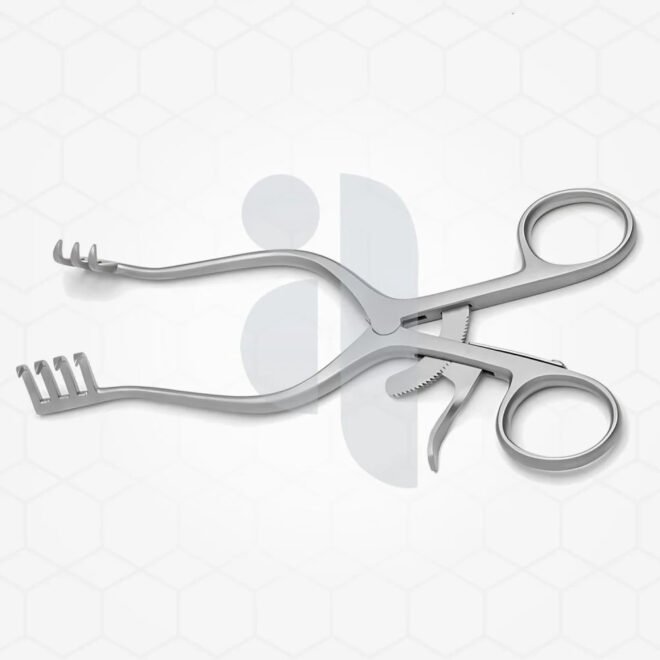

Every successful operation depends on a clear view of the surgical site. When a surgeon makes an incision, the tissue naturally wants to close again, and someone has to hold it open. The wheatlander instrument solves this problem without tying up an assistant’s hands. Also known by its original spelling, Weitlaner, this self-retaining wheatlander instrument is a standard tool in operating rooms worldwide. Here’s what makes it so useful.
What Is a Wheatlander Retractor?
The wheatlander instrument is a self-retaining surgical retractor that spreads and holds the edges of an incision. It looks a bit like a pair of scissors, with two finger rings and two arms. At the working end, each arm has curved prongs, also called tines, that grip the tissue. A ratchet lock near the handles keeps the arms open at the chosen width, so the retractor stays in place on its own throughout the procedure.
Where Surgeons Use It
This retractor appears in many specialties. Orthopedic surgeons use it to expose bones and joints. Spine surgeons and neurosurgeons rely on it during procedures on the back and neck. Plastic and general surgeons use it for soft tissue work and smaller incisions. Because a wheatlander instrument holds steady without manual effort, the surgical team can focus on the procedure, and the operation often moves more efficiently.
Design Features That Support Precision
Small details make a big difference. Prongs come in sharp or blunt versions. Sharp tines grip firm tissue securely, while blunt tines lower the risk of injuring nerves and vessels. Common prong configurations include 2×3 and 3×4, and lengths typically range from about 4 to 8 inches. A smooth, reliable ratchet lets the surgeon adjust tension in small steps. A well-balanced wheatlander instrument feels natural in the hand and opens with controlled, predictable force.
Hygiene and Long-Term Durability
Any tool that enters a surgical site must be easy to clean and sterilize. High-grade stainless steel resists corrosion and keeps its shape through repeated autoclave cycles. Clean the ratchet and joint carefully after each use, because these areas can trap debris. Inspect each wheatlander instrument regularly for bent prongs, loose joints, or a worn locking mechanism. Retire any piece that no longer locks firmly.
Why Choose AzeeMed
AzeeMed focuses on making surgical instruments of the highest quality for the medical community around the globe. With over two decades of experience, the company supplies instruments for plastic, dental, ophthalmic, neuro and spine, and orthopedic surgeries. Every orthopedic mallet from AzeeMed is crafted for precision, with smooth ratchets, well-aligned prongs, and durable steel that stands up to daily use.
Conclusion
This simple self-retaining retractor plays a major role in surgery. It improves visibility, frees skilled hands, and helps procedures run smoothly across many specialties. For precision, hygiene, and durability you can trust, choose a wheatlander instrument from AzeeMed. Explore AzeeMed’s full range of surgical instruments and give your team tools built to perform.


