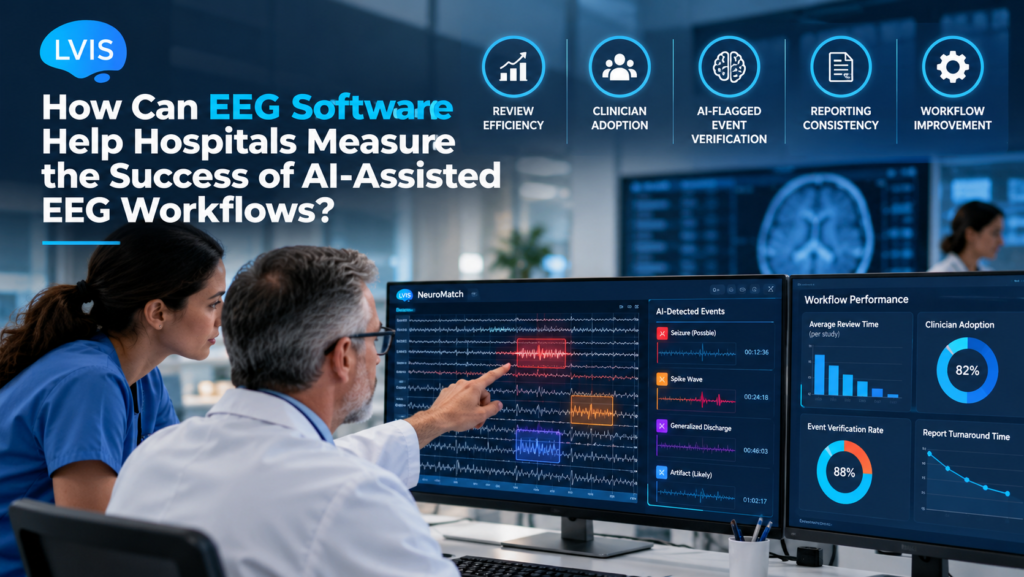

Hospitals are increasingly exploring artificial intelligence to support electroencephalogram (EEG) review, neurological monitoring, and clinical reporting. However, implementing advanced technology does not automatically mean that a neurology department has improved its performance. Hospital administrators and clinical leaders need measurable evidence showing whether new workflows support efficiency, consistency, and appropriate clinical oversight. Modern eeg software can provide tools for organizing recordings, identifying potentially relevant events, and supporting collaboration between clinicians. The real measure of success is how effectively these capabilities fit clinical practice while maintaining patient safety and professional accountability.
Measuring the impact of AI-assisted EEG workflows requires a structured approach before and after implementation. Hospitals should establish baseline performance, define meaningful indicators, and collect feedback from the people using the system. These activities help distinguish genuine operational improvements from changes that simply shift work between team members. They also provide a framework for identifying training needs and technical limitations. A well-designed evaluation helps healthcare organizations make informed decisions about continued adoption and future investment.
Why Should Hospitals Measure AI-Assisted EEG Workflow Performance?
EEG review can involve substantial volumes of signal data, especially during prolonged monitoring or ambulatory studies. Clinicians must distinguish meaningful neurological activity from artifacts and other non-diagnostic patterns. AI-assisted tools may help organize recordings and flag events for review, but these features need to be evaluated in actual clinical settings. Hospitals should determine whether the technology improves relevant processes without introducing unacceptable risks or unnecessary complexity. Performance measurement helps connect technology investment with clinical and operational objectives.
Define Success Before Implementation
Different hospitals may have different reasons for adopting AI-assisted EEG technology. One department may prioritize reducing the time required to review lengthy recordings, while another may focus on collaboration between facilities. A third organization may want more consistent documentation and reporting processes. These objectives should be translated into measurable indicators before implementation begins. Without defined goals, teams may struggle to determine whether the system has delivered meaningful value.
Include Clinical and Operational Perspectives
A technology evaluation should involve neurologists, EEG technologists, laboratory managers, clinical informatics specialists, and hospital administrators. Each group encounters different parts of the workflow and may identify different challenges. Clinicians can assess the usefulness of event annotations and review tools, while administrators may focus on turnaround times and resource allocation. IT teams can evaluate access reliability, integration requirements, and support demands. Combining these perspectives produces a more complete assessment.
How Can Hospitals Establish Baseline EEG Review Times?
Baseline measurements provide a reference for evaluating changes after implementation. Hospitals should collect information about existing review processes before introducing new software or changing clinical responsibilities. Measurements should reflect comparable study types and account for differences in recording duration and complexity. Otherwise, apparent improvements may result from changes in case mix rather than the technology itself. A consistent measurement approach makes later comparisons more meaningful.
Measure Review Time by Study Type
Routine, ambulatory, and continuous EEG studies may require different review approaches. Hospitals should avoid combining these workflows into a single average without considering their differences. Review time can be measured from the beginning of clinical interpretation to completion of the relevant review task. Departments should also document interruptions, technical delays, and handoffs where practical. These details help identify which stages contribute most to the overall workload.
Track Report Turnaround Time
Review duration and report turnaround time are related but distinct indicators. A clinician may complete signal interpretation efficiently while the report remains delayed by documentation or approval steps. Hospitals should measure the interval between relevant workflow milestones using consistent definitions. Examples include recording availability, physician review completion, and final report authorization. Tracking these stages helps identify whether delays occur during interpretation or elsewhere in the process.
Compare Similar Cases
Meaningful evaluation requires comparing cases with similar clinical and operational characteristics. Longer recordings, complex abnormalities, and urgent studies may demand additional review time. Hospitals should consider stratifying results by study duration, care setting, and clinical complexity. Comparisons should also account for staffing changes and differences in reviewer experience. This reduces the risk of attributing unrelated workflow changes to AI-assisted tools.
Which Metrics Show Whether AI-Assisted EEG Review Is Effective?
No single performance metric can describe the full value of a clinical technology implementation. Faster review may be beneficial, but it should not come at the expense of appropriate interpretation or documentation quality. Hospitals need a balanced set of measures covering efficiency, clinician adoption, event verification, and operational reliability. These indicators should be reviewed together rather than interpreted independently. The evaluation should reflect the system’s intended clinical use and the organization’s established quality requirements.
Review Efficiency
Efficiency indicators may include active review time, time to identify relevant segments, and report completion intervals. Departments should define each measure consistently before collecting data. They should also identify whether automated functions reduce manual tasks or create additional verification work. A reduction in one activity may not translate into a shorter overall workflow. Evaluating the complete process helps determine the actual operational effect.
Clinician Adoption
Adoption rates help show whether clinicians are incorporating the technology into routine practice. Hospitals may track the proportion of eligible studies reviewed through the platform and the frequency of relevant feature use. These measures should be interpreted alongside training completion and user feedback. Low adoption may indicate workflow friction rather than a lack of clinical value. Understanding the reasons behind adoption patterns is essential for improvement.
Reporting Consistency
Consistent reporting can support communication between neurologists and referring care teams. Hospitals may review whether required report sections are completed and whether documentation follows established departmental standards. Template use, annotation consistency, and report revision rates may provide additional information. These measures should not be confused with diagnostic accuracy. Clinical quality requires separate evaluation using appropriate professional review methods.
How Should Hospitals Evaluate AI-Flagged EEG Events?
AI-assisted event detection can help direct attention toward selected portions of an EEG recording. However, flagged events must be interpreted in the context of the full clinical record and the software’s intended use. A system may identify patterns that require review without establishing a final diagnosis. Hospitals should therefore measure how clinicians verify, accept, reject, or modify automated annotations. This helps evaluate whether the technology supports clinical work rather than simply generating more alerts.
Measure Event Verification Workload
Hospitals can track how many flagged events require manual confirmation or correction. A high volume of alerts may increase review burden if many are not clinically relevant. Conversely, a useful prioritization system may help clinicians locate important segments more efficiently. The evaluation should consider the time required to verify findings as well as the number of events identified. Clinician judgment remains central to interpreting these results.
Assess Agreement With Expert Review
Clinical teams may compare AI-generated event annotations with assessments performed by qualified reviewers. The comparison process should use a defined reference standard and appropriate case selection. Depending on the intended use, relevant measures may include sensitivity, specificity, precision, and agreement rates. Results should be examined across study types and recording conditions rather than reduced to a single headline figure. Performance findings should guide local clinical governance and appropriate use of the technology.
Monitor Missed and Incorrectly Flagged Events
Both false-positive and false-negative findings can affect clinical workflows. Excessive false positives may create unnecessary review work, while missed events may raise concerns about relying on automated prioritization. Hospitals should establish processes for reviewing discrepancies and documenting significant issues. The clinical consequences depend on the event type and intended use of the system. These evaluations should support appropriate safeguards and continued professional oversight.
How Can AI EEG Tools Support Consistent Clinical Workflows?
Consistency is particularly important when EEG recordings are reviewed by multiple clinicians or across different facilities. Departments may use different approaches to organizing annotations, documenting findings, and completing reports. Standardized digital workflows can help reduce unnecessary variation in these processes. AI EEG capabilities may also assist with identifying events that warrant professional attention. Hospitals should evaluate whether these functions support established clinical protocols and documentation expectations.
Standardize Review Steps
Departments should define the sequence of activities required for an appropriate EEG review. These may include verifying patient information, examining the recording, assessing relevant events, and documenting conclusions. Software can support consistent navigation and organization of these activities. However, standardization should not prevent clinicians from exercising judgment when cases require additional investigation. The goal is to reduce avoidable workflow variation while preserving appropriate clinical flexibility.
Maintain Human Oversight
Automated analysis should be used within the boundaries of the product’s authorized intended use. Clinicians remain responsible for interpreting findings and making patient care decisions. Hospitals should document which tasks are assisted by automation and which require professional confirmation. Training should reinforce the limitations of automated outputs. Clear responsibilities help prevent inappropriate reliance on software-generated findings.
How Can EEG Analysis Software Reveal Workflow Bottlenecks?
Hospitals often discover that delays occur outside the primary interpretation task. Recordings may be difficult to access, studies may wait for assignment, or reports may require repeated administrative steps. EEG analysis software can support more organized review processes when its capabilities align with departmental needs. However, hospitals must measure where time is actually being spent before concluding that a particular feature solves the problem. Workflow mapping provides a practical starting point.
Identify Delays in Data Access
Clinicians may experience delays when recordings must be transferred between systems or accessed from specific workstations. These interruptions can affect the time required to begin reviewing a study. Hospitals should measure access delays and identify their causes. Cloud-based or browser-accessible workflows may offer alternatives depending on network, security, and operational requirements. Performance should be evaluated under the hospital’s actual technical conditions.
Review Handoffs Between Team Members
EEG workflows frequently involve technologists, physicians, and administrative personnel. Delays can occur when studies wait for assignment, clarification, or final authorization. Departments should document these handoffs and determine which are necessary for safe operation. Digital workflow features may help make task status more visible. Improvements should be assessed against the complete process rather than individual user activity.
Examine Reporting and Documentation Steps
Clinical reporting may require multiple actions after the recording has been interpreted. These can include preparing summaries, confirming annotations, applying signatures, and distributing finalized reports. Hospitals should identify repetitive tasks and evaluate whether software functions reduce unnecessary administrative work. Automated reporting features still require appropriate clinical review and validation. Measuring these activities can reveal opportunities for workflow improvement.
How Should Hospitals Measure Clinician Adoption and Training Success?
A technically capable platform may deliver limited value if users do not understand how to incorporate it into their work. Adoption depends on usability, training quality, workflow compatibility, and confidence in system outputs. Hospitals should treat implementation as an organizational change rather than a software installation alone. Training requirements may differ between neurologists, technologists, and IT personnel. Ongoing feedback helps identify where additional support is needed.
Track Training Completion
Training records provide a basic indication of implementation progress. Hospitals should document which users have completed relevant instruction and whether additional training is required. Completion alone does not establish proficiency. Departments may need practical assessments or supervised use for certain functions. Training plans should reflect the user’s responsibilities and the system’s intended clinical application.
Collect Structured Clinician Feedback
User feedback can reveal problems that are not visible in quantitative performance data. Clinicians may report difficulty locating functions, interpreting annotations, or completing routine tasks. Structured surveys and focused discussions can help identify recurring concerns. Feedback should be collected at multiple stages because experiences may change as users become more familiar with the system. Findings should inform training and workflow adjustments.
Evaluate Confidence Without Encouraging Overreliance
Clinician confidence is an important consideration, but it should not be treated as proof of clinical accuracy. Users need to understand both the capabilities and limitations of AI-assisted tools. Hospitals should assess whether clinicians know when additional review is required. Training should address how to interpret uncertain or unexpected outputs. Appropriate confidence supports responsible adoption while maintaining professional skepticism.
How Can EEG Review Software Improve Collaboration?
EEG services may involve clinicians working across hospitals, monitoring units, or remote locations. Collaboration tools can help teams access recordings and coordinate review activities when appropriate. EEG review software may support shared access, annotations, and reporting workflows. Hospitals should evaluate these functions according to actual clinical needs and information security requirements. The objective is to improve coordination without creating unnecessary access or documentation risks.
Support Remote Clinical Review
Remote access may allow qualified clinicians to review recordings without being physically present at the acquisition site. This can be valuable when specialist availability varies between facilities. However, network reliability, access controls, and organizational policies must support the workflow. Hospitals should measure whether remote review improves availability or turnaround times. Any changes should remain consistent with applicable clinical and regulatory requirements.
Coordinate Multidisciplinary Teams
EEG interpretation may involve communication between neurologists, technologists, and other clinical professionals. Shared digital tools can help organize information used during these interactions. Departments should establish clear responsibilities for annotations, reviews, and report approval. Collaboration features should not create uncertainty about who made a particular decision. Auditability and documentation consistency are important evaluation criteria.
What Should Hospitals Know About LVIS Corporation’s NeuroMatch Platform?
LVIS Corporation develops neurotechnology intended to support neurological data analysis and clinical workflows. Its Neuromatch platform provides cloud-based access to EEG recordings and tools designed for review, analysis, reporting, and collaboration. Published platform information describes features such as artifact reduction, automated reports, longitudinal reporting, and AI-enabled event detection. These capabilities provide areas that hospitals can examine when establishing implementation objectives. Actual performance should be assessed within each organization’s clinical environment.
Evaluate Browser-Based Accessibility
The platform’s published capabilities include browser-based access to EEG data. Hospitals may evaluate whether this reduces dependence on particular workstations or simplifies authorized remote review. Access performance should be tested across relevant facilities and network conditions. Security and user access policies should also be reviewed before deployment. Local measurements can determine whether accessibility improvements translate into operational benefits.
Assess Automated Annotations and Reports
LVIS describes automated event detection and reporting capabilities within its platform. Hospitals can evaluate how these functions fit their existing review and documentation processes. Relevant measures may include annotation verification time, report preparation effort, and clinician satisfaction. These outcomes should be measured rather than assumed. All features must be used according to their applicable regulatory status and intended use.
Confirm Feature Availability and Regulatory Scope
The LVIS website identifies U.S. FDA clearance for the platform and states that certain displayed features are not yet cleared in the United States. Hospitals should verify which functions are included in the specific product configuration being evaluated. Regulatory clearance for one feature should not be interpreted as authorization for every advertised capability. Procurement and clinical governance teams should request current documentation from the manufacturer. This helps ensure that evaluation plans reflect the functions available for the intended setting.
How Can Hospitals Build an EEG Technology Evaluation Scorecard?
A structured scorecard helps hospitals compare implementation objectives with measurable results. It can include operational performance, clinical review quality, user adoption, technical reliability, and reporting consistency. Each category should have defined indicators and a method for collecting evidence. The scorecard should also identify responsible stakeholders and review dates. This approach makes evaluation more transparent and repeatable.
Establish Baseline and Follow-Up Measures
Hospitals should collect baseline data before deployment whenever practical. The same indicators can then be reviewed after implementation using comparable methods. Differences should be interpreted in light of staffing, patient mix, and workflow changes. A single observation period may not capture the full effects of adoption. Repeated measurement can provide a more reliable understanding of progress.
Assign Evaluation Responsibilities
Clinical and operational leaders should agree on who will collect, review, and approve evaluation findings. Neurology teams may assess clinical review processes, while IT personnel monitor technical reliability. Administrators can evaluate workflow and resource implications. Responsibilities should be documented before the evaluation begins. Clear ownership helps ensure that important findings lead to action.
Use a Procurement and Evaluation Checklist
The EEG Software Evaluation Scorecard and Hospital Procurement Checklist – LVIS Corporation provides a resource for structuring technology evaluation discussions. Hospitals can use a checklist to organize questions about functionality, clinical workflows, implementation requirements, and operational expectations. Evaluation criteria should be adapted to the organization’s patient population and care setting. The checklist should supplement local clinical, technical, and procurement review processes. It should not replace independent assessment of performance or regulatory suitability.
Which Performance Indicators Should Hospitals Review After Implementation?
Post-implementation evaluation should focus on measures that reflect the hospital’s original objectives. Departments may prioritize review efficiency, event verification, reporting consistency, or clinician adoption. Technical reliability and support requirements should also be considered because they influence routine use. Results should be evaluated together to identify both improvements and unintended consequences. A balanced approach helps prevent decisions based on a single favorable metric.
| Evaluation Area | Suggested Indicator | Key Question |
|---|---|---|
| Review efficiency | Median active review time by study type | Has review time changed for comparable studies? |
| Report turnaround | Time from recording availability to final report | Are reports completed more consistently? |
| Clinician adoption | Percentage of eligible studies reviewed using the platform | Are clinicians incorporating the system into practice? |
| Event verification | Agreement with qualified clinical review | Are flagged events useful and appropriately verified? |
| Alert burden | Number of irrelevant flags requiring review | Is automation creating unnecessary work? |
| Reporting quality | Required documentation completion and revision rates | Are reports meeting departmental standards? |
| Technical reliability | Access interruptions and support requests | Is the system dependable during routine use? |
| Training | Proficiency assessments and user feedback | Do staff understand the system’s capabilities and limits? |
Review Both Benefits and New Workload
Technology adoption can remove some tasks while introducing others. Automated event detection may reduce manual searching but require additional verification of flagged segments. Browser-based access may improve availability while introducing new technical support considerations. Hospitals should document these trade-offs rather than measure only expected benefits. A complete assessment helps determine whether the workflow is genuinely more effective.
Establish a Regular Review Schedule
An initial evaluation may focus on implementation stability and training needs. Later reviews can examine workflow performance after users gain experience. Departments should determine appropriate review intervals based on clinical risk and operational requirements. Significant changes in software functionality or clinical procedures may justify additional assessment. Regular review supports continued improvement.
How Can Hospitals Compare Available EEG Platforms?
Hospitals may examine a list of eeg software options during procurement or technology planning. However, comparing product names and feature descriptions is not enough to determine suitability. Clinical teams should consider intended use, regulatory status, interoperability, security, usability, and implementation support. Demonstrations should include realistic workflows rather than only idealized examples. A structured comparison helps organizations identify which platform aligns with their needs.
Evaluate Clinical Workflow Fit
A platform should support the types of EEG studies and review activities performed by the department. Hospitals should confirm compatibility with relevant acquisition formats and existing processes. They should also evaluate how clinicians access recordings, review annotations, and finalize reports. Features that are valuable in one clinical setting may be less important in another. Workflow testing helps reveal these differences.
Consider Technical and Security Requirements
Clinical software must operate within the hospital’s information technology environment. Evaluation should address authentication, access controls, data handling, connectivity, and applicable security requirements. Cloud deployment may introduce additional questions about hosting, vendor responsibilities, and system availability. IT and compliance teams should participate in these discussions. Technical suitability is essential for dependable clinical use.
Review Implementation and Support Expectations
Successful adoption depends on more than product functionality. Hospitals should understand training arrangements, technical support processes, and responsibilities during deployment. They should also clarify how software updates and feature changes will be communicated. Relevant costs and contractual requirements should be reviewed through established procurement procedures. Clear expectations reduce uncertainty during implementation.
Frequently Asked Questions About AI-Assisted EEG Workflow Evaluation
How Soon Can Hospitals Measure Workflow Improvements?
Some operational indicators can be collected shortly after implementation. However, early results may be influenced by training requirements and unfamiliarity with the system. Hospitals should allow time for workflows to stabilize before drawing broad conclusions. Multiple evaluation periods may provide a more reliable picture. The appropriate timeline depends on study volume and implementation scope.
Does Faster EEG Review Mean Better Clinical Quality?
Not necessarily, because speed and clinical quality measure different aspects of performance. A faster workflow may be valuable when appropriate review standards are maintained. Hospitals should separately evaluate interpretation quality, documentation consistency, and clinically important discrepancies. Qualified clinicians must remain involved in reviewing relevant findings. Efficiency improvements should not be interpreted as evidence of improved diagnostic accuracy without supporting data.
Can AI Replace Neurologists in EEG Interpretation?
AI-assisted tools are intended to support specific tasks within neurological workflows. Their capabilities and limitations depend on the product and its authorized intended use. Automated outputs may require professional verification and clinical interpretation. Hospitals should maintain clear responsibility for patient care decisions. Technology should be evaluated as a support tool rather than assumed to replace clinical expertise.
What Is the Most Important EEG Implementation Metric?
There is no single metric that applies to every hospital. The most useful indicators depend on the organization’s goals and clinical setting. A department focused on delayed reporting may prioritize turnaround time, while another may emphasize consistency of event review. Clinical safety and quality should remain central regardless of operational objectives. A balanced scorecard provides a stronger basis for evaluation.
Should Hospitals Reevaluate Performance After Software Updates?
Yes, significant updates can change how software functions or interacts with established workflows. Hospitals should determine whether additional validation, training, or documentation is necessary. The scope of review should reflect the nature of the change and its potential clinical impact. Updated features should also be checked against current regulatory and organizational requirements. Ongoing evaluation helps maintain appropriate use over time.
Conclusion: Measure Clinical Value Beyond Software Features
AI-assisted EEG technology should be evaluated according to its contribution to real clinical and operational needs. Review efficiency, clinician adoption, event verification, reporting consistency, and technical reliability all provide important evidence. Hospitals should establish baseline measurements, define clear responsibilities, and review performance after implementation. Modern eeg software can support more organized workflows, but meaningful results depend on appropriate deployment and continued clinical oversight. A structured evaluation process helps hospitals determine whether their technology investment is delivering sustainable value.
Explore LVIS Corporation’s EEG Platform
Is your hospital evaluating AI-assisted EEG workflows or reviewing the performance of an existing system? LVIS Corporation offers technology designed to support EEG data access, clinical review, analysis, and reporting. Explore the platform’s published capabilities and discuss which features are appropriate for your clinical environment. Visit https://lviscorp.com/en/neuromatch to learn more and request a demonstration. You can also contact LVIS Corporation at contact@lviscorp.com to discuss your organization’s needs.
Clinical and regulatory note: This article is intended for healthcare technology planning and educational purposes. It does not provide medical advice or establish clinical performance claims for a particular hospital. AI-assisted EEG tools must be evaluated and used according to their intended use, applicable regulatory status, and institutional clinical protocols. Qualified healthcare professionals remain responsible for clinical interpretation and patient care decisions.