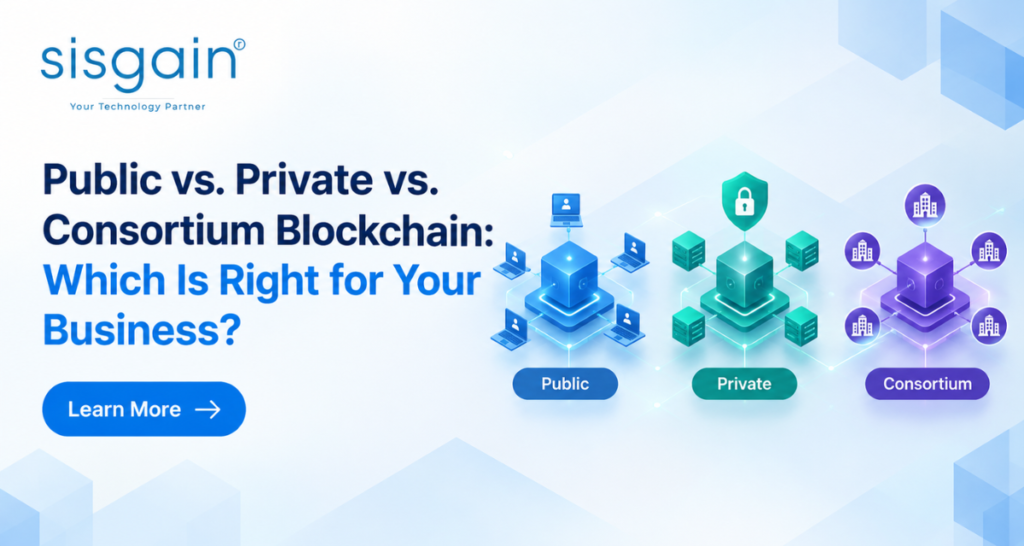
Choosing between public, private, and consortium blockchain networks is an important decision for businesses exploring distributed ledger technology. The question of private vs public blockchain is not simply about which network is faster or more secure. It is about who should control the system, who can participate, what information participants can access, and how the network supports the organisation’s business objectives.
For businesses in the UAE, the decision may arise while planning a supply-chain tracking platform, coordinating transactions between business partners, managing digital assets, or modernising an enterprise workflow. Each scenario has different requirements for privacy, governance, transparency, and integration with existing software.
This guide explains the three main blockchain network models, their practical differences, the trade-offs businesses should consider, and how to select an approach that fits a real business requirement. The focus is on making a sound technology decision rather than choosing blockchain simply because it is a popular technology.
Key Takeaways
-
Public blockchains suit applications that benefit from open participation, public verification, or interaction with a wider decentralised ecosystem.
-
Private blockchains provide controlled participation under one organisation’s administration, making them relevant to certain internal or restricted business workflows.
-
Consortium blockchains distribute network governance among several participating organisations, which can be useful when no single participant should control the shared system.
-
Permissioned versus permissionless describes how participation and access are controlled. It is related to, but not exactly the same as, the distinction between public and private networks.
-
No network is automatically the most secure or cost-effective. The outcome depends on architecture, governance, implementation quality, operating arrangements, and the business use case.
-
The best choice starts with the problem. Businesses should compare blockchain with conventional databases and other approaches before committing to development.
Quick Answers: Which Blockchain Network Should You Choose?
What is the main difference between public and private blockchain? A public blockchain generally allows broad participation under its protocol rules, while a private blockchain restricts participation and administration to authorised entities.
When is a consortium blockchain useful? It can suit several independent organisations that need to maintain shared records while distributing governance among members.
Is a private blockchain always faster? Not necessarily. A restricted network may have advantages in certain configurations, but performance depends on its consensus mechanism, infrastructure, transaction complexity, and workload.
Which model is best for an enterprise? It depends on the participants, data sensitivity, governance needs, integrations, and level of transparency required. Some enterprises may not need blockchain at all.
What Are the Types of Blockchain Networks Explained for Business?
A blockchain is a type of distributed ledger: a record of transactions maintained and validated by participating systems according to an agreed protocol. Depending on the design, cryptographic techniques and consensus mechanisms help participants verify the ledger’s history and agree on valid updates.
Unlike a conventional database managed by one administrator, a distributed ledger can allow multiple participants to verify records under shared rules. However, not every blockchain distributes control equally. Some networks are open to a broad community, while others restrict participation to known organisations.
The three commonly discussed network models are public, private, and consortium blockchain. They differ mainly in participation, governance, and access arrangements.
Public blockchain: Open participation and shared verification
A public blockchain is generally accessible to anyone who meets the network’s technical requirements. Depending on the protocol, participants may be able to submit transactions, inspect publicly available records, operate nodes, or help validate transactions.
This model is useful when an application benefits from verification beyond the boundaries of one company. For example, a digital application may need users to verify asset ownership without relying exclusively on a single platform operator.
Public networks can also support applications that interact with smart contracts, digital assets, decentralised finance, or other decentralised services. The extent of transparency depends on the network and application design; public transaction data does not necessarily reveal the real-world identity behind every address.
The trade-offs include potentially variable transaction fees, public visibility of on-chain activity, dependence on network-level rules, and the need to manage interactions with an external ecosystem.
Private blockchain: Restricted access and central administration
A private blockchain restricts participation to authorised users or organisations. One organisation, or a designated administrative group, generally controls membership and important network settings.
This approach may be appropriate when a business needs a shared transaction history for a defined group but does not want unrestricted participation. Examples could include internal asset tracking, controlled approval workflows, or recordkeeping between departments and approved contractors.
A private network can make it easier to establish participant identities and apply organisational policies. However, it does not automatically eliminate the need for trust. If one organisation controls membership, validation, and administration, other participants must still consider how much authority that organisation holds.
A conventional database may be simpler if the business does not need independent verification or shared governance. The private blockchain option becomes more compelling when the ledger’s properties provide a clear benefit beyond ordinary access controls and audit logs.
Consortium blockchain: Shared governance among organisations
A consortium blockchain is designed for a group of known organisations that share responsibility for operating or governing the network. Rather than leaving all important decisions to one company, the participants agree on rules for validating transactions, managing membership, and making changes.
Imagine several independent businesses that exchange goods but maintain separate operational systems. They need a common record of specific transaction milestones, yet none wants another participant to have unilateral control over the shared ledger. A consortium model may provide a suitable governance structure.
The members must agree on practical questions before implementation: Who can join? How are validation responsibilities distributed? What happens when participants disagree? Who pays operating costs? How can a member leave the network?
Consortium networks can help organisations coordinate records across business boundaries, but their value depends on member participation and enforceable governance arrangements. Technical decentralisation alone cannot replace contracts, policies, or dispute-resolution processes.
How Do Public, Private, and Consortium Blockchains Differ in Practice?
The practical differences become clearer when businesses examine how each model handles participation, decision-making, visibility, and accountability. The most important consideration is not whether a network is open or restricted in isolation, but whether its rules match the relationships between the people and organisations using it.
Who controls the network?
On a public network, control is governed by the protocol, its technical design, and the community or organisations involved in maintaining it. No single application developer necessarily controls the underlying network.
A private network typically has a designated operator or administrative authority. This can make organisational oversight more straightforward, but it also concentrates responsibility and decision-making.
A consortium network distributes selected responsibilities among participating organisations. This can reduce dependence on one member, provided the governance model genuinely prevents unilateral control over important decisions.
Businesses should document who can approve software changes, validate transactions, manage identities, and respond to disputes. These responsibilities should be clear before development begins.
Who can participate, and what can they see?
Participation and data visibility are separate questions.
A public network may allow anyone to inspect on-chain records while requiring users to interact through particular applications or interfaces. A private network may restrict who can join but still permit different visibility levels for different roles. A consortium network can give members shared access to agreed records without necessarily revealing every participant’s confidential information to everyone else.
This distinction matters for businesses handling commercial agreements, shipment details, customer information, and internal approvals. Restricting network membership does not automatically make all data confidential. Access permissions, encryption, storage design, and application-level controls must work together.
How are transactions validated?
Transaction validation is the process through which a network determines whether a proposed update follows its rules and can be included in the ledger.
Public networks may use mechanisms such as proof of stake or proof of work, depending on the protocol. Permissioned networks may use different consensus approaches designed around known participants and defined validation responsibilities.
There is no single mechanism that suits every application. Businesses need to consider transaction volume, resilience, fault tolerance, operational complexity, and the consequences of a network participant becoming unavailable or acting maliciously.
A design that performs well under ordinary conditions should also be evaluated under failure conditions. What happens if a validator disconnects, a member submits invalid information, or participants disagree about a transaction? Those scenarios affect the reliability of the overall system.
What Is the Difference Between Permissioned and Permissionless Blockchain?
The terms permissioned and permissionless describe who is allowed to perform particular activities on a network. They should not be treated as perfect synonyms for private and public blockchain.
A permissionless network generally allows participants to engage in specified network activities without receiving individual approval from a central administrator, subject to the protocol’s rules. A permissioned network requires authorisation for some or all activities, such as joining the network, validating transactions, or accessing restricted records.
A public blockchain can have permissioned components, and a network’s exact access model depends on its architecture. Likewise, a private or consortium network may allow different levels of permission for administrators, validators, and ordinary users.
When does each access model make sense?
Permissionless participation can be useful when an application needs broad accessibility, independent verification, or interaction with a public decentralised ecosystem. It may suit products where the ability to participate without approval from one organisation is central to the business model.
Permissioned participation is often worth considering when an organisation needs verified participants, controlled transaction submission, defined responsibilities, or restricted access to business operations. This may be relevant to enterprise workflows involving suppliers, distributors, or regulated processes.
The key is to distinguish identity from authority. Knowing who a participant is does not mean that participant should be allowed to perform every action. A well-designed application grants only the permissions needed for each role.
Which Blockchain Model Works Best for Different Industries?
Industry context can help narrow the options, but no sector automatically requires one network type. The right model depends on the business process, the number of independent parties, the sensitivity of the information, and the trust arrangements between participants.
Logistics and supply-chain operations
A logistics network may involve importers, freight forwarders, warehouse operators, customs-related processes, and delivery partners. Each party can maintain its own software, making it difficult to establish a consistent history of shipment events.
A consortium network may be appropriate when several independent organisations need to validate shared milestones and no participant should control the common record alone. A private network could be sufficient when one organisation administers the workflow for its approved partners.
The application still needs reliable sources of shipment data, appropriate access controls, and integration with operational systems. Barcode scans, sensor readings, and human confirmations must be validated because the ledger cannot independently prove that a recorded physical event occurred.
For companies already investing in custom logistics software development, the decision should include whether a shared ledger provides additional value beyond improving shipment tracking, system integration, and conventional audit records.
Finance and transaction coordination
Financial applications have different requirements depending on whether they support internal reconciliation, regulated payments, digital assets, or decentralised services.
A public network may suit an application that relies on publicly verifiable transactions or interaction with a broader digital-asset ecosystem. A restricted network may be more appropriate for coordination among identified institutions, provided its design meets the relevant operational and regulatory requirements.
Financial organisations should assess transaction finality, privacy, access control, operational resilience, and the rules governing their particular activities. The network choice does not itself establish regulatory approval or guarantee transaction security.
Healthcare and information exchange
Healthcare organisations may need to verify that records or transactions have not been altered while limiting access to sensitive patient information. A permissioned network could support selected verification workflows among authorised institutions.
However, storing complete medical records directly on an immutable ledger would create significant design concerns. A more appropriate architecture may keep patient information in controlled systems and use the ledger only for carefully selected references or verification events.
The business must also consider patient consent, access rights, retention requirements, and the applicable legal framework. Blockchain should support responsible information management, not make sensitive data harder to govern.
Real estate and digital ownership
Property-related applications may involve developers, buyers, legal professionals, financial institutions, and administrators. A shared record could help participants verify selected workflow events or the history of a digital representation of an asset.
Yet recording a digital token does not automatically transfer legal ownership of a physical property. The relationship between the ledger, authoritative records, contractual obligations, and applicable property law must be clearly established.
The same principle applies to other digital ownership applications: technical records and legal rights need to align.
Government and multi-organisation services
A shared ledger may be considered when several authorised entities need to verify a common sequence of events. A consortium or permissioned design may support defined responsibilities and access requirements.
But if one government authority already maintains the authoritative record and other participants simply need read access, a well-designed central system may be more efficient. The case for blockchain should rest on a genuine need for shared validation or governance.
How Should You Choose the Right Network for Your Business?
A network decision should follow a structured evaluation of the business problem, participants, and operating environment. Instead of selecting a platform first, establish the requirements that any suitable solution must satisfy.
1. Determine how much trust the participants share
Start by asking whether one organisation can reasonably manage the authoritative database on behalf of everyone else.
If all participants trust a single operator and accept its authority to control the records, a conventional database may be enough. If participants need independent verification or shared control, a distributed ledger may offer a stronger rationale.
Where multiple organisations must govern a common system, identify whether they are comfortable with one administrator or need a jointly managed arrangement.
2. Define privacy and access requirements
List the information the application will handle and classify it according to sensitivity. Determine which participants need to view, submit, verify, or approve each type of record.
Consider whether sensitive data should remain in existing systems, whether transaction details can be shared selectively, and whether public visibility creates commercial or privacy risks.
These requirements may narrow the choices before the development team evaluates individual networks.
3. Estimate transaction volume and operating costs
Estimate how frequently transactions will occur, when demand will peak, and how quickly the application must respond. Include transaction fees where applicable, infrastructure, monitoring, support, and integration expenses.
A network that works for a small pilot may not be suitable for a high-volume production workload without architectural changes. Test realistic usage patterns rather than relying solely on advertised performance figures.
4. Evaluate governance and long-term ownership
Decide who will administer the system, approve updates, manage participant access, and pay operating expenses.
For a consortium, these decisions require agreement among the members. For a private network, the operator must define its responsibilities to other participants. For a public network, the application team must understand which network-level decisions it cannot control.
Also consider whether the business can maintain the application if its original developer or infrastructure provider is no longer available.
5. Compare blockchain with simpler alternatives
Before approving investment, compare the proposed solution with a conventional database, an API-based integration, or a shared recordkeeping platform.
A blockchain network is justified only when its particular capabilities address a real requirement. Adding distributed infrastructure without a corresponding business benefit can increase costs, complicate maintenance, and introduce unnecessary dependencies.
What Is a Sensible Implementation Approach?
Once the network model has been selected, the next challenge is translating that choice into a working application. A disciplined blockchain application development process helps teams validate assumptions early and avoid committing to a complex architecture before its value is demonstrated.
Begin with a focused pilot
Choose one workflow with a clearly identifiable problem and measurable outcome. Document the participants, transaction rules, data requirements, and expected benefits.
For example, a group of distributors might pilot the verification of delivery confirmations between two participating organisations before expanding to a larger supply network. This limited scope makes it easier to assess the technical design and identify operational issues.
Test the complete workflow
The pilot should test more than transaction recording. It should examine identity verification, permissions, data exchange, error handling, recovery, and how the application interacts with existing software.
Include cases in which information is missing, participants submit conflicting records, or a connected system becomes unavailable. These tests reveal whether the design is practical outside a controlled demonstration.
Plan for production from the beginning
Even a small pilot should account for security, documentation, governance, and maintenance. Otherwise, a successful demonstration may need to be rebuilt before it can be used in real operations.
The development team should define acceptance criteria, deployment responsibilities, monitoring procedures, and the conditions that must be met before the system expands. Production readiness should be based on evidence, not simply on whether the prototype works.
Businesses comparing types of blockchain development services should evaluate the complete delivery approach, including discovery, architecture, implementation, integration, testing, deployment, and ongoing support. The exact scope should reflect the project’s needs rather than a predefined package.
For organisations seeking blockchain development services UAE, regional knowledge can be useful when coordinating stakeholders and understanding local business requirements. Businesses comparing blockchain development services dubai should still assess technical competence, security practices, delivery transparency, and long-term support rather than relying on location alone.
How Can We Help You Make the Right Technology Decision?
Selecting the right technology begins with understanding how your organisation operates, where coordination breaks down, and what a successful solution must achieve. SISGAIN Technologies can help businesses evaluate software requirements, plan application architecture, connect existing systems, and establish practical implementation priorities. A structured discovery phase can also clarify security expectations, operational responsibilities, and long-term maintenance needs before substantial resources are committed. By focusing on measurable business outcomes and realistic technical constraints, organisations can make informed investment decisions and develop solutions that remain useful as their operations and partnerships evolve.
Conclusion
Choosing between public, private, and consortium blockchain requires a clear understanding of who needs to participate, who should control the system, and how information must be verified and protected. Public networks can support open participation and broad verification, private networks provide controlled administration, and consortium networks enable shared governance among independent organisations.
None of these models is automatically the right choice for every business. Evaluate the level of trust between participants, privacy requirements, transaction demands, governance arrangements, and total operating costs before committing to a particular architecture. Most importantly, compare the proposed solution with simpler alternatives and validate its value through a focused pilot. The best technology decision is the one that solves a genuine business problem without introducing unnecessary complexity.
Frequently Asked Questions
1. Is a public blockchain more secure than a private blockchain?
Neither model is universally more secure. Public networks may benefit from broad independent participation and established validation mechanisms, while private networks can restrict access and define administrative controls. Security depends on the protocol, implementation, governance, key management, and threat model.
2. Can a private blockchain be decentralised?
It can distribute validation or decision-making across multiple participants, but the degree of decentralisation depends on who controls the network. If one organisation can independently change rules, control validators, or exclude participants, authority remains concentrated even if several computers maintain copies of the ledger.
3. Why would businesses choose a consortium blockchain instead of a private one?
A consortium model can make sense when several independent organisations need shared governance and do not want one member to have unilateral control. The participants must agree on membership, validation, decision-making, dispute resolution, and operating costs. Without that agreement, a shared network can become difficult to manage.
4. Are public blockchain transactions anonymous?
Not necessarily. Public addresses may not directly display real-world identities, but transaction histories can sometimes be analysed and linked to individuals or organisations using additional information. Businesses should not treat pseudonymous addresses as a guarantee of privacy.
5. Can a company move from a private blockchain to a public network later?
Potentially, but migration is not always straightforward. The application may depend on network-specific smart contracts, data formats, identity systems, and transaction rules. A migration plan should consider data portability, contract redesign, security testing, user access, and the relationship between historical and new records.
6. Does every enterprise blockchain project need a consortium?
No. A consortium is useful when multiple independent organisations need shared governance. An internal workflow may work better with a private network or a conventional database, while an open digital application may benefit from a public network. The business requirements should determine the model.
Last Update: October 21, 2026