

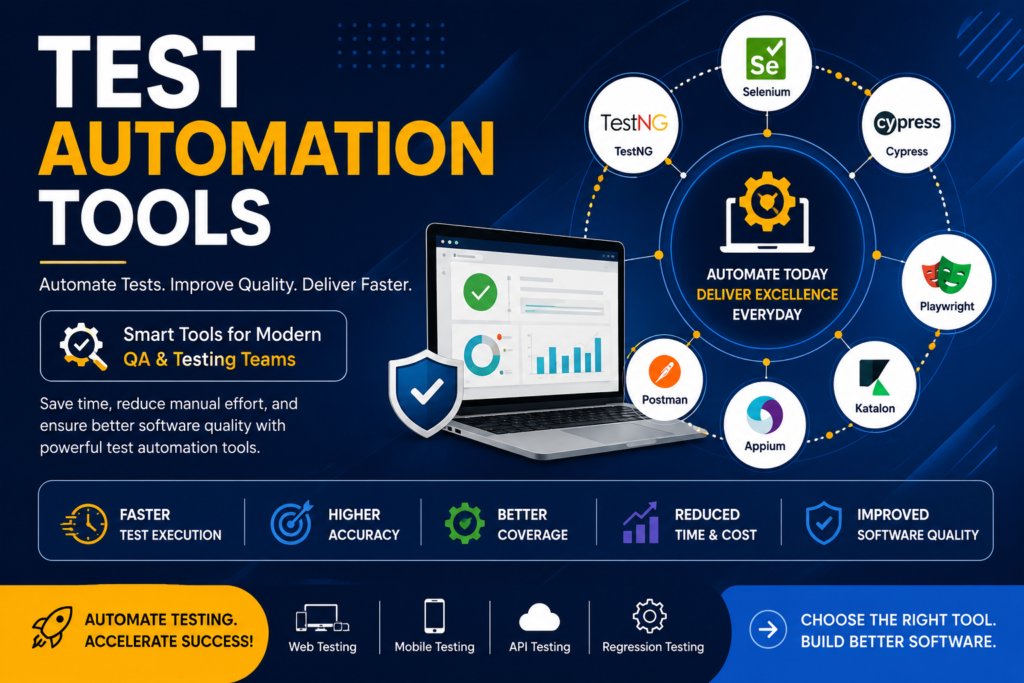

In today’s fast-paced software development world, ensuring that applications work correctly is more important than ever. Software testing helps identify bugs and improve quality before products reach users. However, manually testing every feature can be time-consuming and repetitive. This is where test automation tools come into play.
For students interested in software development, quality assurance (QA), or testing careers, understanding test automation tools is an excellent starting point.
What Are Test Automation Tools?
Test automation tools are software applications that automatically execute test cases, compare actual results with expected results, and generate reports. Instead of manually checking every feature, testers use automation tools to perform repetitive testing tasks quickly and accurately.
These tools help organizations improve software quality while reducing testing time and effort.
Why Is Test Automation Important?
Modern applications receive frequent updates and new features. Testing everything manually after every update can be challenging.
Automation helps by:
- Reducing human errors
- Saving time and effort
- Increasing test coverage
- Improving software quality
- Accelerating software releases
- Supporting continuous integration and delivery
Companies use automation testing to ensure applications remain reliable even as they evolve.
How Do Test Automation Tools Work?
A test automation tool follows a simple process:
1. Create Test Scripts
Testers write scripts that describe how the application should behave.
2. Execute Tests Automatically
The tool runs the scripts without manual intervention.
3. Compare Results
The software compares actual outputs with expected outcomes.
4. Generate Reports
Detailed reports highlight passed and failed test cases.
This process helps teams identify issues quickly and fix them before deployment.
Popular Test Automation Tools
Selenium
One of the most widely used automation testing tools for web applications.
Key Features:
- Open-source
- Supports multiple browsers
- Supports Java, Python, C#, and more
- Large community support
Cypress
A modern testing framework designed for web applications.
Benefits:
- Fast execution
- Easy setup
- Real-time debugging
- Excellent developer experience
Playwright
A powerful automation tool developed by Microsoft.
Advantages:
- Cross-browser testing
- Fast execution
- Supports multiple programming languages
- Advanced automation capabilities
Appium
Used primarily for mobile application testing.
Features:
- Android and iOS support
- Open-source
- Cross-platform automation
TestComplete
A commercial automation testing solution.
Benefits:
- User-friendly interface
- Supports desktop, web, and mobile testing
- Script and scriptless testing options
Types of Testing Performed Using Automation Tools
Functional Testing
Verifies that application features work as expected.
Regression Testing
Ensures new updates do not break existing functionality.
Performance Testing
Measures application speed and responsiveness.
UI Testing
Validates user interface elements and interactions.
API Testing
Tests communication between software components.
Skills Students Should Learn
Students interested in automation testing should focus on:
Programming Languages
- Java
- Python
- JavaScript
- C#
Testing Concepts
- Test Cases
- Test Scenarios
- Bug Reporting
- Software Development Life Cycle (SDLC)
Automation Frameworks
- Selenium Framework
- TestNG
- JUnit
- PyTest
Version Control
- Git
- GitHub
Learning these skills can significantly improve job opportunities in software testing and QA.
Advantages of Learning Test Automation
Students who learn automation testing gain several benefits:
- Better career opportunities
- Higher demand in the IT industry
- Improved technical skills
- Exposure to real-world software projects
- Competitive salary potential
Automation testing has become a critical skill in modern software development teams.
Career Opportunities in Automation Testing
After learning test automation tools, students can pursue roles such as:
- QA Tester
- Automation Test Engineer
- Software Test Analyst
- Quality Assurance Engineer
- SDET (Software Development Engineer in Test)
- Test Automation Consultant
As businesses continue adopting agile and DevOps practices, demand for automation professionals continues to grow.
Conclusion
Test automation tools have transformed the software testing industry by making testing faster, more reliable, and more efficient. For students looking to enter the software industry, learning automation testing can open doors to exciting career opportunities.
By understanding tools like Selenium, Cypress, Playwright, and Appium, students can build valuable technical skills that are highly sought after by employers worldwide. Starting with the basics today can lead to a successful career in software quality assurance and automation testing tomorrow.