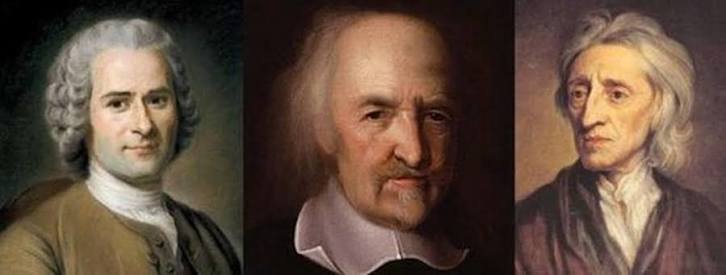

Hobbes vs Locke vs Rousseau: Social Contract Theory Compared
Introduction
Social Contract Theory is one of the most important approaches in Western Political Thought. It explains the origin, legitimacy, and purpose of political authority by examining the relationship between individuals and the state. Three major thinkers associated with this theory are Thomas Hobbes, John Locke, and Jean-Jacques Rousseau.
Although all three philosophers use the idea of a social contract to explain legitimate political order, they reach significantly different conclusions. Thomas Hobbes argues that individuals need a powerful sovereign to escape insecurity and conflict. John Locke maintains that government exists to protect natural rights, including life, liberty, and property. Jean-Jacques Rousseau argues that legitimate political authority must be based on popular sovereignty and the general will.
Their theories have shaped modern debates about democracy, individual freedom, constitutional government, political obligation, and the relationship between citizens and the state.
This article compares Hobbes, Locke, and Rousseau by examining their concepts of the state of nature, human nature, social contract, sovereignty, liberty, government, and revolution.
What Is Social Contract Theory?
Social Contract Theory is a political theory that explains the legitimacy of government through the idea of an agreement among individuals. It asks why people should accept political authority and what conditions make that authority legitimate.
The theory generally begins with a hypothetical condition called the state of nature, in which individuals exist without an established political authority. Philosophers then consider why individuals would agree to establish a political community and what powers that community should possess.
The social contract is primarily a philosophical model for explaining political legitimacy. It does not necessarily refer to a historical document that people actually signed.
Hobbes, Locke, and Rousseau use this framework to address three fundamental questions:
- Why do human beings need a political society?
- What gives government the right to exercise authority?
- When, if ever, can citizens resist or replace their government?
Their answers differ because they have different understandings of human nature, freedom, security, and political power.
1. Thomas Hobbes: Social Contract for Peace and Security
Thomas Hobbes (1588–1679) was an English political philosopher best known for his work Leviathan, published in 1651. His political thought was strongly influenced by the instability and conflict of his time, including the English Civil War.
Hobbes believed that the central purpose of political authority was to establish peace and protect individuals from violence and insecurity.
For a detailed introduction, read Thomas Hobbes: Politics and Philosophy.
State of Nature According to Hobbes
Hobbes describes the state of nature as a condition in which there is no common political authority capable of maintaining peace and enforcing rules.
Human beings possess broadly comparable capacities to harm one another. They also have competing desires, fear, and a concern for their own preservation. These conditions generate insecurity and the possibility of conflict.
Hobbes identifies three principal causes of conflict:
- Competition: Individuals may fight to obtain resources or advantages.
- Diffidence: Fear and mutual distrust may encourage people to attack others before being attacked themselves.
- Glory: Individuals may engage in conflict to protect their reputation or status.
Without a common authority, there is no reliable guarantee that agreements will be respected. Hobbes therefore describes the state of nature as a condition of war, understood not necessarily as continuous fighting but as a persistent readiness for conflict.
His famous description of life in this condition is often summarised as solitary, poor, nasty, brutish, and short.
Human Nature According to Hobbes
Hobbes presents human beings as motivated by desires, aversions, self-preservation, and the pursuit of their interests.
He does not argue that every individual is constantly violent. Rather, even individuals who prefer peace may become dangerous when they cannot trust others or rely on a common authority.
The absence of effective political power makes peaceful cooperation difficult to sustain.
Social Contract According to Hobbes
To escape insecurity, individuals agree with one another to authorise a sovereign power capable of maintaining peace.
The essential elements of Hobbes’s social contract are:
- Individuals seek protection from violence and insecurity.
- They mutually authorise a sovereign to exercise political power.
- The sovereign establishes and enforces laws.
- Citizens generally owe obedience because political authority provides the conditions for peace and security.
An important distinction is that the covenant is made among individuals with one another, who authorise the sovereign. In Hobbes’s account, the sovereign is not simply another contracting party who can be dismissed whenever subjects disagree with a decision.
Sovereignty According to Hobbes
Hobbes supports strong, undivided sovereign authority. He believes that dividing ultimate political power among competing authorities can produce conflict and threaten civil peace.
The sovereign may take the form of a monarch or an assembly. Hobbes does not make monarchy the only possible form of government, although he considers it preferable in several respects.
The sovereign must possess sufficient authority to make laws, settle disputes, and maintain public order.
Liberty According to Hobbes
Hobbes understands liberty primarily in terms of the absence of external impediments to action. Political laws restrict some actions, but a common authority also protects people from violence and insecurity.
Individuals retain a fundamental right to resist direct threats to their own lives. Hobbes does not require a person to surrender the right of self-preservation completely.
However, he does not establish a general right to overthrow the sovereign whenever its decisions are unpopular.
Criticism of Hobbes’s Theory
Hobbes’s theory has been criticised for giving the sovereign extensive power and offering insufficient institutional safeguards against abuse.
If the government becomes oppressive, subjects may have few effective political mechanisms for holding it accountable. Critics also question whether security alone provides an adequate foundation for legitimate government.
Nevertheless, Hobbes remains important for explaining why public order, effective law enforcement, and political stability are fundamental concerns in political philosophy.
2. John Locke: Social Contract for Natural Rights
John Locke (1632–1704) was an English philosopher whose political ideas became central to classical liberalism. His major political work, Two Treatises of Government, was published in 1689, with a title page dated 1690.
Unlike Hobbes, Locke does not portray the state of nature as necessarily a condition of war. He argues that individuals possess natural rights even before the establishment of government.
For more details, read John Locke: The Philosopher of Rights.
State of Nature According to Locke
Locke describes the state of nature as a condition of natural freedom and equality.
Individuals are free to direct their actions and use their possessions within the limits of natural law. They are also morally equal because no person is naturally entitled to rule another without consent.
However, the state of nature is not without problems. Individuals may interpret natural law differently, lack impartial judges, and lack an effective power to enforce just decisions.
These difficulties create insecurity, particularly when individuals attempt to resolve disputes involving their own interests.
Unlike Hobbes, Locke distinguishes the state of nature from a state of war. The state of nature can be peaceful, whereas a state of war arises when someone uses or threatens unjust force against another.
Natural Rights According to Locke
Locke argues that individuals possess natural rights that do not originate solely from government.
His political theory is especially associated with the rights to:
- Life: Protection against unjust threats to one’s existence.
- Liberty: Freedom from arbitrary domination and unjust restraint.
- Property: Protection of possessions and the fruits of one’s labour, subject to Locke’s account of natural law and the qualifications he places on appropriation.
Locke argues that political government is established to protect these rights more effectively.
Property is particularly important in his political philosophy, although he sometimes uses the term broadly to refer to people’s lives, liberties, and estates.
Social Contract According to Locke
Locke argues that individuals consent to form a political community to secure their natural rights and resolve the inconveniences of the state of nature.
By entering political society, individuals accept common rules and institutions rather than relying exclusively on private judgement.
The purposes of government include:
- Establishing known and stable laws.
- Providing impartial judges.
- Enforcing lawful decisions.
- Protecting life, liberty, and property.
- Promoting the public good.
Political authority is therefore conditional. Government is legitimate when it exercises power for the purposes for which it was established.
Limited Government According to Locke
Locke rejects the idea that political authority should be absolute.
Government operates within the limits of natural law, consent, and the purposes of political society. Legislative power is important, but it is not an unrestricted licence to act arbitrarily.
Locke also distinguishes legislative and executive functions, helping establish an important foundation for later constitutional thought.
His ideas are associated with limited government, the rule of law, representative institutions, and the protection of individual rights.
Right to Resistance According to Locke
One of Locke’s most significant contributions is his defence of the right to resist or replace a government that systematically violates its trust.
When rulers attempt to destroy the rights they are supposed to protect or exercise power without legitimate authority, they undermine the basis of their political legitimacy.
In such circumstances, the community may reclaim its authority and establish a new government.
This is a major difference between Locke and Hobbes. For Locke, political obedience is conditional upon government fulfilling its legitimate purposes.
Criticism of Locke’s Theory
Locke’s theory has been criticised for its emphasis on property and for the difficulties involved in determining the precise limits of natural rights.
Critics also question whether formal legal equality can provide genuine freedom when substantial inequalities in wealth and resources exist.
Nevertheless, Locke’s defence of consent, natural rights, limited government, and resistance to arbitrary authority has had a major influence on liberal political thought and constitutional government.
3. Jean-Jacques Rousseau: Social Contract for Popular Sovereignty
Jean-Jacques Rousseau (1712–1778) was a Genevan philosopher whose political ideas became influential in debates about democracy, citizenship, freedom, and equality.
His major political work, The Social Contract, was published in 1762. Rousseau seeks to explain how individuals can live under political authority without losing their freedom.
For more details, read Jean-Jacques Rousseau: The Philosopher.
State of Nature According to Rousseau
Rousseau’s account of the state of nature differs from those of Hobbes and Locke.
He imagines human beings in their natural condition as relatively independent, guided by self-preservation and a natural feeling of pity. He does not portray natural human beings as necessarily driven by the intense competition and insecurity that Hobbes associates with the state of nature.
Rousseau argues that social development, comparison, dependence, and unequal relationships transform human behaviour. The growth of private property and social inequality contributes to relations of domination.
In his Discourse on the Origin and Foundations of Inequality Among Men, Rousseau examines how social institutions can create and reinforce inequality.
His account is therefore not simply a description of a peaceful historical era. It is a philosophical explanation of how social arrangements can undermine human freedom and equality.
Human Nature According to Rousseau
Rousseau emphasises natural self-preservation, compassion, and human perfectibility: the capacity of human beings to develop and change.
He argues that social institutions and relationships shape human behaviour. Competition for status and dependence on others can encourage selfishness and inequality.
For Rousseau, the political problem is not merely how to prevent violence. It is how to create a legitimate community in which citizens can enjoy freedom while participating in collective self-government.
Social Contract According to Rousseau
Rousseau’s social contract establishes a political community in which each individual joins with all the others under common laws.
The aim is to create a legitimate form of political association in which citizens remain free and equal members of the sovereign community.
The social contract involves the collective formation of a political body rather than simply authorising an independent ruler to exercise power over passive subjects.
Its main principles include:
- Popular sovereignty.
- Collective self-government.
- Civic equality.
- General laws directed towards the common good.
- Freedom through participation in legitimate political authority.
General Will According to Rousseau
The concept of the general will is central to Rousseau’s political philosophy.
The general will refers to the common interest of the political community, rather than the sum of all private desires or the interests of a particular faction.
Rousseau distinguishes the general will from the will of all. The will of all may represent the combined private preferences of individuals, whereas the general will concerns what citizens share as members of a political community seeking the common good.
For example, a law that applies equally to citizens and protects their common freedom may express the general will. A policy designed exclusively to benefit a powerful group would not necessarily do so.
Rousseau argues that legitimate laws must be general in their source and application. Citizens should be subject to laws that they collectively establish as members of the sovereign people.
Popular Sovereignty According to Rousseau
Rousseau maintains that sovereignty belongs to the people collectively.
Sovereignty cannot simply be transferred permanently to a monarch or representative body because the people must remain the authors of legitimate laws.
He therefore gives a particularly strong emphasis to popular participation in legislation. His position differs from modern representative democracy in important respects, as he questions whether representatives can genuinely exercise the sovereign legislative will of the people.
Government, in Rousseau’s framework, administers the laws and carries out public functions, while sovereignty remains with the citizen body.
Liberty and Equality According to Rousseau
Rousseau seeks to reconcile individual freedom with collective political authority.
He distinguishes natural freedom from civil and moral freedom. Natural freedom is transformed by entry into political society, while civil freedom exists within a framework of common laws and rights.
Moral freedom involves acting according to laws that one prescribes to oneself rather than simply following immediate desires.
Rousseau’s argument is that citizens can remain free when they obey legitimate laws that express the general will of which they are members.
However, this claim raises a difficult question: what happens when an individual disagrees with a decision made in the name of the general will? Rousseau’s account has therefore generated extensive debate about majority rule, minority rights, and the potential for collective authority to become oppressive.
Criticism of Rousseau’s Theory
Critics argue that the general will can be difficult to distinguish from the preferences of a majority or the claims of political leaders who speak in the people’s name.
If authorities claim to know the common good better than citizens themselves, Rousseau’s language of collective freedom may be used to justify coercion.
His limited acceptance of representative sovereignty also creates practical challenges for large, complex modern states.
Despite these criticisms, Rousseau remains a major influence on democratic theory, popular sovereignty, civic participation, and debates about political equality.
Hobbes vs Locke vs Rousseau: Comparative Table
The following table summarises the main differences among the three thinkers.
| Basis of comparison | Thomas Hobbes | John Locke | Jean-Jacques Rousseau |
|---|---|---|---|
| Major work | Leviathan (1651) | Two Treatises of Government (1689; title page dated 1690) | The Social Contract (1762) |
| View of the state of nature | Insecurity and a condition of war | Freedom and equality, but without reliable impartial enforcement | Natural independence transformed by social development and inequality |
| Human nature | Self-preservation, desire, fear, and competition | Rational and morally equal, governed by natural law | Self-preservation, pity, and the capacity for development |
| Main problem | Insecurity and violent conflict | Insecure protection and enforcement of natural rights | Domination, dependence, and illegitimate social inequality |
| Purpose of the contract | Peace and security | Protection of natural rights | Legitimate collective self-government |
| Main political principle | Sovereign authority | Consent and limited government | Popular sovereignty and the general will |
| Nature of sovereignty | Strong and undivided sovereign power | Limited political authority held in trust | Sovereignty belongs to the people collectively |
| Role of government | Maintain peace and order | Protect rights and promote the public good | Implement laws within the legitimate political community |
| Individual rights | Strong emphasis on self-preservation, but limited institutional protection against the sovereign | Natural rights to life, liberty, and property | Freedom and equality within a legitimate political community |
| Right to resistance | Limited, especially where resistance threatens the sovereign order; self-preservation remains fundamental | Recognised when government violates its trust | Political legitimacy depends on popular sovereignty and the general will |
| View of liberty | Freedom understood largely as absence of external impediments | Freedom under natural law and protection from arbitrary power | Civil and moral freedom through legitimate collective self-rule |
| Associated political tradition | Strong sovereign authority | Classical liberalism | Popular sovereignty and democratic republican thought |
Key Differences Between Hobbes, Locke, and Rousseau
1. Different Views of the State of Nature
The state of nature is one of the most important concepts for comparing the three philosophers.
For Hobbes, the absence of common political authority produces persistent insecurity and the possibility of conflict. Individuals therefore need a powerful sovereign.
For Locke, the state of nature is a condition of freedom and equality governed by natural law. Its main problem is the lack of impartial enforcement and reliable institutions for resolving disputes.
For Rousseau, the state of nature is associated with relative independence and natural compassion. He focuses on how social development, dependence, and inequality can undermine freedom.
Their contrasting views of the state of nature explain why they propose different forms of political authority.
2. Different Purposes of the Social Contract
Hobbes prioritises security. The contract creates the conditions necessary for peace by authorising a sovereign capable of enforcing common rules.
Locke prioritises the protection of natural rights. Government is established because individuals need impartial laws and institutions to protect their lives, liberties, and possessions.
Rousseau prioritises legitimate collective self-government. The contract establishes a political community in which citizens participate as members of the sovereign people.
In short, Hobbes emphasises security, Locke emphasises rights, and Rousseau emphasises collective freedom and popular sovereignty.
3. Different Understandings of Sovereignty
Hobbes believes that a divided or ineffective sovereign may fail to maintain peace. He therefore defends strong and undivided sovereign authority.
Locke argues that government must remain limited by the purposes for which political authority is established. The government cannot legitimately exercise arbitrary power over citizens.
Rousseau locates sovereignty in the people collectively and argues that the general will must remain the source of legitimate law.
These differences produce three distinct approaches to political legitimacy: effective sovereign authority, rights-protecting government, and popular self-rule.
4. Different Views on Revolution and Resistance
Hobbes is generally opposed to resistance that threatens the sovereign’s capacity to maintain order, although he recognises that individuals cannot be expected to surrender their fundamental interest in self-preservation.
Locke provides a stronger justification for resistance. When rulers systematically violate natural rights or betray the trust placed in them, citizens may replace the government.
Rousseau’s theory centres on the continuing sovereignty of the people. A political order that fails to express legitimate collective self-government faces a fundamental problem of legitimacy.
Locke is especially important for understanding the liberal right to revolution, while Rousseau is especially important for understanding popular sovereignty.
Similarities Between Hobbes, Locke, and Rousseau
Despite their differences, the three philosophers share several important characteristics.
1. They use the social contract framework. Each examines political authority through the idea of an agreement among individuals rather than relying exclusively on divine right or inherited political status.
2. They examine the state of nature. Each uses a hypothetical pre-political condition to explain the need for, or legitimacy of, political society.
3. They address political obligation. All three attempt to explain why individuals should accept political rules and authority.
4. They connect political institutions with human freedom and security. Their conclusions differ, but each explores how political order affects individual life.
5. They influenced modern political thought. Their arguments remain important for discussions of constitutionalism, sovereignty, democracy, natural rights, and political legitimacy.
Their shared framework makes comparison possible, but their contrasting conclusions are what make social contract theory such an important subject in Western Political Thought.
Criticism of Social Contract Theory
Social contract theories have attracted criticism from several perspectives.
1. The Contract Is Hypothetical
Critics question whether individuals ever actually agreed to establish the political institutions under which they live. The contract often functions as a philosophical thought experiment rather than a documented historical event.
2. Consent Is Difficult to Establish
Living within a state does not necessarily mean that an individual has explicitly consented to its government. Theories based on consent must therefore explain how political obligation applies to people who never directly agreed to the original contract.
3. Inequality May Be Underestimated
Political agreements may appear voluntary even when some individuals have far fewer resources or opportunities than others. Critics argue that a satisfactory theory must examine the material conditions that shape people’s ability to exercise freedom.
4. The Interests of Marginalised Groups
Feminist and other critical approaches have argued that classical social contract theories often fail to address adequately the exclusion of women and other marginalised groups from historical political participation.
These criticisms do not make social contract theory irrelevant. Instead, they encourage political philosophers to reconsider the conditions under which political institutions can be considered legitimate, fair, and accountable.
Contemporary Relevance of Social Contract Theory
The ideas of Hobbes, Locke, and Rousseau continue to help explain modern political debates.
Public order and national security: Hobbes’s theory highlights the importance of effective institutions capable of protecting people from violence and maintaining peace.
Constitutional rights: Locke’s theory provides a philosophical foundation for limited government, the protection of individual rights, and resistance to arbitrary authority.
Democratic participation: Rousseau’s emphasis on popular sovereignty raises questions about citizens’ participation in lawmaking, public consultation, and the relationship between elected representatives and the electorate.
Government accountability: All three theories encourage us to ask why political authority is legitimate and what obligations governments owe to the people they govern.
Freedom and collective interests: Their disagreements remain relevant to discussions about the balance between individual liberty, public safety, equality, and the common good.
Modern constitutional democracies combine elements associated with several traditions, including strong institutions, rights protection, and popular participation. However, no modern political system can be reduced entirely to the theory of any one philosopher.
Frequently Asked Questions (FAQs)
1. What is the main difference between Hobbes, Locke, and Rousseau?
Hobbes emphasises security under a powerful sovereign, Locke emphasises natural rights and limited government, and Rousseau emphasises popular sovereignty and the general will.
2. Who believed in an absolute sovereign?
Thomas Hobbes defended a powerful and undivided sovereign authority as necessary for peace and security. He did not restrict the sovereign to monarchy; an assembly could also exercise sovereign power.
3. Who gave the theory of natural rights?
John Locke is particularly associated with the natural rights to life, liberty, and property. He argues that government exists to protect these rights.
4. What is the general will according to Rousseau?
The general will represents the common interest of the political community, rather than simply the sum of individual private preferences. Rousseau regards it as central to legitimate lawmaking and popular sovereignty.
5. Who supported the right to revolution?
John Locke explicitly defended the right of a political community to resist and replace a government that systematically violates its trust and the rights it was established to protect.
6. What is the difference between Hobbes’s and Locke’s state of nature?
Hobbes describes the state of nature as a condition of profound insecurity and potential conflict. Locke views it as a condition of natural freedom and equality governed by natural law, although it lacks reliable institutions for impartial enforcement.
7. Why is Rousseau important in democratic theory?
Rousseau’s concepts of popular sovereignty, the general will, civic equality, and collective self-government have had a lasting influence on democratic and republican political thought.
8. Which philosophers are associated with Social Contract Theory?
Thomas Hobbes, John Locke, and Jean-Jacques Rousseau are three of its most influential modern theorists. Immanuel Kant and, in contemporary political philosophy, John Rawls also developed influential approaches to social contract reasoning.
Conclusion
Hobbes, Locke, and Rousseau offer three different explanations of the relationship between individuals and the state.
Hobbes argues that political authority is necessary to overcome insecurity and establish peace. Locke maintains that government must protect natural rights and remains accountable to the people. Rousseau argues that legitimate political authority must express popular sovereignty and the general will.
Their theories reveal different priorities in political philosophy: security, individual rights, and collective self-government. Understanding these differences is essential for studying the development of modern political thought.
For students preparing for UGC NET Political Science, the most effective way to remember this comparison is to associate Hobbes with security, Locke with natural rights, and Rousseau with popular sovereignty and the general will.
To study each philosopher in greater detail, explore the following resources from Political Science Solution:
- Thomas Hobbes: Politics and Philosophy
- John Locke: The Philosopher of Rights
- Jean-Jacques Rousseau: The Philosopher
References
- Hobbes, Thomas. Leviathan. 1651. A foundational work on political authority, the state of nature, and the social contract. Read more about Hobbes’s moral and political philosophy at the Stanford Encyclopedia of Philosophy.
- Locke, John. Two Treatises of Government. 1689. A major work on natural rights, consent, limited government, and political resistance. Read more about Locke’s political philosophy at the Stanford Encyclopedia of Philosophy.
- Rousseau, Jean-Jacques. The Social Contract. 1762. A foundational work on popular sovereignty, the general will, and legitimate political authority. Read more about Rousseau’s political philosophy at the Stanford Encyclopedia of Philosophy.
- Stanford Encyclopedia of Philosophy. “Contemporary Approaches to the Social Contract.” An overview of social contract reasoning in political philosophy. Read the article.
- Political Science Solution. “Thomas Hobbes: Politics and Philosophy.”
- Political Science Solution. “John Locke: The Philosopher of Rights.”
- Political Science Solution. “Jean-Jacques Rousseau: The Philosopher.”