
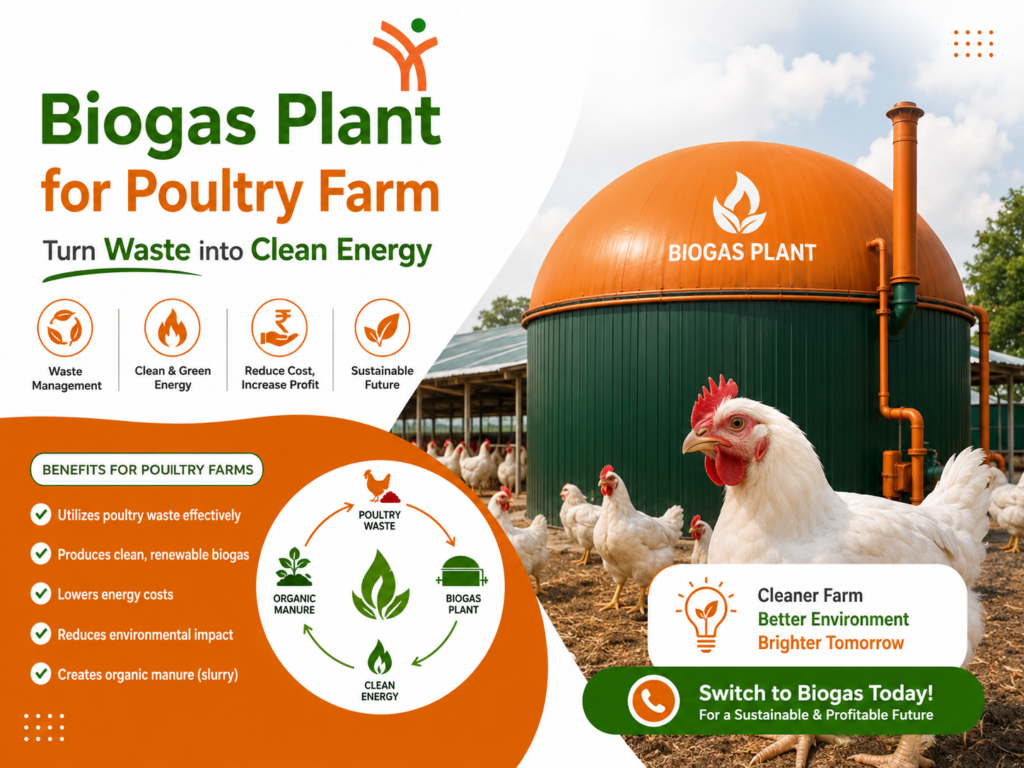

The increasing problem of poultry waste management has taken a toll. It has become a major challenge for the farms to manage the litter. Untreated poultry litter causes bad odour, health issues, and environmental problems. This problem needs a sustainable solution. A commercial biogas plant for poultry farms is the best solution. It offers a practical solution by converting poultry waste into useful renewable energy.
Through anaerobic digestion, a biogas plant for poultry farms can produce biogas, while the remaining digestate can be used as bio-manure. For larger farms, the same concept can also support a commercial biogas plant or CBG production.
Poultry waste management is one of the biggest problems on any farm as the untreated waste can lead to smell, flies, disease, and pollution. The commercial biogas plant for poultry farms provides an excellent solution where poultry waste is converted into renewable energy. Using the anaerobic digestion process, poultry waste can be treated to generate biogas, where the digestate left behind is utilized as bio-manure. This process can even be extended to large-scale farms as well.
What is a commercial Biogas Plant for Poultry Farms?
A commercial biogas plant for poultry farms is a bio-energy system that generates biogas through the anaerobic decomposition of poultry litter, and other appropriate waste materials. It occurs in an airtight digester whereby microorganisms decompose organic materials in the absence of oxygen.
How Does a Biogas Plant Work for Poultry Farm?
A typical poultry waste management system follows these steps:
Collection of Waste from Poultry
Poultry waste such as litter and manure is collected and fed into the processing unit.
Feedstock into the Digester
The feedstock is fed into an airtight anaerobic digester where the conditions are favorable for the degradation of organic matter.
Anaerobic Digestion
In the digester, microorganisms break down the poultry waste in the absence of oxygen. Biogas is produced through biological treatment of poultry waste and digestate.
Biogas Collection
The biogas thus produced is stored in a gas storage unit where it can be treated to eliminate any moisture and unwanted gases prior to utilization.
Energy Generation/CBG Production
Depending upon the requirement of the project, the treated biogas can be utilized in a gas engine to generate energy. Through further processing, it can be transformed into biomethane or CBG.
Why Should Biogas plant for Poultry Farms in India should be Installed?
A biogas production plant in a poultry farm biogas plant may assist farms to be able to deal with their massive amounts of organic waste and even derive some energy from it.
It may allow farmers to minimize their reliance on traditional fuels, improve waste handling, and even get an extra revenue stream from bio-manure production.
Who Can Benefit from a Poultry Farm Biogas Plant in India?
The application of a poultry biogas plant may be beneficial to commercial poultry farms, broiler farms, layer farms, breeder farms, poultry processing plants, and integrated poultry farm biogas plants that produce large amounts of organic wastes.
In case of bigger units, one may consider installing a CBG plant in India in case there is enough feedstock availability and the project is economically and technically feasible.
Wrapping Up
The utilization of a biogas plant for poultry farms is a very efficient approach for converting waste from the poultry into renewable energy sources. This is done through various processes, such as the collection and pre-treatment of the poultry litter, anaerobic digestion, the collection and purification of biogas, and the application of biogas in power generation, heating, or production of compressed biogas (CBG).
Frequently Asked Questions
What are the possible uses of biogas plant for poultry farms?
Depending upon the type of biogas plant installed, a poultry farm can use the generated biogas for various uses such as cooking, heating, producing electricity through a biogas generator or upgrading it into Bio-CNG/CBG.
What are the advantages of installing a biogas plant for poultry farms?
Installation of a biogas plant on a poultry farm will help in handling poultry litter in an eco-friendly manner and producing renewable energy. This will help in managing waste and foul smell, reducing dependency on traditional fuel as well as producing nutrient-rich bio-manure.
How does a biogas plant for poultry farms in India?
A poultry biogas plant uses anaerobic digestion to convert poultry litter and other organic waste into biogas. The waste is collected, mixed with water if required, and fed into an airtight digester. Microorganisms break down the waste without oxygen and produce biogas, which can be used for electricity, heating, or upgraded into Bio-CNG.
What type of biogas plant for poultry farms waste can be used?
Poultry litter, including chicken manure mixed with bedding material, is commonly used as feedstock in biogas plants. Depending on the plant design, other biodegradable farm wastes can also be added to maintain suitable digestion conditions.
How much biogas plant for poultry farms produce?
Biogas production depends on the number of birds, quantity of poultry litter, moisture content, feedstock quality, and plant design. For example, a farm with around 10,000 birds can generate approximately 1.2 tonnes of litter per day under typical conditions.
Domestic Biogas , Commercial Biogas , BioGas , Sewage Water Treatment Plant , Effluent Water Treatment Plant , Zero Liquid Discharge Water Treatment Plant