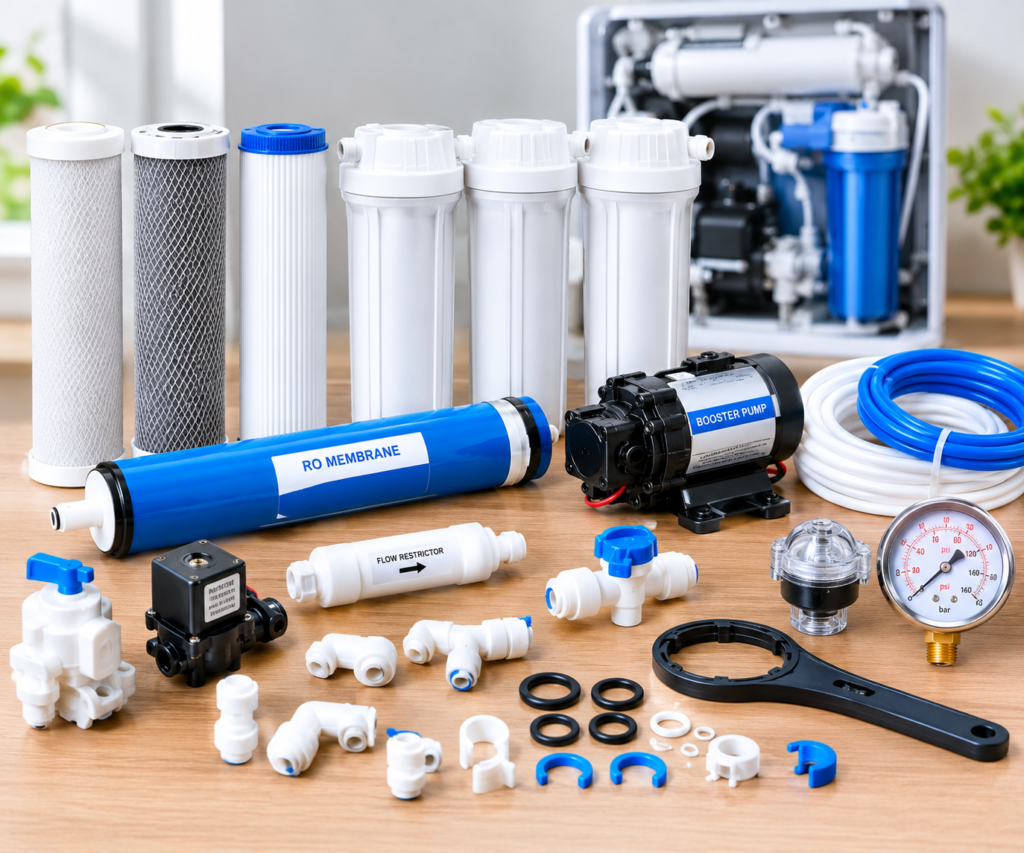

How to Choose the Right Domestic RO Spare Parts for Your Water Purifier
A domestic RO water purifier relies on multiple components to deliver treated water. Filters, membranes, pumps, electrical accessories and water-flow controls all contribute to the system’s operation. When a part becomes faulty or needs replacement, choosing the correct component is essential for proper compatibility and reliable performance.
However, not every RO spare part fits every purifier. Differences in specifications, design, electrical requirements and water-treatment stages can make a replacement unsuitable even when it looks similar to the original.
Understanding how to select domestic RO spare parts can help homeowners, water purifier dealers and RO technicians avoid unnecessary purchases and make better maintenance decisions.
Why Choosing the Correct RO Spare Parts Matters
Using a compatible replacement component helps the purifier operate according to its intended design. An unsuitable membrane may not match the system’s capacity, while an incorrect power adapter can create electrical problems.
Similarly, incompatible fittings or tubing may cause leakage, and an incorrectly selected flow restrictor may affect the RO process.
Before purchasing a component, identify the actual problem and verify the product specifications. This approach can reduce avoidable replacements and help technicians complete repairs more effectively.
1. Identify Your Water Purifier Model
The first step is to identify the make and model of your domestic RO purifier. Check the product label, user manual or manufacturer’s documentation.
Different purifier models may use different membrane dimensions, pump specifications, filter cartridges, connectors and electrical components.
If the model number is unavailable, record the dimensions and specifications of the existing component. However, physical similarity alone is not enough to confirm compatibility.
2. Select the Right RO Membrane
The RO membrane is a major component of a reverse osmosis system. It separates many dissolved substances from water, and its performance depends on feed-water quality, pressure, temperature and membrane condition.
Domestic RO membranes are available in capacities such as 75 GPD, 80 GPD and 100 GPD.
When selecting a membrane, check:
- Rated capacity and operating requirements
- Physical dimensions and housing compatibility
- Feed-water quality and operating conditions
- Manufacturer recommendations for the purifier
Low water output does not always mean the membrane is faulty. Blocked filters, low pressure and pump problems may cause similar symptoms, so diagnosis should come before replacement.
3. Check Pump Specifications Before Buying
A booster pump provides the pressure required by many domestic RO systems. Selecting a replacement requires attention to technical specifications rather than appearance alone.
Verify the operating voltage, current requirements, pressure rating, flow capacity and connection type. The replacement should be suitable for the purifier’s design.
If the pump is noisy, fails to start or produces inadequate pressure, inspect the water supply, electrical connections and other related components before deciding that the pump must be replaced.
4. Choose Suitable Sediment and Carbon Filters
Pre-filters help protect downstream components and prepare water for the RO membrane.
Sediment filters help capture suspended particles, while suitable carbon filters can reduce chlorine and certain compounds affecting taste and odour.
Before ordering replacement filters, check their dimensions, cartridge type, filtration purpose and compatibility with the existing filter housing.
Filter replacement frequency varies according to incoming water quality, household consumption and manufacturer guidance. A fixed interval may not suit every home.
5. Verify Electrical Components and Adapters
Electrical components, including SMPS adapters, supply power to compatible parts of the purifier. Using an unsuitable adapter can lead to malfunction or equipment damage.
Before purchasing a replacement, verify:
- Input and output voltage requirements
- Current rating
- Connector type and polarity, where applicable
- Compatibility with the purifier’s electrical system
Electrical inspection and installation should be performed safely. If you are uncertain about the specifications, consult a qualified technician.
6. Check Flow Restrictors, Float Switches and Fittings
Smaller components can also affect purifier operation.
A flow restrictor regulates concentrate-water flow in systems designed to use one. A float switch may help control filling in compatible storage-tank systems. Tubing, connectors, seals and taps carry water between different parts of the purifier.
Select replacements based on the original design, connection size, operating requirements and manufacturer specifications. Incorrect fittings or poor installation may lead to leakage or irregular operation.
7. Choose the Correct Cabinet and UV Components
A domestic RO cabinet must provide sufficient space and the correct mounting arrangements for the internal components. Before selecting a cabinet, compare its dimensions, component layout and tap position with the purifier design.
For purifiers that include UV treatment, ensure the replacement lamp and associated electrical components match the manufacturer’s specifications. UV maintenance should follow the recommended procedure rather than relying only on indicator lights.
Common Mistakes to Avoid When Buying RO Spare Parts
A few common purchasing mistakes can lead to compatibility problems and repeat repairs.
Buying based only on appearance: Two components may look similar but have different specifications.
Ignoring the root cause: Replacing a membrane will not resolve a problem caused by low pressure or a blocked pre-filter.
Using an incompatible adapter: Incorrect electrical ratings or connectors can cause faults or damage.
Overlooking installation requirements: Poorly fitted tubing, seals and housings may cause leakage.
Ignoring water quality: Incoming water conditions influence component performance and maintenance needs.
Skipping product specifications: Always review the available details and verify compatibility before ordering.
Where to Find Domestic RO Spare Parts Online
Homeowners, RO technicians, dealers and water purifier service businesses may need replacement components for routine maintenance or repairs.
RO Service & Sales provides an online category where users can explore available domestic RO spare parts and accessories.
Visit the Domestic RO Spare Parts collection to browse available components for household water purifier systems. Check the product specifications and confirm suitability for your purifier before ordering.
Frequently Asked Questions
1. How do I know which spare part fits my domestic RO purifier?
Start with the purifier’s make and model, then compare the replacement part’s specifications, dimensions, connections and electrical requirements.
2. Can I replace an RO membrane without checking other components?
It is better to diagnose the problem first. Low output may be caused by blocked filters, low pressure or pump issues rather than a faulty membrane.
3. Are domestic RO pumps available in different specifications?
Yes. Pumps differ in voltage, pressure, flow capacity and connections. Choose one that matches the purifier’s requirements.
4. How often should RO spare parts be replaced?
Replacement frequency depends on the component, incoming water quality, consumption, system performance and manufacturer recommendations.
5. Where can I explore domestic RO replacement parts?
You can visit the Domestic RO Spare Parts page on RO Service & Sales to explore the available products and review their details.
Conclusion
Selecting the right domestic RO spare parts involves understanding the purifier model, diagnosing the problem and checking each component’s specifications. Membranes, pumps, filters, adapters, flow controls and fittings all have different compatibility requirements.
For reliable maintenance, avoid choosing components based only on appearance or replacing parts without identifying the underlying fault. Explore the Domestic RO Spare Parts collection at RO Service & Sales to find available components for your water purifier requirements.