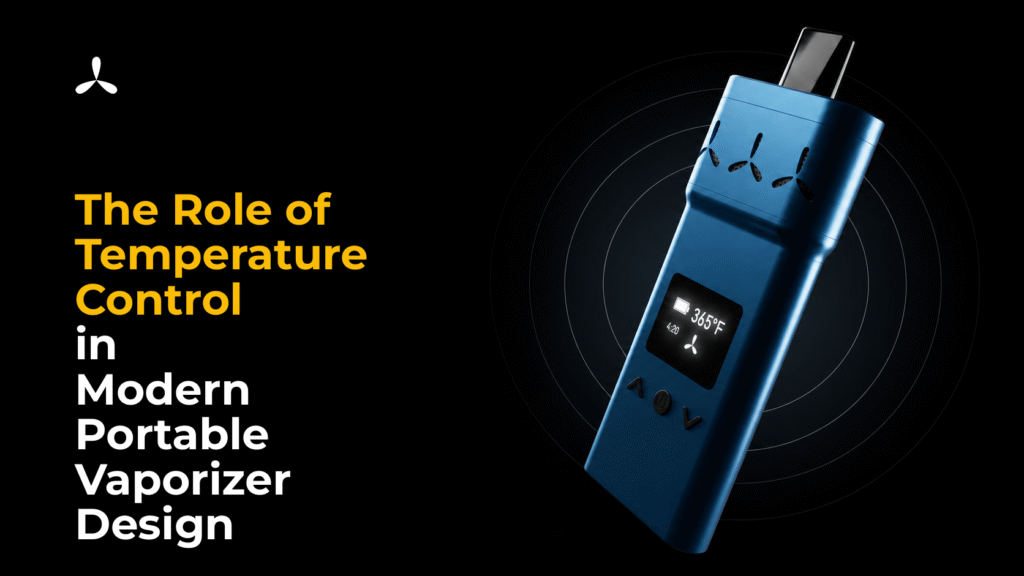

Temperature control has become one of the defining features of modern portable vaporizer design. As vaporizer technology continues to evolve, manufacturers are focusing on more than compact dimensions, battery performance, and heating speed. They are also developing systems that allow users to manage how heat is delivered throughout a session.
For anyone exploring a portable dry herb vaporizer, understanding temperature control can provide valuable insight into device performance, heating technology, and overall usability.
Modern vaporizers use different approaches to temperature management, ranging from simple preset heating levels to more advanced digital controls. These systems influence how the device operates, how consistently it maintains heat, and how users interact with it.
In this guide, we explore the role of temperature control in portable vaporizer engineering, the technologies behind it, and why it remains an important consideration when comparing modern devices.
What Is Temperature Control in a Portable Vaporizer?
Temperature control refers to a vaporizer’s ability to regulate the heat applied to the material inside its heating chamber.
Unlike devices that rely on uncontrolled heating, temperature-regulated vaporizers are designed to operate within selected temperature settings. Depending on the model, users may be able to choose between preset levels or adjust the temperature more precisely.
A typical temperature-control system includes several components:
- Heating element: Generates the heat required for vaporization.
- Temperature sensor: Measures temperature at a designated point inside the device.
- Control circuitry: Adjusts power delivery based on the selected setting and sensor readings.
- User interface: Allows users to select or monitor temperature settings.
- Power source: Supplies the energy needed to operate the heating system.
These components work together to help maintain controlled heating conditions.
However, an important distinction exists between the temperature displayed on a vaporizer and the actual temperature of the material inside the chamber. Sensor placement, airflow, chamber design, and heating method can all influence the relationship between the two.
This is why temperature-control performance depends on more than the number shown on a display.
Why Temperature Control Matters in Vaporizer Engineering
1. More Consistent Heating Performance
One of the primary objectives of temperature control is to reduce unnecessary fluctuations during operation.
When a portable vaporizer reaches its selected temperature, the heating system must respond to changes caused by airflow, material placement, and heat loss.
A well-designed control system can adjust power delivery to help maintain the intended heating conditions.
This is particularly relevant for portable devices, where compact heating chambers and limited battery capacity create additional engineering challenges.
Consistent heating does not mean that every part of the chamber reaches exactly the same temperature. Instead, it means the device is designed to manage thermal changes within its operating capabilities.
2. Greater Control Over the User Experience
Different temperature settings can produce different vaporization characteristics.
Lower settings generally provide less thermal energy, while higher settings increase the amount of heat delivered to the material.
The resulting experience depends on several factors, including material composition, moisture content, airflow, and the vaporizer’s heating technology.
Adjustable temperature controls give users more flexibility than devices operating at a single fixed setting.
Rather than relying on one heating profile for every session, users can select settings that align with their preferences and the device manufacturer’s guidance.
3. Improved Heating-System Efficiency
Portable vaporizers must balance heating performance with energy consumption.
Heating elements require electrical power to reach and maintain operating temperatures. Poor thermal management can increase energy consumption, particularly when heat escapes through the chamber walls or surrounding components.
Temperature-control systems help regulate when and how much power is delivered to the heating element.
Modern devices may use electronic control algorithms to reduce power once the selected temperature is reached and increase it again when additional heating is required.
Actual efficiency depends on insulation, chamber materials, heating-element design, battery characteristics, and control-system implementation.
4. Better Integration With Compact Designs
Portable vaporizers have limited internal space for heating elements, electronics, batteries, and thermal insulation.
As devices become more compact, engineers must carefully consider how heat travels through the internal structure.
Temperature regulation plays an important role in managing this challenge.
A compact vaporizer needs to deliver sufficient heat to its chamber while limiting unnecessary heat transfer to components that are not intended to become hot.
This requires coordination between thermal design, electronic controls, and the physical arrangement of internal components.
How Different Heating Technologies Influence Temperature Control
The effectiveness of temperature control is closely connected to the heating method used inside a vaporizer.
Modern portable devices generally use conduction, convection, or a combination of both.
Conduction Heating
Conduction heating transfers thermal energy through direct contact between the material and the heated chamber surface.
In this design, temperature regulation primarily manages the heating element and chamber temperature.
Conduction systems can be relatively simple and compact, making them suitable for smaller portable vaporizers.
However, material closest to the chamber walls may receive more heat than material positioned near the centre.
Chamber geometry, material distribution, and thermal conductivity all influence heating consistency.
Convection Heating
Convection heating uses heated air to transfer energy to the material.
Instead of relying primarily on contact with hot chamber walls, the system heats air that passes through the chamber.
Temperature regulation in convection systems must account for airflow and changing thermal demand.
When air moves through the device, it can temporarily lower the temperature of the heating system. The electronics must respond by adjusting power delivery.
Effective convection design therefore requires careful coordination between the heater, airflow channels, and temperature sensors.
Hybrid Heating
Hybrid heating combines conduction and convection principles.
This approach uses heat transferred through chamber surfaces alongside heated airflow.
Hybrid systems introduce additional thermal considerations because engineers must manage both heating mechanisms.
For example, the AirVape Legacy PRO 2 and Legacy CORE use hybrid heating technology. Their designs illustrate how temperature regulation can be integrated with multiple heat-transfer methods in portable devices.
No single heating method is automatically superior in every application. Performance depends on the complete thermal system rather than the heating category alone.
Preset Temperature Settings vs Precision Temperature Control
One of the most noticeable differences between modern portable vaporizers is how users select their preferred heating levels.
Preset Temperature Settings
Preset systems provide a limited number of predefined heating options.
Instead of selecting an exact temperature, users choose from available levels using buttons or indicator lights.
This approach offers several design advantages:
- Straightforward operation with fewer adjustments.
- Simple interfaces that require less display hardware.
- Convenient switching between predefined heating levels.
- A more accessible experience for users who prefer uncomplicated controls.
The AirVape Legacy CORE demonstrates this approach with seven LED-indicated heating levels.
Its design combines preset temperature selection with hybrid heating, offering a straightforward interface without requiring a full digital temperature display.
Precision Temperature Control
Precision temperature control provides more detailed adjustment options.
Devices equipped with digital controls may allow users to select specific temperatures within the supported operating range.
This design is particularly relevant for users who want greater flexibility when configuring their sessions.
For example, the AirVape X features adjustable temperature settings and a digital display, while the Legacy PRO 2 combines precision temperature adjustment with a colour display and additional operating features.
However, precise temperature selection should not be confused with guaranteed temperature uniformity throughout the chamber.
The displayed setting represents the device’s control target, while actual temperatures may vary across different internal surfaces and airflow conditions.
Temperature Control and Heat-Up Time
Heat-up time is another important aspect of portable vaporizer design.
It describes how long a device takes to reach its intended operating temperature after activation.
Modern vaporizers aim to balance rapid heating with controlled thermal performance.
Several engineering factors influence heat-up time, including heating-element power, chamber mass, thermal conductivity, battery output, and insulation.
For example, AirVape lists approximately 15 seconds of heat-up time for the Legacy PRO 2 and approximately 30 seconds for the Legacy CORE. These figures demonstrate how different models can prioritise heating speed and thermal design differently.
Faster heating is convenient, but it does not necessarily indicate better temperature stability.
A device that heats quickly must still regulate power effectively once it reaches the selected setting.
Engineers must also consider temperature recovery, which refers to how quickly a heating system responds after losing thermal energy during use.
Both initial heat-up time and temperature recovery contribute to overall performance.
The Relationship Between Temperature Control and Battery Performance
Portable vaporizers depend on rechargeable batteries, making energy management an essential part of their design.
Heating elements are often among the most power-intensive components inside these devices.
Temperature-control systems influence battery consumption by managing how electrical energy is delivered to the heater.
Maintaining Temperature Without Excessive Power
Once a device reaches its selected temperature, it generally requires less energy to maintain that setting than it did during initial heating, assuming similar operating conditions.
A responsive control system can reduce power delivery when additional heating is unnecessary.
However, energy consumption still depends on the selected temperature, ambient conditions, session duration, and heating architecture.
Session Mode and On-Demand Heating
Different operating modes can also affect how temperature is managed.
In session mode, the vaporizer maintains its selected heating conditions over a defined period.
On-demand heating activates the heating system when needed rather than maintaining continuous heat throughout a longer session.
The Legacy PRO 2 supports both session-based operation and an on-demand mode, illustrating how modern temperature-control systems can accommodate different operating preferences.
Neither mode guarantees superior battery life under all conditions. Actual energy consumption depends on usage frequency, heating duration, and device design.
How Chamber Materials Affect Temperature Regulation
Temperature control is not determined by electronics alone.
The materials used in the heating chamber also influence how thermal energy moves through the device.
Common chamber materials include ceramic and stainless steel, sometimes with specialised surface finishes.
Ceramic Chambers
Ceramic is used in vaporizer heating chambers because of its thermal properties and suitability for high-temperature applications.
The exact performance depends on the ceramic formulation, wall thickness, and heating-element arrangement.
Ceramic chambers can help distribute heat through their structure, although temperature uniformity still depends on the overall design.
Stainless Steel Chambers
Stainless steel provides mechanical durability and resistance to corrosion.
Its thermal performance depends on the alloy, chamber geometry, and surrounding heating system.
Some premium devices use additional surface treatments or plating.
For example, AirVape’s Legacy PRO 2 features a gold-plated stainless steel chamber, while the AirVape X uses an oval ceramic heating chamber.
These material choices reflect different engineering approaches.
Rather than evaluating a chamber solely by its material, users should consider how its construction works with the heating element, airflow system, and temperature controls.
Temperature Sensors and Electronic Feedback Systems
Modern electronic vaporizers rely on feedback mechanisms to regulate heating.
A temperature sensor provides information to the control circuitry, which determines whether additional power is required.
The basic process involves measuring temperature, comparing it with the selected target, and adjusting the heating element accordingly.
This is known as closed-loop temperature control.
More sophisticated systems may use algorithms that account for heating response and temperature changes over time.
However, the effectiveness of any feedback system depends on several factors:
- Sensor accuracy and placement.
- Speed of electronic response.
- Heating-element characteristics.
- Thermal contact between components.
- Airflow and chamber geometry.
A well-designed system must balance responsiveness with stability.
If the controller reacts too slowly, temperature fluctuations may become more noticeable. If it reacts too aggressively, the system may overshoot the target temperature.
Managing these trade-offs is a central part of temperature-control engineering.
User Interface Design and Temperature Accessibility
Temperature control also influences how users interact with portable vaporizers.
Modern devices use different interfaces, including LED indicators, physical buttons, and digital displays.
The ideal interface depends on the intended user experience.
For compact devices, simplified controls can reduce complexity and support convenient operation.
For more advanced models, digital displays provide additional information about selected settings and operating status.
AirVape’s product range demonstrates these differences.
The Legacy CORE uses seven preset heating levels with LED indicators, while the Legacy PRO 2 provides a colour display and more detailed temperature adjustment.
The AirVape X and X Royal Edition also incorporate digital temperature controls within slim portable designs.
These variations highlight an important principle: sophisticated temperature management does not always require a complicated interface.
A well-designed vaporizer should make its available controls understandable and practical.
Temperature Control and Device Safety
Temperature management also contributes to the safe operation of electronic heating devices.
Portable vaporizers contain heating elements, batteries, circuitry, and materials exposed to elevated temperatures.
Engineers must consider how these components behave during normal operation and foreseeable abnormal conditions.
Temperature-related design measures may include thermal monitoring, automatic shutoff functions, electrical protection, and insulation between hot components and exterior surfaces.
These features serve different purposes. A session timer, for example, is not a substitute for dedicated overheating protection.
Users should follow the manufacturer’s operating instructions, avoid damaged batteries or charging equipment, and allow devices to cool before cleaning or maintenance.
It is also important to recognise that controlled heating does not make inhaled aerosols harmless. Temperature regulation improves control over device operation, but it does not eliminate potential exposure risks.
How AirVape Integrates Temperature Control Into Its Portable Devices
AirVape’s European collection illustrates several approaches to temperature management.
AirVape Legacy PRO 2
Designed around hybrid heating, precision temperature adjustment, a colour display, and selectable operating modes.
AirVape Legacy CORE
Combines hybrid heating with seven preset temperature levels for straightforward temperature selection.
AirVape X Royal Edition
Integrates adjustable temperature controls with an oval ceramic chamber and a slim portable structure.
These models show that temperature-control design is not limited to one interface or heating architecture. Instead, it can be adapted to different priorities, from simplified operation to more detailed thermal adjustment.
What to Consider When Evaluating Vaporizer Temperature Control
When comparing portable vaporizers, it is useful to look beyond whether a device offers adjustable temperatures.
Consider how the complete heating system is designed.
A device’s temperature range indicates the available settings, but it does not reveal how accurately those settings are maintained.
Likewise, a fast heat-up time does not automatically guarantee consistent heating throughout a session.
Other important considerations include the heating method, chamber construction, airflow design, control interface, and battery system.
For users interested in a broader comparison, AirVape’s Premium Vaporizer Guide explains how these features differ across its portable device range.
Understanding these relationships can make it easier to identify which design characteristics are most relevant to individual preferences.
The Future of Temperature Control in Portable Vaporizers
As portable vaporizer technology develops, temperature management is likely to remain an important area of engineering innovation.
Potential improvements include more responsive sensors, refined heating algorithms, better thermal insulation, and more efficient power management.
Manufacturers may also continue developing interfaces that provide detailed control without increasing device complexity.
Another important area is the relationship between heating performance and portability.
Smaller devices create challenges for thermal insulation, component placement, and battery capacity.
Future designs will need to address these limitations while maintaining predictable heating performance.
The broader direction is towards more integrated systems in which electronics, heating elements, chamber materials, and airflow are developed together rather than treated as separate features.
Conclusion
Temperature control plays a fundamental role in modern portable vaporizer design.
It influences heating consistency, energy management, user interaction, and the integration of different heating technologies.
From preset temperature levels to precision digital controls, modern devices offer several approaches to managing thermal performance.
AirVape’s Legacy CORE, Legacy PRO 2, and X-series models demonstrate how these approaches can be adapted to different device designs and operating preferences.
Ultimately, effective temperature management depends on the entire heating system. Understanding how temperature controls interact with chamber materials, airflow, electronics, and battery performance provides a more complete picture of modern vaporizer engineering.
Explore the AirVape EU collection to learn more about the heating technologies and temperature-control features available across its portable vaporizer range.
Frequently Asked Questions
Why is temperature control important in portable vaporizers?
Temperature control helps regulate the heat delivered by the vaporizer’s heating system. It supports more predictable operation, provides flexibility in selecting heating settings, and contributes to energy management.
What is the difference between preset and precision temperature control?
Preset systems offer a fixed selection of heating levels, while precision systems allow more detailed adjustment within a supported temperature range. Both can provide effective temperature regulation depending on device design.
Does a higher temperature setting always produce better performance?
No. Higher settings deliver more thermal energy, but performance depends on the material, chamber design, airflow, and heating method. Higher temperatures are not automatically preferable and may increase thermal degradation.
How does hybrid heating work with temperature control?
Hybrid heating combines heat transferred through chamber surfaces with heated airflow. Temperature-control circuitry regulates the heating system to manage these combined thermal processes.
Does temperature control affect battery life?
Yes. Temperature settings, heating duration, and control-system efficiency can influence energy consumption. Actual battery life also depends on battery capacity, device architecture, and usage patterns.
Which AirVape models offer adjustable temperature controls?
AirVape offers several temperature-control approaches, including the Legacy CORE with seven preset levels and the Legacy PRO 2, AirVape X, and X Royal Edition with more detailed temperature adjustment.